
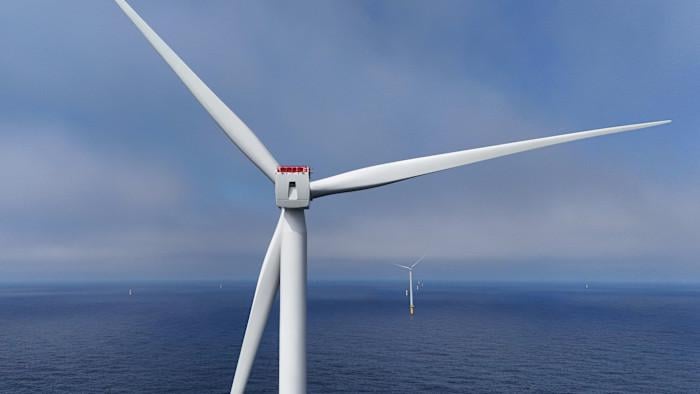
Capacity will rise by a record 45GW this year, according to S&P Global Energy
Donald Trump is presiding over an unexpected clean energy boom, as rising electricity demand spurs investment in new capacity despite the US administration’s efforts to thwart a solar and wind rollout.
Clean energy additions will rise by a record 45 gigawatts this year, according to S&P Global Energy — equivalent to the average electricity demand of Turkey. The increase is roughly 25 per cent higher than the previous record set in 2024.
The US president’s war in Iran, which has driven up global energy prices, along with surging power demand from AI data centres and developers’ rush to capitalise on expiring tax credits, are driving the cleantech boom, said analysts. Trump’s administration has also been pragmatic in the face of its energy needs.
“There was a campaign promise to go against renewables, but at the same time they’re realising that you can’t do without it,” said Izzet Bensusan, chief executive of Captona, an energy infrastructure investment group. “I don’t see a world where power demand is flattening out.”
S&P said new solar and wind capacity will jump in 2026 by nearly a third and almost 50 per cent respectively. Solar will set another record in 2027, while wind falls back before recovering.
White House spokesperson Taylor Rogers, however, touted “record-high oil and gas production” under Trump.
“The president has delivered on his promise to unleash American energy,” Rogers said. “At the same time, the administration has ended subsidies for costly and unreliable energy sources that American taxpayers were unfairly forced to fund.”
The solar and wind additions come despite Trump’s early efforts to kill an energy transition pushed by his predecessor Joe Biden.
The Trump administration broke up Esmeralda 7 in Nevada. It would have been the largest single solar project in the US.
The president’s One Big Beautiful Bill Act also slashed tax credits for solar and wind, and his administration has interfered with routine project approvals, including for more than 150 onshore wind projects. But under the terms of the OBBBA, solar and wind developers had until July 4 to begin work on projects and until 2030 to finish them.
The deadline “prompted developers to hurry and begin construction”, said S&P Global renewables analyst John Murray.
Expectations for sharply higher electricity demand are also driving the pace of the rollout.
US power consumption is expected to grow 39 per cent by 2035, according to consultancy ICF, driven by energy-hungry data centres and the electrification of household appliances and transport. The surge comes after demand remained steady for more than a decade.
Solar and wind are among the quickest, cheapest forms of energy to add to the grid. According to RMI, a think-tank, new solar and wind sites have a lead time of less than two years, compared to at least three years to develop gas projects.
Producers can break even by selling solar and wind power for as little as $38 and $37 per megawatt hour respectively, compared to at least $48 per megawatt hour for gas, according to investment bank Lazard. However, these figures do not fully account for system upgrade costs and batteries to smooth out intermittency.
Renewable power developers also stand to profit, as electricity prices are expected to rise 40 to 120 per cent once Biden’s Inflation Reduction Act subsidies expire.
“Candidly, it’s a good time to be a developer,” said Ethan Zindler, head of country and policy research at BloombergNEF. “Data centres need power and they need it basically yesterday.”
Extreme weather and Trump’s Iran war have also contributed to the growth.
Consumer investment in residential solar panels, batteries and zero-emission vehicles led clean energy spending in the second quarter of 2026, increasing 45 per cent from the previous quarter and 21 per cent from the same period in 2025, according to researcher Rhodium Group.
“People in Florida are installing a lot of home batteries to ensure their house still has power in a hurricane,” said Hannah Hess, a director with Rhodium’s energy and climate practice. “And with the Iran war driving higher fuel prices, we’re seeing more EV and hybrid [vehicle] purchasing.”
US courts have slowed Trump’s war on green energy. A district court judge in Oregon recently ordered the Pentagon to cease blocking onshore wind development. The courts have blocked all five of the administration’s attempts to halt construction at wind projects off the US’s east coast.
Developers are having some success lobbying the administration directly, leaning on people with ties to the administration to advocate for individual projects, people familiar told the FT. Among the arguments is that the projects will not displace fossil fuels — Trump’s preferred source of energy.
“What we found on the permit side is that the administration is pretty pragmatic,” said Cliff Graham, chief executive at clean energy company Avantus. “There’s a lot of land between Reno, Tucson and Barstow, where there’s no better use than solar-plus-storage.”
Posted by IHateTrains123