
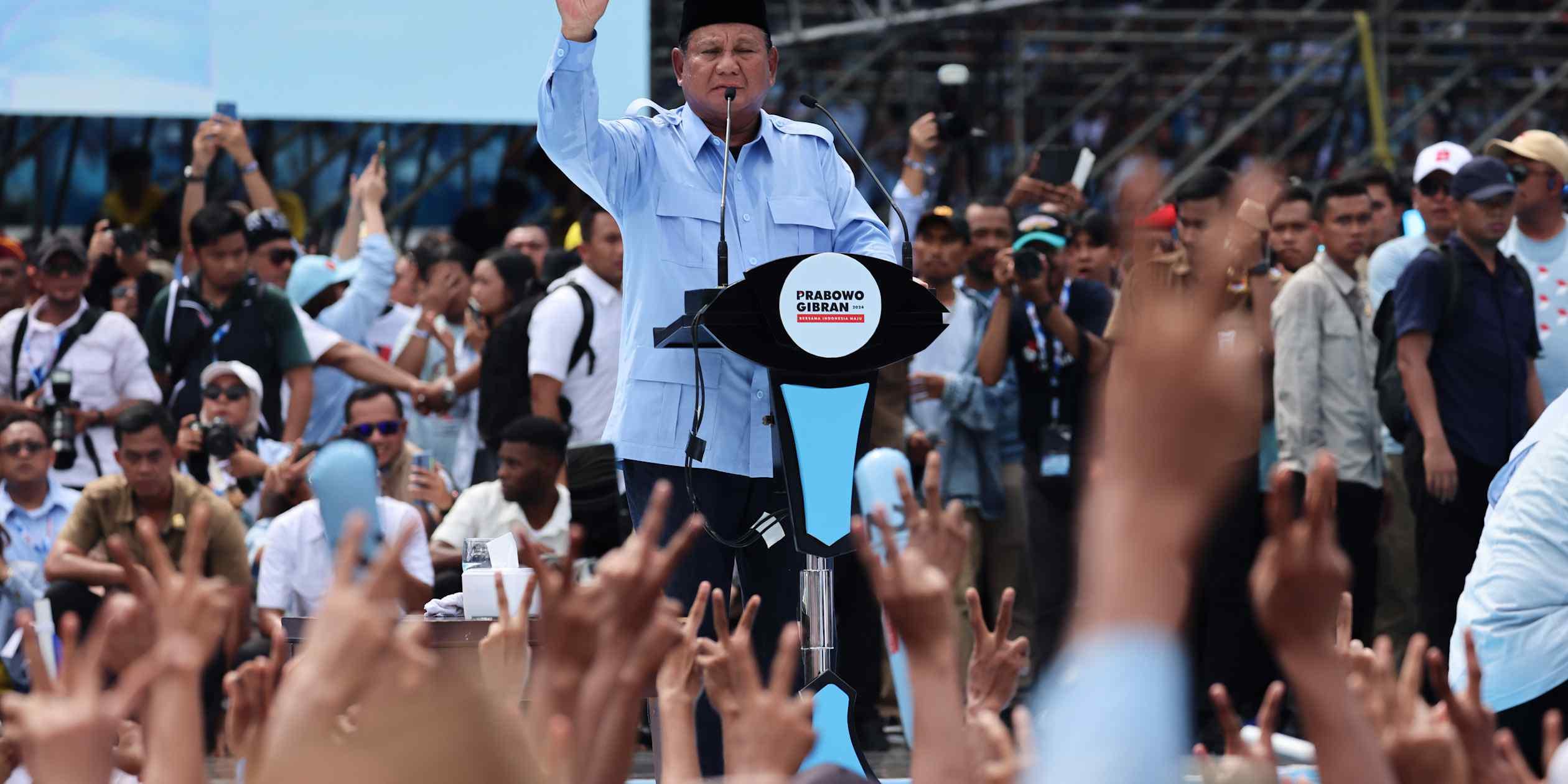
SURABAYA, Indonesia — Two recent opinion polls show that President Prabowo Subianto's approval ratings have plummeted, with one saying the West Java governor is significantly more popular — raising questions about Indonesia's political landscape ahead of the 2029 elections.
A poll released on Wednesday by Tempo Data Science, the research unit of Tempo magazine, shows that Prabowo's approval rating dropped from 75% in December last year to 37% in August. The survey had 1,260 respondents from Indonesia's 38 provinces.
Khairul Anam, general manager of Tempo Data Science, attributed the declining public satisfaction mainly to negative perceptions of the economy. "The two main issues putting pressure on people's daily lives are the high prices of necessities and the limited job opportunities," he said.
The result came a month after pollster Saiful Mujani Research & Consulting (SMRC) reported that Prabowo's approval rating had sunk from 81% in November to 51% last month.
Saidiman Ahmad, a researcher and program manager at SMRC, said the president's popularity level followed the same downward trajectory as his flagship programs: free meals for children and opening village cooperatives. Between November last year and July, public satisfaction with the two programs almost halved to just 34% and 25%, respectively.
The two costly programs have sparked a wave of protests in multiple cities over the past year, including the latest one that turned violent late on Thursday in Jakarta, where thousands rallied outside parliament. They were also demonstrating against corruption, inflation and other issues.
SMRC asked respondents to choose their favorite for Indonesia's next leader from among 20 names. Only 14.5% chose Prabowo, while 35% picked Dedi Mulyadi, the governor of West Java. Prabowo's main rival in the 2024 election, Anies Baswedan, the former Jakarta governor, and Vice President Gibran Rakabuming, came third and fourth with around 8% each.
With only Prabowo and Mulyadi in contention, the latter prevailed among respondents with 59% over the former's 28%. The rest of the respondents were undecided.
"If a presidential election were to be held today in Indonesia, Prabowo would likely lose," Ahmad said. "The president's popularity has certainly taken a severe beating this year."
In SMRC's poll last November, Prabowo topped the multi-name chart with 34%, followed by Mulyadi with 19.7%.
Mulyadi, 55, is a politician with Prabowo's Gerindra party, which the president still chairs. Popularly known in Indonesia by his initials KDM, the governor of Indonesia's most populous province — West Java is home to approximately 50 million people — is often compared to former President Joko "Jokowi" Widodo. Both are seen as populist figures coming from non-elite backgrounds.
Mulyadi's populist bent is fanned by a strong social media presence, with over 12 million followers on TikTok and 9 million subscribers on YouTube.
Rendy Pahrun Wadipalapa, a political scientist at the National Research and Innovation Agency, said Mulyadi is the main beneficiary of Prabowo's diminishing popularity, which presents a dilemma: "Gerindra and Prabowo are almost certainly watching this closely and will likely try to manage Dedi's exposure carefully."
Wadipalapa said Prabowo might decide not to run for re-election, clearing the way for Mulyadi, or try to contain the latter's rise by offering him the vice presidency. But the 74-year-old president has never indicated he will not seek another term. In a February speech, he challenged his critics to "a fight in 2029."
Ahmad said that with his rising popular appeal, Mulyadi might not be happy with the second best option, and might leave Gerindra because "other parties will naturally gravitate towards a popular candidate."
Indonesia has a fragmented political system in which 24 parties competed in the last elections, held simultaneously with the presidential vote in early 2024. Only eight parties met the parliamentary threshold to win seats in the House of Representatives.
The election laws previously required a party or a coalition of parties to command 20% of legislative seats, or 25% of popular votes in the previous legislative election, to be able to nominate a presidential candidate. The constitutional court abolished that clause last year.
Observers doubt Prabowo will run with Gibran as vice president again in 2029 given the evident fallout between the two, and with Gibran's father, the former president. The eldest son of Widodo, Gibran has largely been sidelined from Prabowo's programs since they took over national leadership in October 2024.
Widodo, whose backing of Prabowo was considered vital to his election, has reportedly grown apart from the president, who was his defense minister.
Constitutionally barred from running for a third term, Widodo is also pushing his other son into politics. In 2023 Kaesang Pangarep became chair of the Indonesian Solidarity Party (PSI), but it failed to garner the minimum 4% of votes required to win seats in parliament.
Widodo left his old party, the Indonesian Democratic Party of Struggle (PDI-P), over disagreements on presidential candidates. PDI-P is currently the largest party in parliament and the only one outside Prabowo's coalition.
Instead, the former president last year announced he would throw his weight behind PSI. In June, he started a "political safari" on the party's behalf, starting in Lampung province, followed by a visit to East Nusa Tenggara last month.
PSI Deputy Chairman Andy Budiman said he was optimistic his party will make it into parliament in 2029, saying it is enjoying growing popularity for two reasons: the "Jokowi effect" and, at the former president's urging, "structural consolidation" to establish a presence in every village in Indonesia.
"Jokowi's decision to identify with PSI has undoubtedly raised the party's profile, enabling it to tap into new sources of popular support," Budiman told Nikkei Asia.
Johannes Nugroho is a contributing writer.
Posted by Distinct_Front_4336