
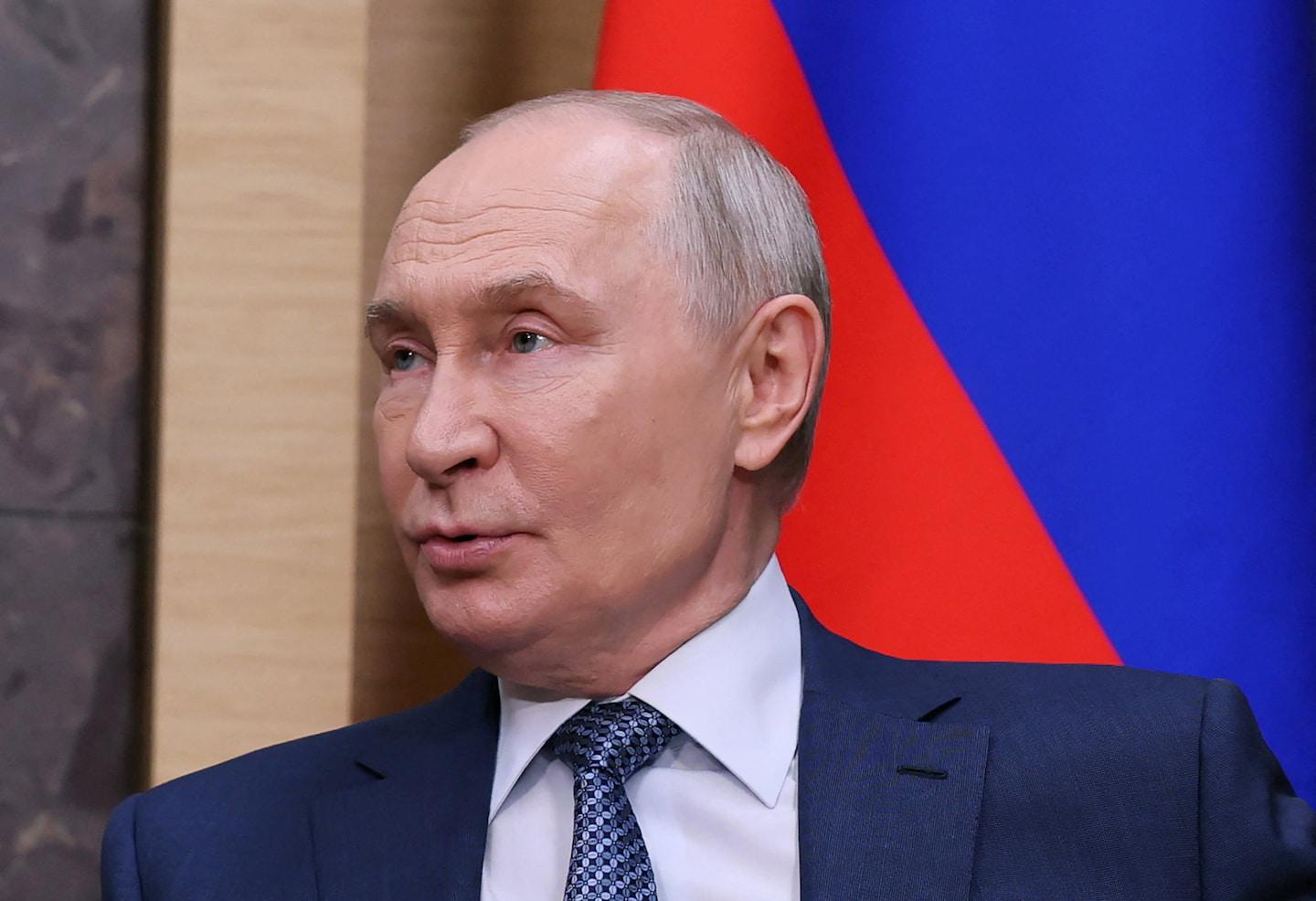
Aiming to exploit Ukraine’s badly weakened air defenses, Russian President Vladimir Putin is intensifying a bombing campaign that he believes will force Kyiv to capitulate on some of his key territorial demands, perhaps by this winter, members of the Russian elite and analysts said.
In the 10 days since CIA Director John Ratcliffe made a rare, unexpected visit, Moscow has ramped up its jet-powered drone and missile campaign, targeting civilian infrastructure including energy and water supplies, supermarkets and food warehouses.
“I have no doubt that the enemy will crumble,” Putin told Russian journalists this week in reply to a question about the progress of the 4½-year-old war — voicing confidence despite a deteriorating economy and mounting discontent among the Russian public.
Putin’s public remarks appeared to confirm assessments that Ratcliffe’s visit not only failed to persuade the Russian leader to stop the war but may have hardened his resolve to sidestep a ceasefire and continue to push for territorial concessions.
In Moscow, Ratcliffe warned counterparts in Russian intelligence that escalating the war would backfire, The Post has reported. He urged a return to talks, arguing Russia’s position was weak and would deteriorate further, according to three people familiar with his discussions.
But after the meetings, Ratcliffe felt that he had delivered the intended message “but not moved the needle,” a fourth person familiar with the matter said. Russia viewed the visit as “an attempt to try to convince Putin to stop, but Putin read it as weakness,” this person said.
“The message was: Things are not going well for you. It’s time to talk. Let’s figure this out, because it’s going to be even worse for you in six months’, 12 months’ time,” one of the people said.
The CIA has declined to comment on Ratcliffe’s trip.
Putin’s response to the visit seemed to come in the relentless, day-and-night airstrikes on Ukraine, and in his remarks at a regional security conference in Kyrgyzstan, where he met Iranian President Masoud Pezeshkian and pledged support for Tehran in its war with the United States.
Russia’s escalating strikes on Kyiv and other Ukrainian cities since Ratcliffe’s visit “could be some kind of signal to Washington that Russia is continuing the offensive operation and there is no need to change its position and become more flexible,” said a Russian academic who is close to senior Russian diplomats and spoke on the condition of anonymity to discuss sensitive security issues.
There had been speculation that Ratcliffe’s visit was also intended to dissuade Russia from helping Iran.
But the purpose of the visit was “primarily about Ukraine and trying to get the Russians to see that if their negotiating objective is to get the Ukrainians to give up Donbas, then it’s just not going to happen,” said a Western official familiar with the discussion.
The message was: “It’s really not in your interests to keep doing this,” the official said, speaking on the condition of anonymity to discuss sensitive diplomacy.
Kremlin spokesman Dmitry Peskov declined to comment on a report by Russian state media that U.S. envoys Steve Witkoff and Jared Kushner could arrive for talks this weekend in Moscow and then Kyiv. “The Kremlin will provide information on the Russian side’s contacts with Witkoff and Kushner once they take place,” Peskov said.
Russia’s military advances in Ukraine have all but stalled, and its budget has become increasingly strained with the deficit snowballing to $74.4 billion by the end of July, or 2.8 percent of GDP, well beyond the government’s original forecast of 1.6 percent for this year.
Financial anxiety has mounted, prompting Russians to pull billions from the country’s banking system, and bad debts are climbing after a government-directed corporate lending boom to ramp up military output. Several senior members of the Russian elite have warned publicly against prolonging the war.
Ratcliffe delivered his view when he met last week with the head of Russia’s Federal Security Service, Alexander Bortnikov, a powerful member of Putin’s inner circle — who has previously proven effective in coordinating prisoner exchanges between the U.S. and Russia, two of the people familiar with the discussions said.
“This is really the first time that there has been a serious attempt to have this kind of contact in a more formalized way,” one of the people familiar with the discussions said. “If you are trying to get to the inner circle, Bortnikov is probably one of the most important people.”
Bortnikov is seen as representing a more direct line to Putin, given his KGB background and respect for intelligence, another of the people said.
But Ratcliffe’s assessment was far removed from Putin’s view of the situation, according to members of the Russian elite and analysts.
And if the CIA director hoped his message would result in a meeting with Putin, he was bound to be disappointed, Russian analysts said.
Signaling that Russia is losing the war and that it’s better to end the war now “was not interesting for Putin to discuss,” said Tatiana Stanovaya, a senior fellow at the Carnegie Russia Eurasia Center. Putin “is certain he is winning the war, and however much time it will take he believes that at some point Ukraine will break, and Russia won’t need to fight.”
Despite declaring on Thursday that he saw a chance of reaching a negotiated peace deal, Putin has no interest in any proposal for a ceasefire based on the current frontline, the Russian academic said.
“It seems to me taking control over all of Donbas is the minimum preliminary condition for all future talks,” the academic said. “This task has been voiced many times by the president and other officials. It will be very difficult to step back from this.”
“The Russian leadership considers they have enough instruments to dominate escalation,” the academic added. “Each strike by Ukraine can be answered by a strike which brings more damage than the one brought to Russia.”
On Thursday, Putin acknowledged that the government had not been prepared for Ukraine’s strikes on Russia’s energy infrastructure, which have led to a sharp drop in fuel output and triggered the worst fuel crisis since the Soviet collapse.
“We made a mistake,” he said, speaking at the Eastern Economic Forum in Vladivostok as he conceded Russians should be prepared for prolonged gasoline shortages.
But Putin has insisted that further escalation by Ukraine — including Ukrainian President Volodymyr Zelensky’s threats this week to close Russia’s skies to civil aviation across Russia by sending swarms of drones — is bound to fail, saying that Kyiv has only opened “a Pandora’s box” by targeting Russian civilian infrastructure.
Putin, speaking in Kyrgyzstan, accused Zelensky of “terrorism,” adding: “One does not negotiate with terrorists.”
The progress of Russian forces toward the administrative borders of Donbas, the strategically critical fortress belt region in east Ukraine, has been halting for months. But a recent spike in oil prices, driven by renewed fighting between Iran and the United States, has boosted Putin.
It has allowed the Russian leadership to think it can still outlast Ukraine, even though the chief economist of one of Russia’s biggest state banks has warned publicly that Russia cannot win a war of attrition against Ukraine while Kyiv is supported by the West, one Moscow business executive said.
“There is an opinion inside the Kremlin that a few more months of war is not a problem for Russia and the Russian economy, but for Ukraine it’s a huge problem,” the business executive said, speaking on the condition of anonymity for fear of angering the government.
“Putin hopes time is still on his side — because despite the problems with fuel and the growth of dissatisfaction with the war, Russia’s population is not as ready to protest as Ukraine’s,” the business executive said.
“The Russian leadership has the view that if they bomb energy infrastructure and water supplies in the regions around Kyiv it will lead to the maximum dissatisfaction of the population and the government will be forced to end the war,” he added. The bombing campaign “is the only possibility for Russia to do something — because destroying the Ukrainian army with the resources that it currently has is extremely difficult.”
As Russia takes advantage of depleted stocks of Patriot and air defense systems, there are growing fears in Kyiv of food shortages as winter nears. “We could be heading toward a complete humanitarian disaster,” said one Ukrainian official, who like others spoke on the condition of anonymity to discuss sensitive matters.
Kyiv is facing financial constraints of its own. The government is urgently seeking an additional $27 billion in financing from the European Union as it seeks to plug a shortfall in its defense budget.
Putin could also be banking on changing political winds in the West. In regional elections in Germany this weekend, Alternative for Germany, a party sympathetic to Russia, is set to do well, while France’s far-right leader, Marine Le Pen, is surging in polls ahead of a presidential election next year.
“The West is becoming weaker and changing politically internally,” Stanovaya said. “Putin really does consider that circumstances are changing in his favor.”
But prolonging the conflict is still fraught for Putin, creating a risk that fuel shortages will worsen, and consumer prices rise, and public protests could break out.
“Whether Putin understands this is not clear,” the Moscow business executive said. “The FSB chief who met with Ratcliffe probably does. But he is not going to go to Putin and persuade him to agree a peace deal on the current frontline.”
Posted by John3262005
1 Comment
Seems like the CIA director’s visit to Russia was unsuccessful on both the Ukraine and Iran war
According to the article, the director’s comments *”may have hardened Putin’s resolve to sidestep a ceasefire and continue to push for territorial concessions”*