
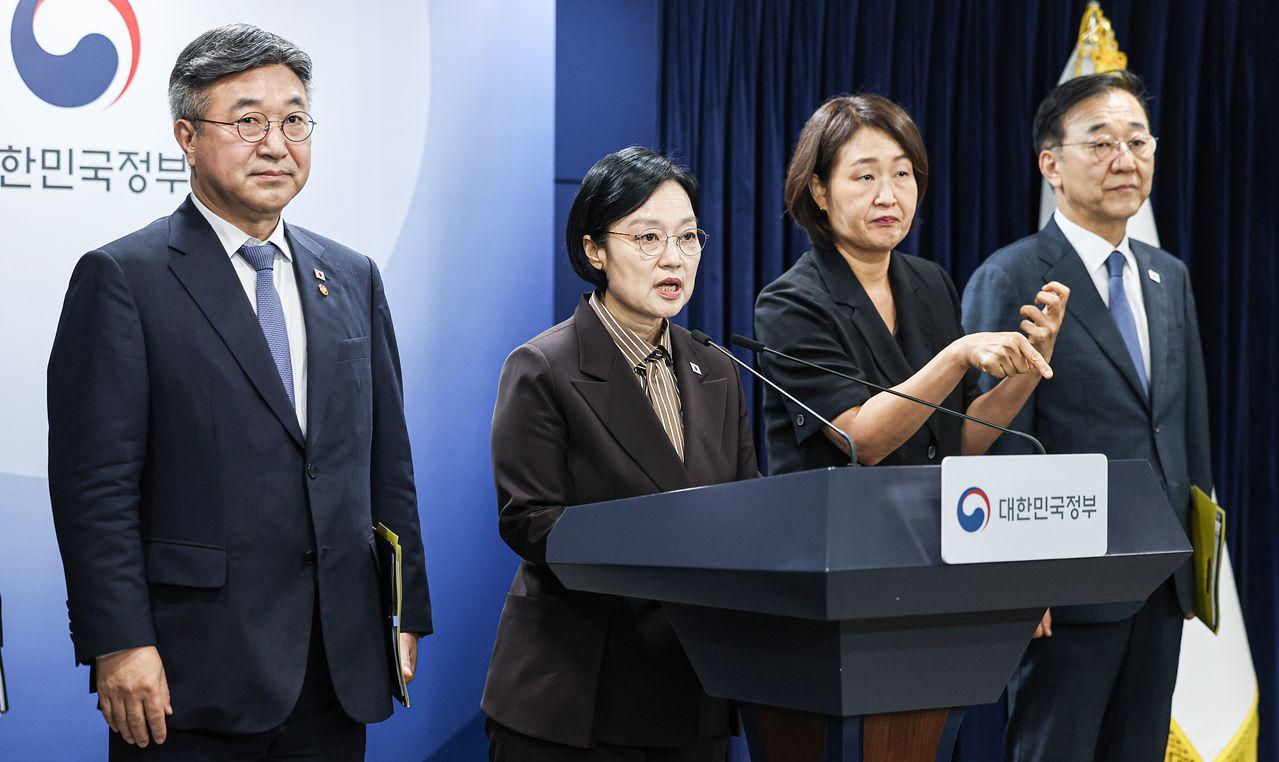
The government is launching a major restructuring plan that will reduce the number of public institutions by 109. Five power generation subsidiaries under Korea Electric Power Corp. (KEPCO) will be consolidated into a single company, while Korea National Oil Corp. (KNOC) and Korea Gas Corp. (KOGAS) will also be merged into one state-run corporation. Korea Land and Housing Corp. (LH), whose debt exceeds 170 trillion won, will be split into two public corporations, with one responsible for land development and housing construction and the other handling housing welfare and asset reserves.
The government announced its “Plan for Functional Reform of Public Institutions” on the 3rd following a meeting of the Public Institutions Management Committee. The government concluded that structural reform had become necessary as the number of public institutions, their organizations and workforces, and their debt had all continued to expand.
The number of public institutions has risen from 298 in 2007, when the Act on the Management of Public Institutions took effect, to 342 this year. Their combined debt reached 769 trillion won at the end of last year. President Lee Jae-myung instructed the government last August to carry out extensive consolidation, saying, “There are so many public institutions that I cannot even keep count of them.”
The government will carry out the restructuring along three tracks: structural reform of 15 key public institutions, consolidation of overlapping or similar functions involving 11 institutions, and integration of 83 subsidiaries and small-scale institutions.
Prime Minister Han Sung-sook said, “We will reduce the number of public institutions by 109, the largest such reduction ever,” adding, “For institutions where legal amendments are not required, implementation will begin immediately.”
LH is the only institution that will be split under the restructuring plan. Land development and housing construction will be assigned to a tentatively named “Housing and Urban Development Corporation,” while housing welfare and asset reserves will be handled by a tentatively named “Housing and Urban Asset Corporation.”
A portion of the development corporation’s profits will be accumulated in a separate account within the Housing and Urban Fund and used to finance the asset corporation’s housing welfare programs. The Ministry of Land, Infrastructure and Transport will separately announce detailed plans for the division of functions and organizational restructuring.
Korea National Oil Corp. and Korea Gas Corp. will be merged into a tentatively named “Energy Resources Corporation.” The government plans to combine their oil and gas exploration, development, and resource procurement functions in order to strengthen bargaining power against major global energy companies.
The plan is based in part on the fact that oil and natural gas are often discovered and produced together in the same fields, creating significant overlap between the two companies’ business areas. Japan likewise supports oil and gas development as well as the securing of metal and mineral resources through the Japan Organization for Metals and Energy Security (JOGMEC).
Korea Coal Corp., whose mines have all ceased operations, will be liquidated. Its debt stood at 2.59 trillion won at the end of last year. Although it no longer conducts any significant commercial operations and is largely handling residual affairs, it still incurs more than 75 billion won in annual interest expenses.
The five power generation companies—Korea South-East Power, Korea Southern Power, Korea East-West Power, Korea Western Power, and Korea Midland Power—which were separated from KEPCO in 2001 to introduce competition into the electricity industry, will be merged again after 25 years into a tentatively named “Korea Power Generation.”
The government plans to achieve economies of scale by integrating fuel and maintenance-material procurement, research and development, and investment in renewable energy.
The consolidated company will establish, among other units, a Renewable Energy Division and a Just Transition Division responsible for workforce and business restructuring resulting from the phaseout of coal-fired power generation.
The Busan, Incheon, Ulsan, and Yeosu Gwangyang port authorities will also be merged into a tentatively named “Korea Port Authority.” Policy and planning functions will be centralized, while the four existing port authorities will be converted into regional branches.
The proposed merger of Incheon International Airport Corp. and Korea Airports Corp. has been postponed. The government will first establish an “Airport Strategy Council” to promote measures aimed at revitalizing regional airports before reconsidering whether the two airport operators should be consolidated.
In addition, institutions and small subsidiaries with overlapping functions in sectors including broadcasting and media, employment and labor education, advanced medical care, and small-business distribution will be reorganized by function. One example is the proposed consolidation of subsidiaries responsible for facility management at public financial institutions.
However, substantial obstacles remain before the mergers can actually be completed.
One immediate issue is the prospect of conflicts among regions over where the headquarters of the newly consolidated corporations will be located. The five power generation companies currently have their headquarters in Jinju, South Gyeongsang Province; Boryeong and Taean, South Chungcheong Province; Busan; and Ulsan.
If a headquarters is moved to another region, the existing host city could lose tax revenue and resident population, raising the likelihood of strong opposition from affected local governments.
North Jeolla Province and the proposed Jeonnam-Gwangju Integrated Special Metropolitan City have also begun efforts to attract the headquarters of the consolidated power company, emphasizing links with their renewable energy industries.
Second Vice Minister of Economy and Finance Heo Jang said of the headquarters issue, “Discussions are ongoing.”
Yoo Seung-hoon, a professor in the Department of Future Energy Convergence at Seoul National University of Science and Technology, said, “The five power generation companies have a significant impact on tax revenues in the regions where they are based. If the headquarters are relocated elsewhere during the consolidation process, the loss of tax revenue will inevitably provoke considerable opposition from the current host regions.”
The handling of debt is another major challenge.
LH’s debt stood at 173.7 trillion won at the end of last year, up 13.6 trillion won from a year earlier, while its debt-to-equity ratio reached 230.8 percent. However, the government’s announcement did not specify how LH’s existing assets and liabilities would be divided between the two newly created corporations.
The housing welfare division is particularly problematic, having recorded operating losses of 3.1949 trillion won from rental housing alone last year.
The proposed merger between Korea National Oil Corp. and Korea Gas Corp. is complicated by both financial and governance issues.
KNOC was in a state of complete capital impairment at the end of last year, with total equity standing at negative 2.529 trillion won. KOGAS has been improving its financial position, but its debt still exceeds 42 trillion won.
Another complication is that KOGAS is a publicly listed company. Because a substantial portion of its shares is held by private investors, the method used to carry out the merger could provoke opposition from minority shareholders.
The government is considering separating KNOC’s distressed assets and liabilities into a separate subsidiary.
Opposition from labor unions is also expected to be a significant variable in the consolidation process.
The Joint Countermeasures Committee of the Public Sector under Korea’s two major labor confederations said in a statement on the 3rd, “This functional reform plan contains numerous consolidation and restructuring measures that carry a serious risk of undermining public services,” adding that it expressed “grave concern and regret.”
The committee continued, “We strongly condemn the government’s undemocratic, closed-door administration, which excluded substantive consultation with the affected parties and broader public deliberation in the process of developing the functional reform plan.”
The committee includes the Federation of Korean Trade Unions, the Korean Confederation of Trade Unions, and five industry-level unions representing public-sector institutions.
The government plans to guarantee employment succession for employees of institutions subject to consolidation, with the exception of executives, and to introduce support measures to ensure that employees’ pay and other working conditions do not deteriorate following the mergers.
Park Jin, a professor at the Korea Development Institute (KDI), said, “After public institutions are consolidated, they should not simply continue every activity they previously carried out. A judgment must be made as to which businesses should continue and which should be discontinued.”
He added, “Projects that generate excessive debt or impose high costs without providing meaningful services to the public should be eliminated decisively.”
Posted by Freewhale98
1 Comment
1. Summary
Korean government plans to reduce 109 state-owned enterprises (SOEs) by merging or shutting down smaller SOEs. Meanwhile the government making more state-owned housing companies to increase housing supply. This is expect to restructure the heavy debts which Korean SOEs suffer from.
2. How is this related to the sub
(1) SOE & YIMBY: The number of state-owned enterprises to be cut significantly while new state-owned housing companies to be created to supply more housing.