
[1] Map of ideology & Policy
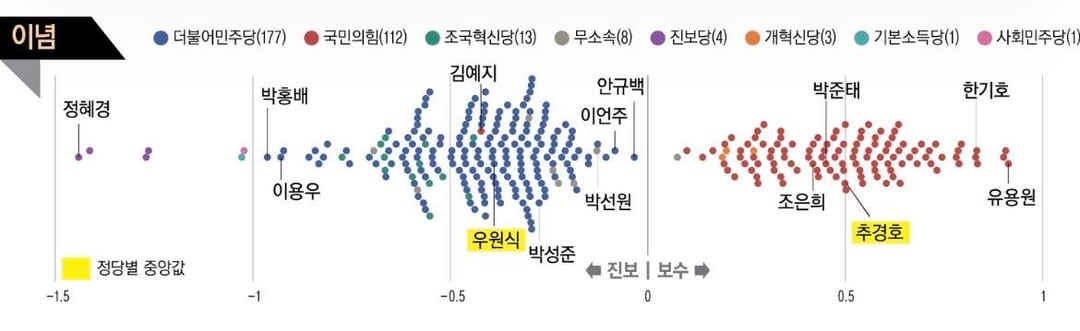
– People power party ( red ) , Democratic Party ( blue )
– Left – progressive, right – conservative
Democratic Party lawmakers are relatively focused around center-left while People Power Party lawmakers are scattered all over the place from center-left to far-right. This is an analysis based votes and legislation they supported.
[2] Map of Partisanship
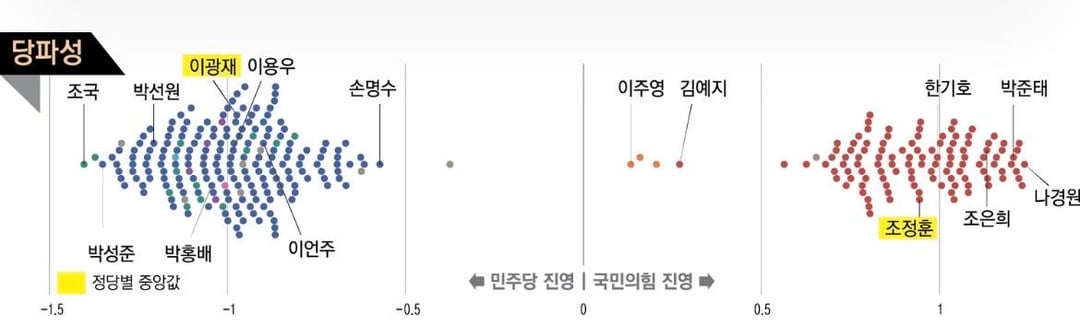
– People power party ( red ) , Democratic Party ( blue )
– Left – pro-DPK, right – pro-PPP
DPK and PPP exhibited wider partisan language compared to their vote records.
Source: https://www.khan.co.kr/article/202609140600101
The Kyunghyang Shinmun, working with knowledge-content startup Underscore, collected and analyzed bills for which 319 current and former members of the 22nd National Assembly were the primary sponsors, along with their public remarks, from June 2024 through early July of this year.
The analysis found that Democratic Party lawmakers had an average ideology score of -0.414, while lawmakers from the People Power Party averaged 0.486, producing a gap of 0.9 points. On partisanship, the Democratic Party averaged -0.985 and the People Power Party 0.943, for a gap of 1.928 points. In other words, the distance between the two parties based on partisanship was more than twice as large as their ideological difference.
For this analysis, “ideology” was used in the traditional philosophical sense of the progressive-conservative spectrum. Positions that emphasized values such as equality, welfare, and labor rights were classified as progressive, while those that prioritized the market, national security, and economic growth were classified as conservative.
“Partisanship,” by contrast, was defined independently of ideology. It measured the extent to which a lawmaker supported either the Democratic/progressive camp or the People Power/conservative camp, or attacked the opposing side.
For both ideology and partisanship scores, higher positive (+) values indicate a stronger leaning toward the People Power Party and conservatism, while more negative (-) values indicate a stronger leaning toward the Democratic Party and progressivism.
Posted by Freewhale98