
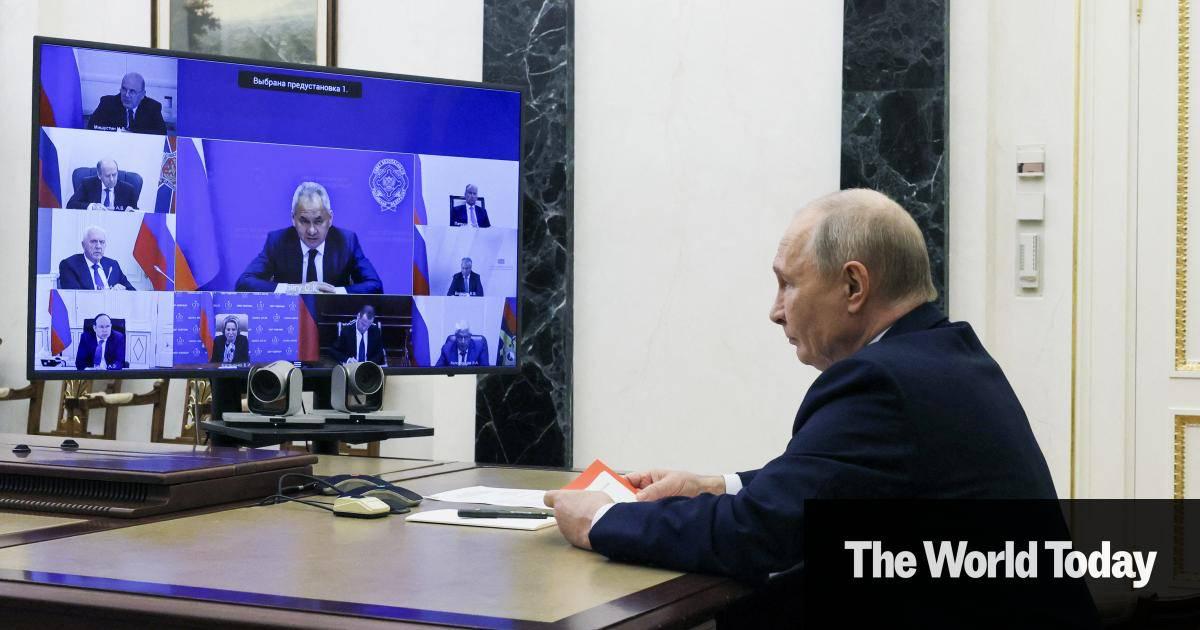
High-level dissent is being stamped out as Putin makes big business bear the costs of the invasion – but concern is mounting, writes Natalya Kovaleva.
Vladimir Putin’s decision to launch his full-scale invasion of Ukraine in February 2022 met little resistance from Russia’s political and economic establishment. The few prominent objections came at a cost. Putin’s longtime aide Dmitry Kozak, who reportedly opposed the invasion in Kremlin security council meetings, saw his influence diminish. When Oleg Tinkov, the founder of Russia’s largest online bank, condemned the invasion on Instagram, he was forced to sell his stake in the bank for a fraction of its value, losing nearly $9 billion.
Those within the Kremlin’s orbit took note. As western governments froze billions of dollars in Russian assets and imposed travel bans hoping to compel the elites to put pressure on Putin, most chose to cut ties with the West. Their response reflected a bargain that has underpinned Putin’s rule for more than two decades: loyalty and public silence on political decisions in exchange for the freedom to accumulate wealth and relative predictability in dealings with the state.
In the months after the invasion, this deal appeared to hold. Officials, technocrats, business leaders and figures at the top of the military-security establishment seized new opportunities for enrichment while largely avoiding comment on the war.
Five years on, the rising cost of the war is testing that arrangement. Putin’s determination to achieve victory – despite setbacks – has placed increasing burdens on Russia’s business and political leaders. The relationship between the Russian state and elites has changed in three distinct ways – with direct implications for Putin’s grip on power.
Business asked to shoulder war costs
Putin’s full-scale war against Ukraine immediately affected state-owned business and the private sector in Russia. While some benefited from the expansion of the defence sector and from acquiring assets left behind by foreign companies, the shock of international sanctions and the move towards a more isolated economy cost billions for the top business owners.
Alexey Mordashov, for example, the controlling shareholder of steel giant Severstal and Russia’s richest man, lost more than $11 billion due to sanctions in 2022, according to Forbes Russia. He has since recovered much of his wealth, which Forbes estimated at $37 billion in 2026.
On the day of the invasion, Putin gathered Russia’s leading businessmen at the Kremlin and urged them to ‘cooperate with the government’ to support military production, the economy and jobs. But the war has lasted longer than Putin and his close aides could possibly have imagined. The effects of western sanctions and surging defence spending have strained the economy. Last year it grew by just 1 per cent, compared with 6 per cent in 2021. Russia’s 2026 budget deficit has already exceeded the annual target by half.
As economic problems and frontline casualties mount, the business elites are being asked to contribute more while facing greater uncertainty over their wealth, political position and future.
The expansion of Ukraine’s drone and missile campaign deep into Russia has been a major cause of this disruption. Recent strikes on oil refineries and industrial sites have led to fuel shortages and driven up inflation, while attacks on Wildberries, Russia’s largest e-commerce platform, have destroyed a third of the retailer’s warehouse capacity and 480 billion roubles (£4.2 billion) worth of goods belonging to some 100,000 local businesses.
Companies have spent more than $1 billion on defences against drone strikes, with some resorting to rudimentary steel cables. The Kremlin refused to share the costs. At the same time, the state is increasing its demands on big business. In March 2026, after announcing tax increases earlier in the year, Putin reportedly asked business owners to donate directly to the war effort during a closed meeting. By August, ‘voluntary donations’ to the state budget swelled to a record 384 billion roubles (£3.3 billion).
Meanwhile, in May, Anton Siluanov, the finance minister, warned that the government would require an additional 2 trillion roubles (£17.5 billion) to cover military costs before the year’s end, as defence spending climbed to 40 per cent of the federal budget in 2026. The expectation that the private sector will help shoulder this shortfall shows how one-sided the economic terms of this relationship have become.
The elites are losing their assets
Putin is not only asking the elites to fund his war but has begun to seize their assets. The process injects cash into a war-strained economy, while giving security officials incentives to pursue profitable assets to demonstrate loyalty and climb the ranks.
A wave of forced nationalizations has moved an estimated 6.5 trillion roubles (£56.8 billion) in assets to state ownership since 2022, a trend that accelerated sharply in 2025. Last year, the Federal Agency for State Property Management reported taking over at least 805 companies. Prosecutors have justified the seizures on grounds ranging from alleged fraud and corruption to foreign control of strategic assets, ‘extremism’-related offences tied to support for Ukraine and ‘unlawful privatizations’ dating back to the early 1990s.
The largest forced nationalization to date involves Rusagro, a Russian agricultural company. Its founder, Vadim Moshkovich – once Russia’s 51st richest businessman – had assets worth 550 billion roubles (£4.8 billion) confiscated in June 2026 as part of a fraud case against him.
The result is the elites squeezed from both sides: sanctions have mostly cut off the exit once available to the country’s wealthiest, while at home the Kremlin has grown more willing to grab what remains within its reach. Russia’s business leaders now find themselves at the mercy of an increasingly interventionist state, with few effective levers to influence the terms of the relationship.
Loyalty no longer guarantees political protection
Confiscations are only part of a broader change. As political repression has intensified during the war, the regime has grown more willing to prosecute, arrest and sideline figures across business and political circles.
High-profile cases, from the unravelling of the political network around former defence minister Sergei Shoigu to the arrest of Major General Ivan Popov on fraud charges after he publicly criticized the military command’s handling of the war, have been interpreted by observers as growing tensions within the elite.
Perhaps more revealing have been the recent arrests of regional officials. In Krasnodar region, eight senior officials were arrested within six months of a regional election held in September 2025, including a former deputy governor and a transport minister.
In April 2026, independent Russian outlet Novaya Gazeta reported that criminal cases had been opened against at least 697 regional and federal officials since the start of the war, with the number rising almost threefold in 2025 compared with pre-war 2021.
The scale of this change suggests this is more than a series of isolated purges. The war has created a political environment in which criminal prosecution is being used to discipline the state bureaucracy.
The expanding roles of the federal security service (FSB), the Investigative Committee and Prosecutor General’s Office have created new vulnerabilities for the elites, upending the expectation that political connections will shield them from prosecution.
What does this mean?
The Putin regime shows no sign of imminent collapse, even as its relationship with the business and political elites grows more strained.
Having staked so much on the war, Putin appears unwilling to make any concessions in the face of mounting domestic pressures in the belief that victory remains within close reach. The country’s ruling establishment, meanwhile, is signalling a growing appetite for stability and an end to the war.
In May, the chief economist of the state-controlled development bank VEB, Andrey Klepach, warned that Russia was falling behind economically and could not win a prolonged war of attrition. He was dismissed in August. In June, Sberbank chairman German Gref stated that Russians were united in wanting an end to the ‘military activities’. While not challenging Putin directly, these statements indicate a growing willingness among senior figures to voice concern about the economic and social costs of a war without a clear end.
The pressure to cover the shortfall in Russia’s ballooning military budget before the end of the year will be the next significant test of this relationship. For now, growing dependence and coercion are holding the system together. Elites’ dissatisfaction does not automatically threaten Putin politically. On the contrary, greater insecurity is likely to reinforce authoritarian control in the short term.
Yet, disciplining the elites in the long term will only grow harder if Putin cannot deliver something resembling a victory and show that the sacrifices have been worthwhile.
Posted by IHateTrains123
3 Comments
The long and short of it is that Russian elites are increasingly shouldering the fiscal burden of the war be it through sanctions, “kinetic sanctions” (drone strikes on their properties), property seizure and direct pressure from the Kremlin. So far, the Russian state has seized some 6.5 trillion rubles worth of assets from these elites to, mostly, fund the war. Seemingly amidst this backdrop of pressure and direct action from the Kremlin, the wealth and political connections that once shielded these elites no longer applies.
Also in the same vein as the main article, the [IEA is estimating](https://www.pravda.com.ua/eng/news/2026/09/11/8052995/) that the Russians could lose up to 18% of their oil refining capacity within 18 months. Naturally downstream of this downturn in production is, once again, [gasoline shortages](https://ua.news/en/war-vs-rf/na-pivnichnomu-zakhodi-rosiyi-zagostrivsia-defitsit-benzinu-cherez-udari-po-npz) being reported in some Russian regions.
!ping Rus
Good
Intensify it.
GoFundMe campaigns for Russian oligarchs won’t do well