
Full article:
The secretive German ‘guerrilla unit’ buying up arms for Ukraine
Small defence ministry team in Berlin strikes weapons deals in as little as two weeks
In an extra-high-security wing of the German defence ministry lurks a team so secretive that some call it a guerrilla unit. One close collaborator describes it as “incredibly un-German”.
The Sonderstab Ukraine — special staff for Ukraine — is the engine behind Germany’s €11.5bn-a-year military support for Kyiv. Unlike the sprawling bureaucracy behind procurement for the German armed forces, this small, low-profile unit prides itself on striking deals to buy weapons for Ukraine in as little as two weeks.
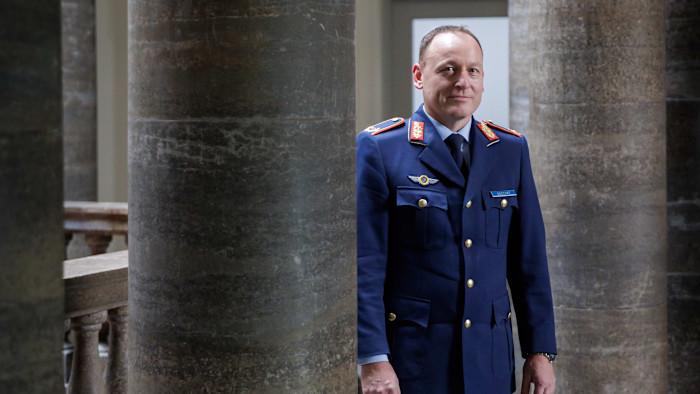
“We have extremely short decision-making chains,” said brigadier general Joachim Kaschke, a former Tornado pilot who serves as the unit’s head. “That makes us agile and flexible.”
He was speaking from his office outside the secure area, which was off-limits for the FT.
Created a few months after Vladimir Putin’s full-scale invasion of Ukraine in 2022, the Sonderstab’s role has morphed as Germany moved from nervous support to becoming one of Kyiv’s most important backers.
Last year, after President Donald Trump slashed US military aid for Ukraine, Berlin became the single biggest provider of military support. To date it has spent close to €58bn on weapons, ranging from small kamikaze drones to air-defence systems costing hundreds of millions of euros apiece.
Over the past year, the Sonderstab’s role has shifted again, becoming a hub for exchanges between the German and Ukrainian militaries and defence industries as Nato members seek to learn from Kyiv. Kaschke points to Ukraine’s cutting-edge technology and its “wealth of tactical and operational experience”.
Germany’s support for Ukraine was not always so robust. In the tense weeks leading up to the Russian invasion in February 2022, Berlin drew global mockery and dismay for an offer to supply Kyiv with 5,000 helmets.
Scarred by its Nazi past, the country had a longstanding policy of refusing to send weapons into combat zones. It also had a complex relationship with Russia.
But the full-scale invasion — and heavy pressure from its allies — forced Germany to tear up that policy. Berlin first sent shoulder-fired anti-tank and anti-aircraft weapons from Bundeswehr stocks, before gradually moving to heavier equipment.
In the first weeks and months, Germany’s top defence officials set up a “situation centre” in the defence ministry to monitor the escalating conflict and brief the political leadership. “Very quickly, this monitoring became linked to the question: how do we actually support Ukraine?” said Christian Freuding, the German military commander appointed to lead the centre. In July 2022, it became the Sonderstab Ukraine.
Freuding pulled together a small, elite team. “At the beginning, we worked around the clock, in shifts,” said Freuding, who last year left the Sonderstab to lead Germany’s land forces. “It wasn’t acceptable to say, ‘Well, it’s 5pm now, we’re going home.’”
Scrambling for weapons, Berlin tried a scheme under which allies sent their own equipment to Kyiv and Germany promised to replenish their stocks.
But it soon became clear that Ukraine also needed weapons that were not in any European arsenal.
Matthias Puschnig, a reserve officer who spent most of the past three years working for the Sonderstab, recalls the amazement in Berlin after Ukraine obtained five fixed-wing surveillance drones from Quantum Systems, a German start-up.
Ukrainian forces connected the drones to the Starlink communications network and used them to identify targets for artillery units. The system helped thwart repeated Russian attempts to cross the Siverskyi Donets river in one of the most crucial battles of spring 2022. “It was the first time that we understood why the Ukrainians were successful — because they did things like this,” said Puschnig.
Germany started paying for Quantum drones for Kyiv, as well as buying other weapons directly from German industry. Kyiv provided a shopping list. Berlin paid the bill.
“We soon realised that, if we wanted to support Ukraine fundamentally, we had to usher in our industry,” Puschnig said. “And at the same time, companies in Germany understood the chance that this offered.”
Olaf Scholz, the German chancellor at the time, remained cautious, holding back on a request to send Leopard 2 tanks. But he did agree to send Ukraine its first IRIS-T air defence system, which the Sonderstab paid Germany’s Diehl to supply. Together with US-made Patriot systems, IRIS-T would go on to play a crucial role in defending Ukrainian cities from Russian missile attacks — and would later be ordered by the Bundeswehr for its own inventories.
The Sonderstab gained a reputation for speed and efficiency. Because contracts were signed by the Ukrainian government rather than the German one, the unit could bypass labyrinthine procurement rules — and the 13,000-strong agency that buys equipment for the Bundeswehr.
It also enjoyed strong political backing from Boris Pistorius, Germany’s popular and powerful defence minister, who took office in January 2023.
The unit remains lean: fewer than 20 people work there. “It’s got a bit of a start-up vibe,” said one person who knows the team. “They have a very deep knowledge of systems: what works . . . and what is overpriced, glitzy nonsense.”
While some German officials project confidence about the country’s procurement strategy, the Sonderstab is more questioning, the person added.
Freuding, who still considers the unit his “baby” and stays in close contact with Ukraine, struck a similar note: “I think that, as a military leader, you always have to . . . question whether your own path is the right one.”
When he took office last year, Chancellor Friedrich Merz was eager to be seen as a more steadfast supporter of Kyiv than Scholz.
His election coincided with Trump’s second term in the White House and a steep fall in US military aid for Ukraine. US support for Kyiv fell 99 per cent last year, according to a tracker run by the Kiel Institute for the World Economy.
Germany, the EU’s biggest economy, led Europe’s effort to fill the gap. Alongside plans to spend hundreds of billions overhauling the Bundeswehr, Merz has repeatedly increased military support for Kyiv. This year, Germany’s military aid budget for Ukraine reached €11.5bn.
But the European drive — including a €90bn EU loan — has not been enough to stop Russian advances. Kyiv is also still struggling to secure enough interceptors able to shoot down Russian ballistic missiles targeting Ukraine’s major cities.
Still, Ukraine’s ambassador to Berlin has described the aid provided by Berlin as “enormous” and “exactly what we need”.
Kaschke said it was entirely up to Kyiv how to spend the German money. “We are not there to advise them — there is no ‘mentoring’,” he said, although Berlin sometimes puts Ukrainian officials in touch with German companies.
The arrangement has prompted concerns among some in industry and politics about the risk of corruption in a country battling wartime graft.
Former Ukrainian defence minister Mykhailo Fedorov, who was fired in July, warned last month that Ukraine’s ability to fight Russia was being undermined by rampant corruption.
Kaschke said his team rigorously checked all contracts paid for by German taxpayers, ensuring prices were in line with market rates and setting delivery milestones.
Germany has also backed the production of new weapons, including Ukrainian missiles capable of striking deep inside Russia. That was partly a workaround after Merz was forced to row back on an opposition-era promise to supply Kyiv with German-made Taurus missiles.
Merz and Ukrainian President Volodymyr Zelenskyy signed agreements in Berlin this year to make defence co-operation more reciprocal, including joint ventures between German and Ukrainian companies.
The deals also opened the door for Ukrainian companies to access lucrative Nato markets, causing unease in parts of Germany’s arms sector. “The situation with Ukraine has changed and it’s trying to become an exporter as well as an importer,” said one defence company executive. “It’s becoming more political.”
German foreign minister Johann Wadephul this week echoed industry concerns that German companies were being overlooked in Ukraine-related spending.
He told a podcast Berlin “was not entirely satisfied”, adding that he told Zelenskyy during his last visit to Kyiv: “We stand by you, we support you. But I also have to explain this to German taxpayers, and the very least you can do is involve the German defence industry in all procurement projects.”
Unlike the UK, Germany has not stationed military personnel in Ukraine, where British soldiers have been advising Ukrainian colleagues and learning from them.
The more cautious Bundeswehr has instead drawn on Ukrainian battlefield expertise by bringing several dozen soldiers to Germany to share lessons on using and countering drones. Berlin is also gaining access to battlefield data, including from Ukraine’s Delta system, which fuses information from satellites, sensors, drones and intercepted Russian communications to give soldiers a real-time picture of the front. Kaschke said that was one of the most “valuable aspects” of the relationship.
Some worry the Sonderstab is not doing enough to access Ukraine’s trove of battlefield data. “We could really be doing more to make sure that every euro spent in Ukraine is worth double — helping both Ukraine and Germany at the same time,” said a start-up executive.
Kaschke, who has made nine visits to Ukraine since taking over the Sonderstab, insisted Berlin understood the urgency. Russia did too. “With every shot they fire, they can adjust their systems and tactics,” he said. “Our systems have to keep pace.”
Posted by ZweigDidion