
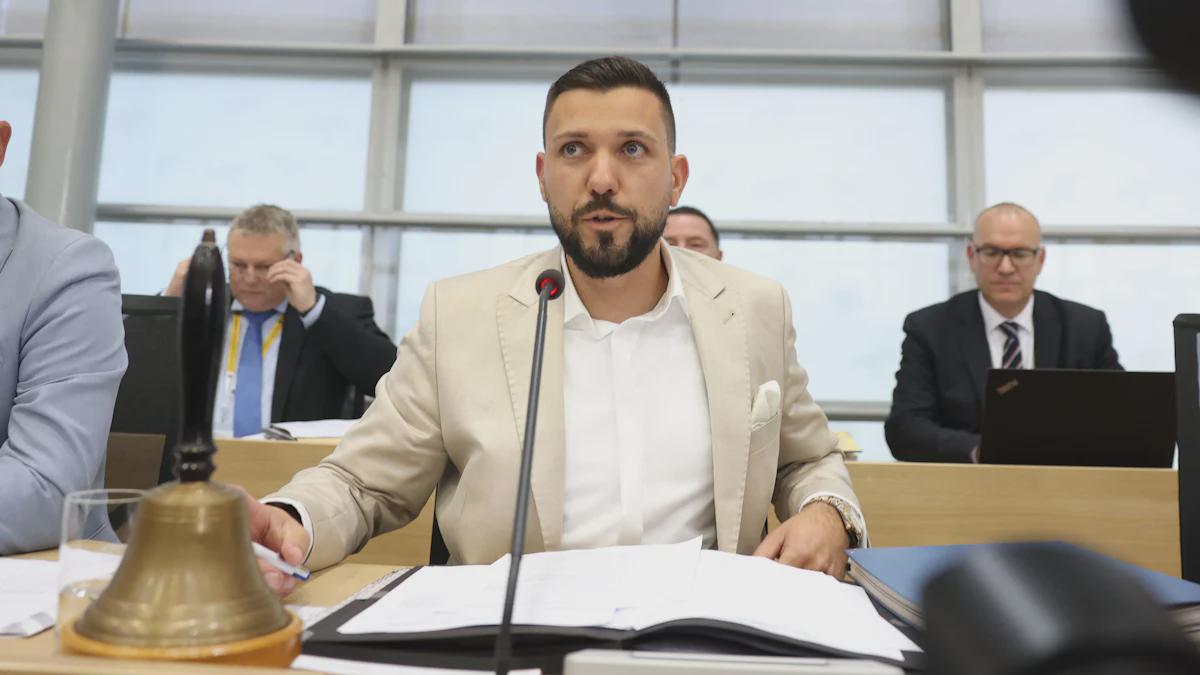
The 35-year-old received 48 of the 82 votes cast—four more than the AfD and BSW combined. In his inaugural speech, Rausch emphasized: "The same rules will apply to everyone."
Who besides the AfD and BSW voted for Tobias Rausch?
Where did the four additional votes come from? The AfD and BSW combined would have accounted for 44 votes, yet a total of 48 lawmakers elected Tobias Rausch as the new state parliament president. Assuming the AfD and BSW voted en bloc for the AfD general secretary, four additional votes must have come from parties that had previously ruled out electing Rausch: the CDU, SPD, Greens, or The Left. Exactly who cast them remains unclear, as lawmakers vote individually and by secret ballot in a voting booth.
Suspicion might quickly fall on the CDU, whose lawmakers are being courted by the AfD—particularly with an eye on the election of the state premier in December. Even before the state parliament’s inaugural session, Tobias Rausch had hinted that he had secured five pledges to vote for Ulrich Siegmund from outside the AfD ranks. However, Bundestag member Sepp Müller—who aims to become the CDU state chairman in December—does not believe these votes came from within his own party: "Our parliamentary group is solid. I have no reason to doubt the reliability of our lawmakers." Siegmund is currently three votes short of the absolute majority he needs in December to take office at the State Chancellery.
Rausch delivers first speech as State Parliament President: "The same rules will apply to everyone"
In his first speech as the newly elected President of the State Parliament, Tobias Rausch made clear how he views his role. "I will not discharge this office as the president of a parliamentary group, but as the president of the entire State Parliament of Saxony-Anhalt," he told the assembled lawmakers. He began by thanking the former State Parliament President, Gunnar Schellenberger (CDU), who had congratulated him on his election just minutes earlier.
Rausch stated that he held the office in high regard. During his time in the opposition, he had learned that parliamentary rules—as well as procedures and rights of participation—could be viewed controversially, yet were also subject to change. Rausch has been a member of the Saxony-Anhalt State Parliament since 2016.
However, Rausch said he did not intend to use this as an opportunity to "settle scores with the past," but rather to derive principles for the future. Rules should not be altered based on opposition or party-political calculations; instead, they must remain valid even if the parliamentary majority shifts. He pledged to carry out his duties with "fairness, composure, and the necessary firmness." "The same rules will apply to everyone."
For this reason, he said, he would "ask what our constitution, our laws, and our parliamentary rules require." His party is classified by the state's domestic intelligence agency as definitively right-wing extremist.
Posted by IHateTrains123
3 Comments
https://preview.redd.it/d6fu1hc2luth1.jpeg?width=1170&format=pjpg&auto=webp&s=db28afb8fce494937d1f4998a1ab551ef7fd929b
For context, this is a legislative, presiding role akin to the Speaker of the House. He runs parliamentary sessions but he holds no executive governing power.
The executive head of government is the Minister-President, who has yet to be chosen
Fascists back in power again in Germany