
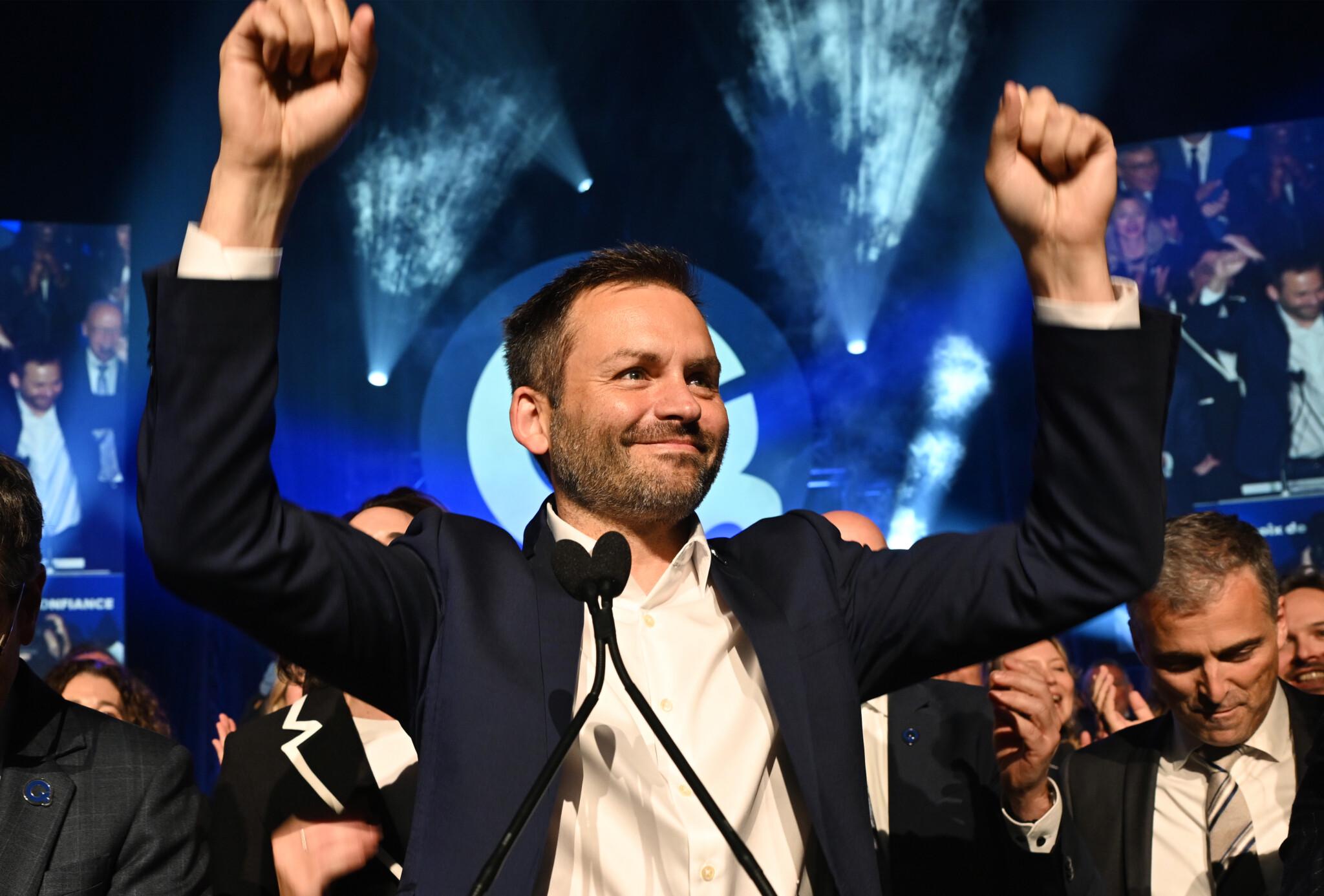
There are several storylines emerging from last night’s Quebec election. Although each is interesting in its own right, taken together, they point to a province whose politics are more fragmented and unsettled than they have been in decades.
The first is the return of the Parti Québécois (PQ) to government. Paul St-Pierre Plamondon’s party won 59 seats with just 28 percent of the popular vote—apparently the lowest vote share ever recorded by a winning party in Quebec. It’s an extraordinary result: a separatist party will form government even though more than seven in ten Quebecers voted for someone else.
A weak mandate shouldn’t only undermine the possibility of a third referendum on sovereignty, but it may also complicate the incoming government’s governing and legislative agenda. For Canadians committed to Quebec’s place in a united country, that’s a reasonably good outcome. The PQ is back in power, but separatism hasn’t acquired anything resembling a popular mandate.
The second major story is the collapse of the governing Coalition Avenir Québec (CAQ). The CAQ was founded in 2011 under the charismatic leadership of François Legault. It brought together Quebec nationalists who had grown tired of the old federalist–separatist divide and voters concerned about the province’s stagnant economy and sclerotic public institutions. At its most promising, the party seemed capable of forging a new centre-right synthesis: nationalist without being separatist, culturally conservative without being reactionary, and more market-oriented than the old centre of gravity of Quebec politics.
That promise proved remarkably fragile. After winning 74 seats in 2018 and 90 in 2022, the CAQ was wiped off the electoral map on Monday night. There are many explanations, including a complicated governing record, personal scandals and the inevitable exhaustion that follows two terms in office. But a big part of the story is institutional. Legault and those around him never succeeded in turning the CAQ into a durable political institution independent of its founder. It remained, to a considerable extent, a vehicle for Legault himself.
In this respect, Legault’s experience stands in contrast to Stephen Harper’s. Harper understood that a successful political insurgency couldn’t depend indefinitely on a single leader. His project instead sought to build the Conservative Party into a formidable political organization that would outlast him. That work was less high-profile than winning elections, but it may prove to be his greatest political legacy.
The third story is the rise of the Conservative Party of Quebec under Éric Duhaime. The party won 19 seats and 20.7 percent of the vote, an extraordinary leap from the nearly 13 percent it received without electing a single member in 2022. For the first time in its modern history, it will have a substantial caucus in the National Assembly.
Conservatives across the country will understandably celebrate. Many know Duhaime from his long record as a broadcaster, writer, activist, and advocate of conservative ideas. The party’s broad commitments—to freer markets, individual liberty, fiscal restraint and a decentralized federation—are recognizable to conservatives elsewhere in Canada. Its breakthrough creates the possibility of a durable conservative voice in a province where that perspective has often lacked an effective political home.
But possibility is of course not permanence. Duhaime’s real challenge now is to avoid the fate of Legault and the CAQ and, before them, Mario Dumont and the Action démocratique du Québec. Quebec politics has repeatedly produced charismatic leaders and insurgent parties that enjoyed an impressive moment without building the institutional foundations needed to endure.
The Conservatives must use their new foothold to build a real institution: recruit serious candidates, develop a deeper policy agenda, strengthen local riding associations, cultivate the next generation of leaders, and demonstrate that they can perform the patient work of parliamentary opposition. Monday’s breakthrough may otherwise become another fascinating but aberrant footnote in modern Quebec politics.
These three stories are connected by the peculiar interaction of Quebec’s first-past-the-post electoral system and its increasingly fragmented party structure. Five parties won more than 10 percent of the vote and none reached 30 percent. The CAQ received more than half a million votes and won no seats, while the PQ came close to a majority government with barely more than one voter in four.
There’s a democratic distortion here that cannot be ignored. Quebecers expressed a wide range of political preferences, including a clear popular majority for parties opposed to independence or not campaigning for it. Yet the electoral system translated that divided vote into a governing plurality for the one major party explicitly committed to breaking up the country.
That raises legitimate questions about the continuing utility of first-past-the-post in an age of growing political heterogeneity and multiplying voter preferences. Those questions deserve a fuller discussion on another day.
For now, the central point is that Quebec has produced an election result at once dramatic and inconclusive: a separatist government without a separatist mandate, the near-erasure of a once-dominant governing party, and the arrival of a new conservative caucus with enormous promise and much still to prove. How these forces reshape Quebec’s politics and public policy—and how they reverberate through national politics—will be among the country’s most consequential political questions in the months and years ahead.
Posted by IHateTrains123
1 Comment
Damn 79 to 0 seats overnight