
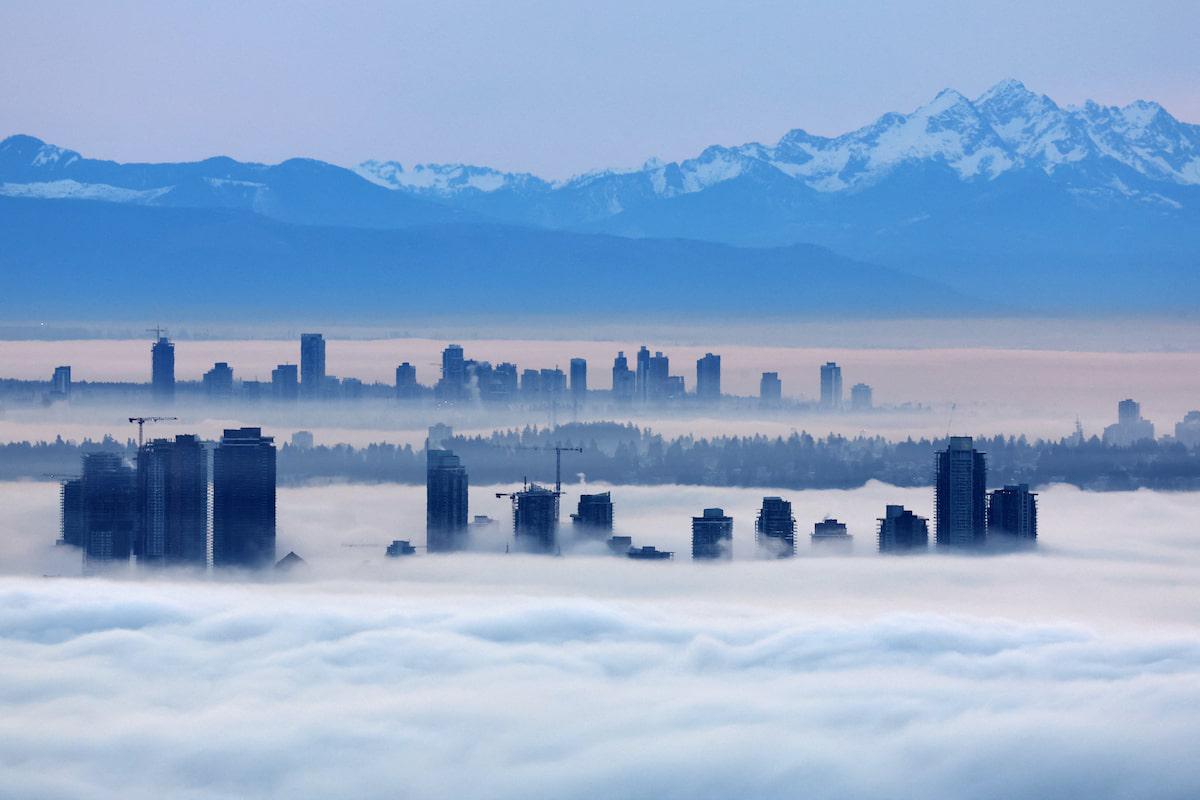
In fast-growing cities, there are pockets where the population is shrinking. Has the solution to the housing crisis been there all along?
Kerrisdale looks much the same as ever. In this affluent pocket of Vancouver’s west side, gable-roofed houses stand behind tall hedges and shelter under mature maples.
Yet a subtle change has occurred: In many corners of the neighbourhood, there are fewer people.
On the side streets of Kerrisdale, many blocks have lost between 10 and 30 per cent of their population since the 1970s. One section near the Marine Drive Golf Club fell from 1,010 residents to 630 – down 380 people, or 38 per cent.
This is not an anomaly. Over the past half-century, both the Vancouver and Toronto regions have doubled in population.
But a Globe and Mail analysis of census data shows that within these growing metropolises, there are shrinking cities: established areas where populations have fallen as much as 40 per cent.
This trend of local population declines has been largely overlooked, even as Canadian governments work to create more homes and build the infrastructure – pipes, roads, community facilities – to serve the people who will occupy them.
In last year’s federal budget, the government promised $50-billion toward such projects.
In March, Prime Minister Mark Carney pledged $4.4-billion to “housing-related infrastructure” in Ontario, and in June, the government pledged $1.6-billion over 10 years for such projects in British Columbia.
But experts suggest some of this spending could be put to better use, or avoided entirely.
That is because governments rarely ask a fundamental question: Where do we have unused capacity? Many urban neighbourhoods have water systems, roads, parks and schools that were built for larger populations than today’s.
As new houses have been built across the Lower Mainland and the Greater Toronto and Hamilton Area, as apartment towers have swelled the populations of formerly desolate industrial districts, each city has maintained an archipelago of neighbourhoods where neighbours have become increasingly scarce.
The Globe compared figures from the 1971 and 2021 censuses for both Toronto and Vancouver, examining the population of “dissemination areas” – each one an area of a few blocks, typically home to about 500 people.
In the Vancouver region, 21 per cent of those areas declined in population over those 50 years, losing 76,424 people in total. Many other areas failed to keep up with the quick growth of the region.
In the Toronto region, the pattern is much more stark: Almost three-quarters of those established areas had declined by 2021, shedding a total of 540,789 people.
This pattern is hard to discern on the streetscape; these prosperous cities generally do not have crumbling, empty buildings or vacant lots. But the declines are subtly reflected in empty public-school classrooms, a lack of foot traffic and the closing of neighbourhood retailers.
The history of growth and shrinkage is shaped by a combination of demographic changes and specific urban planning policies. But nothing is set in stone: Experts say these places could yet absorb more residents, often at a lower cost than building entirely new communities.
Shifting demographics
Several demographic trends contribute to the pattern of the shrinking city. Canadians today are living longer, having fewer children and occupying more square footage than previous generations.
Roland Haebler is a case in point. A general contractor, he was raised on the west side of Vancouver. He and his wife raised their two sons in a 3,400-square-foot house in Kerrisdale; they remain there as empty nesters, though their son’s dog Hershy is often around the house. “We live in the same space as when we had two boys who walked to school,” said Mr. Haebler, 65. Their pandemic project was to convert their coach house into a music studio. “And now we have a spare bedroom, and I’ve moved my study from the basement into one of the other bedrooms.”
Prof. Maxwell Hartt, a geographer at Queen’s University who studies population decline, says that this story is quite typical. In the shrinking zones of Toronto and Vancouver, “there aren’t a lot of vacant homes,” he said. “It is fewer people in the same amount of places.”
Canadians are having fewer children. Young parents often choose to move from cities to suburbs. And seniors – whose lifespan has increased from an average of about 75 to 82 in the past four decades – are largely remaining in place, by choice or by necessity.
The COVID-19 pandemic prompted thousands of people to migrate out of large cities, particularly Toronto and its adjacent communities. However, that pattern was outweighed until 2025 by high levels of international migration; both the Toronto and Vancouver metro areas have continued to grow in each year of the past decade except for last year.
“There are, I’m sure, many retired people who would be happy to move down,” Dr. Hartt said, “but there isn’t a condo or an apartment nearby to move into in their community.”
Mr. Haebler was surprised to learn that most blocks in his neighbourhood have lost people. Some of his neighbours have divided up their lots to make room for new apartments, often for their children. “Everybody’s got a laneway suite now, and everybody’s got a basement suite,” he remarked.
“There’s multiple generations living in homes where there was only one before.”
Such small-scale additions to the neighbourhood, which planners describe as “gentle density,” don’t trouble Mr. Haebler. But these building projects are outnumbered by changes in the other direction. Empty nesters are more numerous; families are often smaller; and buildings are being converted from rooming houses or apartments into single-family homes.
To reverse the current trend in Kerrisdale would require big, visible change, with mid-rise or even tall buildings permitted across a wider area.
“In Burnaby, there are high-rises going up everywhere,” Mr. Haebler mused. If such large buildings were permitted in Kerrisdale, “I don’t think I would like that very much.”
Mr. Haebler has no interest in selling his house to a developer, and would not support larger buildings on his block.
Such attitudes are common. And while new buildings generate political friction, nobody really notices when existing buildings shed some of their occupants.
The latter trend is common enough in Vancouver, but far more pronounced in Toronto. A large zone of the old City of Toronto, running along Bathurst Street westward to High Park and north to Eglinton Avenue, has seen declines of up to 40 per cent.
Through the 19th century, houses here were home to larger families, and it was common for homeowners to take in tenants. The crowding increased as immigrants arrived in large numbers following the Second World War: Among them were Italians, Portuguese, Poles and Ukrainians, who each settled the west side of the city and then in many cases became homeowners, often raising large families.
As these latter groups became wealthier and more established, they largely moved to the new suburbs of Metro Toronto and beyond. The side streets near the core continued to hold two- and three-storey houses, but those houses gradually became emptier.
To the sprawl and back
On one side of the road, farm fields. On the other side, a concrete apartment tower rising 15 storeys from the new neighbourhood of North York.
This was the northern border of Metropolitan Toronto in the late 1960s, when the rapid growth of the city ran into strict boundaries.
The Metropolitan Toronto Planning Board enforced a vision of “urban contiguity,” as the historian Richard White puts it. Within a defined area, “development would be welcomed, but outside that designated urban area, development would be tightly controlled.”
This pattern continued, imperfectly, from 1954 until the early 1970s, when the economic and political pressure for suburbanization won out. The regions around Toronto grew explosively through the 1980s and 90s, largely in the form of houses, while the City of Toronto stagnated.
The last quarter-century has seen another reversal, pushing back against sprawl. In the 1990s, the Toronto region saw increasing gridlock as cities experienced fiscal pressure; at the same time, environmentalists gained popular support to protect green space, especially on the Oak Ridges Moraine north of Toronto. In response, a Liberal government in 2006 introduced the Growth Plan for the Greater Golden Horseshoe, which sought to reverse sprawl by focusing new housing within urbanized areas. Toronto and its neighbouring municipalities were forced to accept more density.
Likewise, Metro Vancouver’s Urban Containment Boundary has directed almost all new growth inward since 1979, and the Regional Growth Strategy, implemented in 1996, reflected a similar attitude.
This “intensification” policy was driven in part by the understanding that the older city neighbourhoods had capacity to hold more people, said Victor Doyle, a planner who spent two decades with Ontario’s Ministry of Municipal Affairs.
“In house neighbourhoods, the population had declined dramatically from seven people in a house to two or three,” he said. “So the housing stock itself could accommodate lots of new people.”
And with the addition of new buildings, he added, “these zones could accommodate a lot more.” They had “soft infrastructure” such as parks and schools, and they were close to downtown jobs, particularly in Toronto.
But in each case, there was a catch. New residents moved into existing cities – but regional and provincial planning generally didn’t dictate where they should go within those cities.
So, as in many other North American cities, a grand bargain was struck: New housing was pushed into the places where few people lived, principally industrial districts near downtown, while house neighbourhoods remained unchanged. In Toronto, the King-Spadina and Liberty Village districts rapidly transformed from industrial uses to high-density neighbourhoods with tens of thousands of residents.
“We protected certain neighbourhoods, so a lot of the geography of the city was insulated from change,” said Josh White, the City of Vancouver’s chief planner. “Those weren’t just geographic realities; those were geographic realities combined with political choices that we made.”
This has generated an uneven pattern of growth sometimes described as “tall and sprawl.” In Vancouver, that has meant high-rise residential buildings within the city’s downtown peninsula, and clusters in the suburban downtowns of Surrey and Burnaby. It has also meant mid-rise buildings focused on particular major streets, but not on the streets next to them.
As an example, Mr. White cited the Cambie Corridor Plan that added new housing when the Canada Line transit route was completed in 2009.
Development “is heavily concentrated physically on Cambie Street, to the exclusion of a lot of density even blocks away,” Mr. White explained. “That’s been the typical pattern of growth in Vancouver for the last couple generations. And that’s one of the patterns we’re trying to shift now.”
The city’s new Official Development Plan, which took effect in March, opened up the potential for new middle-density housing across a much larger swath of the city, organized into 17 new “villages.” The goal was to permit townhouses and small apartment buildings in areas that have seen little construction for decades, and to even out the city’s peaks and valleys in population.
However, Vancouver City Council decisively rejected the villages idea in July. Councillor Sarah Kirby-Yung described the public response as “a landslide of opposition.”
Reversing the patterns of the past 50 years will be difficult, and there are serious political headwinds. Questions around new housing – how much should be added, where and in what form – have dominated Vancouver politics for a generation. Housing has not dominated Toronto’s politics to the same degree, but change remains unpopular.
Still, intensification could pay fiscal and social benefits.
Empty schools, empty pipes
In central Toronto, Darlene Varaleau remembers when the schoolyard at Bickford Park High School was full of action.
“This place used to be busy,” recalled Ms. Varaleau, gesturing at the high school and community centre across the street from her house near Bloor and Christie Streets. “All the children used to go to after-school programs and have swimming lessons here. And then the kids grew up, and most of them left.”
The high school sat in the public park of the same name. Now called Bickford Centre, the building opened in 1965 to serve a growing population of immigrants and local baby boomers alongside a city-run public facility called Bob Abate Community Recreation Centre.
It rises five storeys high and includes a gym, swimming pool and auditorium. But the school that once served 1,000 students is largely quiet. In the last academic year, according to a Toronto District School Board spokesperson, Bickford Centre housed four small specialty high schools with a total of 77 students, while 386 adult students attended short-term programs.
At any given time, this facility is mostly empty. Ms. Varaleau, 74, is advocating for new community programs to make use of the building.
The school board offers one visible example of underused infrastructure in our big cities. For two decades, TDSB and Ontario’s Ministry of Education have argued over funding of its facilities.
This tension is connected to the city’s pattern of growth and shrinkage. In a few places, TDSB schools are oversubscribed. But the board has 301,366 classroom spaces and only 234,514 students, leaving nearly 69,000 empty seats. These are largely located in areas whose population has been declining for years.
Ms. Varaleau’s block, steps from the Christie subway station, had about 750 people in 1971. As of 2021, it had roughly 500, and that number is shrinking.
“There was a migration out of this area,” Ms. Varaleau explained. “You know, these were big families. There were a lot of people in these houses. And now, this is a desirable place to live, so you’ve got two people where there were five or more.”
Indeed, the average household size across Canada has shrunk significantly over the past two generations, from 3.5 in 1971 to 2.4 in 2021. In Toronto, and particularly in older districts such as Ms. Varaleau’s, the change is still more pronounced.
Children in Toronto today are heavily concentrated in a few places – largely the zones where many new homes have been built in condominium apartments. When young couples in those areas have children, many of them will stay in place or else move to the suburbs in search of more space. Houses in the central city, which remain more expensive, can be financially out of reach.
A similar phenomenon is occurring in Vancouver. The downtown Olympic Village neighbourhood, which has many young families, has seen calls for a new school for a decade. A new elementary school is now slated to open in 2029. At the same time, the Vancouver School Board’s buildings in many other downtown areas are below capacity. Meanwhile, suburban boards are booming. Last year, the Surrey Board of Education approved a $5.7-billion, five-year capital plan including 27 new schools.
In both cities, particularly in Toronto, schools are maintaining empty space while new school buildings are being constructed from scratch.
New suburban development generally requires all-new infrastructure. And the cost of building it, in places where homes are spread out, is high.
A 2021 study by Hemson Consulting for the City of Ottawa found that when low-density suburban houses are built, they create a deficit: Their property taxes do not cover the cost of the public infrastructure such as water mains, each home leaving the city worse off by $465 a year. Conversely, infill growth generated a surplus of $606 per home – property taxes cover all the costs of infrastructure, and then some.
That holds true even in places where water infrastructure is aging and under strain, said Kerry Black, an associate professor and Canada Research Chair in the Department of Civil Engineering at the University of Calgary.
Calgary has coped with two water-main failures – on the same pipe, the 50-year-old Bearspaw South Feeder Main – in the past two years. But Dr. Black said such failures are about aging infrastructure, not heavy use. “In many cases we’re not using these systems to their full capacity,” she said. “But they are at their end of life and will need major repairs anyway.”
Expanding cities out into new territory does not reduce that cost, she says; it simply adds new infrastructure that is costly and that will also need to be maintained and repaired.
“Imagine it in the context of a house,” she said. “I’ve got an old house, and now I’m going to buy a new one because it seems like it needs less maintenance.” But government, in this metaphor, keeps the old place and takes care of both.
The better solution, she suggested, is “to fix the existing house, to get the value for our money that we put into it at the outset.” Repairs or replacements to existing water infrastructure, she added, can also add more capacity in any places where it is needed.
Constructing all sorts of infrastructure “is far less expensive” in urban areas than it is in newly built neighbourhoods, said Shoshanna Saxe, associate professor of civil and mineral engineering at the University of Toronto.
Dr. Saxe argued that intensification could focus on neighbourhoods built after 1950. Many of these have similar patterns of population decline to those in older neighbourhoods.
And generally, Dr. Saxe said, these postwar suburbs have “overbuilt” networks of roads and water infrastructure. “It’s not just that there used to be more people there,” she said. “It’s that we have capacity within our networks to add more people because of things like fire requirements.”
Water supply systems are designed to deliver pressure to meet peak demand – which is determined by requirements for fire trucks pumping water to fight a fire, typically ten times the pressure required for normal demand. “In almost all suburban neighbourhoods you have more water capacity than you need to serve the people there,” Dr. Saxe explains. “You could add lots of people before you needed more water pipes.”
Their roads, meanwhile, “are hugely overbuilt” relative to the populations they support, Dr. Saxe said. These road networks can accommodate more people if certain streets were consolidated and if more road space was shifted from driving to mass transit, such as bus lanes and cycling.
In short, use what you have.
No more sprawl?
To back up the idea that more compact cities are more cost-effective, Canadians would need to take stock of existing infrastructure. How do we do that?
“We don’t,” Dr. Saxe said. “If there are comprehensive studies, I’m not aware of them.”
Generally, Canadian governments build infrastructure in response to population growth; they do not count their existing assets.
But there is one exception, an existing model in Canada for directing growth to where the capacity is: transit-oriented development. Ontario’s 2024 provincial planning statement directs new housing to transit stations. British Columbia has an analogous transit-oriented development policy, introduced in 2023.
Transit-oriented development is a well-established policy across the country – although it has not been widely implemented outside the Vancouver region. Now, there are signs that this tool could start to open the door to change in existing house neighbourhoods.
Jason Thorne, the City of Toronto’s chief planner, pointed to recent planning changes that favour small “multiplex” apartments, and newly updated zoning that would open up broader zones around transit stations.
“We are starting to see more housing permissions in neighbourhoods than has ever been the case” since the beginnings of land-use planning 80 years ago, he said. This will make the decisions “about where we put infrastructure much more complex and complicated,” he said, because growth patterns may be less focused and less predictable.
Complicated – but possible. Could we simply redirect much of the new housing, and new people, across existing neighbourhoods? Dr. Saxe suggested yes, with a caveat.
“The infrastructure could take it,” she said, “but the buildings will look different.”
Because today’s families are smaller than those of past generations, houses will need to be replaced by apartments. “There will be different types of units, different types of living, which will require construction.”
What might this look like? For specific examples, we can look back to how Canadian central cities grew in the 1950s and 60s – with clusters of mid-rise and high-rise apartment buildings.
The City of Vancouver allowed the intensification of the West End; there, more than 220 high-rise apartment towers were added between 1962 and 1975, adding about 10,000 people. Toronto saw a similar but more dispersed pattern: Several central neighbourhoods, including the Annex, saw substantial apartment construction between 1954 and 1972.
Individual houses were replaced, often one or two at a time, by buildings containing many more homes. (Across the Toronto region, more than 1,000 mid-rise and high-rise apartment towers were built in that postwar period, and they now house a total of a million people.) In both the Toronto and Vancouver cases, the street networks and public spaces remained largely intact as the housing stock changed.
Repeating this model on a larger scale could mean designating particular urban areas for redevelopment, as Vancouver tried to do with its rejected Villages initiative.
Or it could mean a more widespread adoption of density – altering regulations for big cities, or their most central neighbourhoods, rather than making new rules block-by-block. Instead of focusing around transit stations, a central-city policy would emphasize the general presence of amenities and transit.
This would represent a rethink in planning and in municipal politics. The generational compromise of “tall-and-sprawl,” block-by-block planning would be replaced by a different pattern, one that would allow growth across urban centres.
Within those chosen zones, large new buildings and houses would stand alongside one another. Allowing private builders, and non-profit housing developers, to construct apartments across a much wider territory would shake up the markets for development land and for housing.
Politically, this would be very difficult – as evidenced by Mr. Haebler’s reaction to seeing apartments in his neighbourhood, and the public outcry that led Vancouver politicians to pause the city’s plan.
Still, Dr. Saxe suggested that some form of more focused metropolitan growth would generate serious benefits through building on the cities we already have. “We can take advantage,” she said, “of a massive, expensive, underused infrastructure.”
Posted by IHateTrains123