
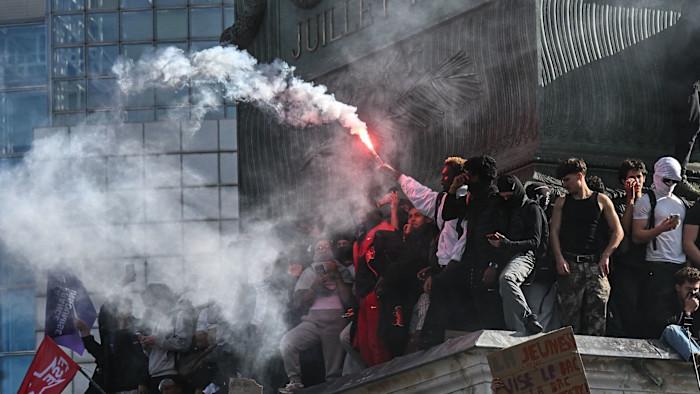
Submission Statement: Clouds of tear gas followed the arc of water cannons fired into the crowd in central Paris this week, as student strikes that shut hundreds of schools and led to thousands of arrests in recent weeks culminated in clashes between heavily armed police and protesters.
“Down with the cops, the state and the fascists!” the crowd, mostly young people, chanted on Thursday. “Too young to be listened to, but old enough to be tear-gassed,” read a sign carried by a young woman in a light purple headscarf.
French students are revolting against a school system they say is failing them, just as France faces a fiscal reckoning after years of lavish welfare spending. Students are demanding more teachers, better facilities and smaller classes, and an overhaul of how universities select their students, which they say is stressful and unjust.
The crisis is piling pressure on President Emmanuel Macron’s minority government as it is seeking to push through a belt-tightening budget while investors grow increasingly worried about France’s incapacity to reduce its public deficit. That means the government cannot turn to its usual method of calming protests — taking out the cheque book.
Rioters have burned schools and emergency service vehicles. Police suspended the use of stun grenades for the rest of the uprising after a 15-year-old’s hand was blown off in the northern town of Lens.
More than 7,000 people have been detained since the demonstrations began, according to the interior ministry. Hundreds of law enforcement officers have been injured, as have students and school staff.
Nationally, about 10 per cent of scheduled classroom hours go untaught largely because absent teachers are not replaced, according to the education ministry, an issue that has become a flashpoint for demonstrators.
A sharp decline in French maths and literacy scores in the OECD’s transnational Pisa study this year has fuelled the feeling that the public education system is broken.
Overall, education spending, from pre-school through university, has increased in recent years, albeit unevenly. According to statistics agency Insee, it rose nearly 14 per cent between 2010 and 2024, adjusted for inflation, from €173.3bn to €197.1bn.
A 2025 study from think-tank IPP shows that about 13 per cent of France’s national public education budget is actually accounting for contributions to teachers’ generous pensions. After stripping those out, France falls into the bottom quarter of OECD countries for spending per primary school student, the study said.
Posted by DifficultBarber6969
5 Comments
!ping EUROPE
Woah! This thing has gotten much bigger than I’ve expected initially. It seems there’s a generational fracture that’s happening across the world in both developed and developing countries that’s reaching a simmering point.
Holy fuck. Also “uprising” lol.
https://preview.redd.it/nwnv5t2plnuh1.jpeg?width=1440&format=pjpg&auto=webp&s=f8676a4cc4762bf54b033600e2661bfd23dab9f8
I have seen enough, double pensions.
> A sharp decline in French maths and literacy scores in the OECD’s transnational Pisa study this year has fuelled the feeling that the public education system is broken.
Funny how Pisa scores are declining worldwide with no uniform decrease in education funding.
I wonder if this is a recent effect of kids relying on AI, a lagging effect of the Covid remote classroom or even more lagging effect of kids just doing too much social media / screen time.