
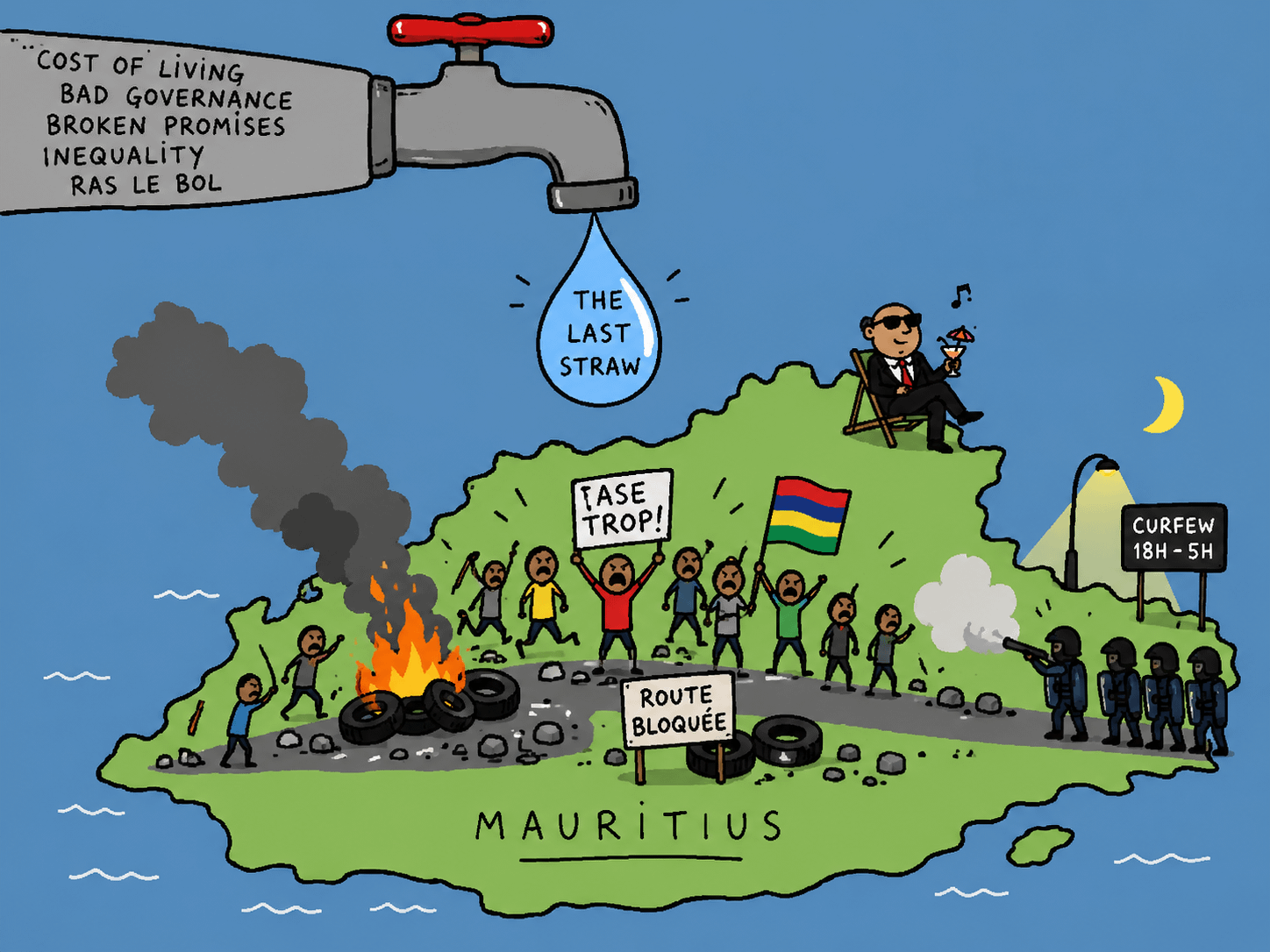
Most people know Mauritius as a peaceful tropical island. But things have taken a pretty dark turn here over the past week. I'm Mauritian, and I thought I'd share a timeline of what's happening in our country.
October 7–8: It starts with water.
Residents in several areas, take to the streets after days of water shortages. Roads are blocked, tyres are burned, and tensions rise between protesters and police.
October 9: A woman gets shot.
Élodie Thomas, a 27-year-old mother, is shot by a police officer while travelling home from work in a minibus. She wasn't there to protest. She was simply trying to get home. She's hospitalised in serious condition. The officer is subsequently arrested.
October 10–11: Public anger grows.
The incident shocks the country. Questions about police brutality and accountability dominate conversations. The Prime Minister promises there won't be a cover-up.
October 12–13: Things get out of hand.
Protests spread to different parts of the island. Roads are blocked, vehicles are burned, businesses are looted, and police stations and public infrastructure are attacked.
Schools close, examinations are postponed, and public transport is disrupted.
October 13: The government imposes a curfew.
Prime Minister Navin Ramgoolam announces an overnight curfew in 15 designated areas, including the capital.
October 14 (today): The curfew is extended.
The government announces two additional nights of curfew, now covering 17 areas.
Authorities report 94 arrests, including 16 minors.
The government also announces increased social media monitoring, discusses applying anti-terrorism legislation where applicable, and considers lowering the age at which minors can be detained and prosecuted.
I'm not defending the violence. People deserve to feel safe, and restoring order is necessary. But we have to ask questions and think.
The water issue was really just the last straw. People have been frustrated for a while now, with the rising cost of living, pension reforms, poor public services and so many other issues. The water shortage could be just what finally pushed people over the edge.
-
Crisis or opportunity? Could the government use genuine unrest to justify expanding police and surveillance powers? Interestingly, controversial National Crime Agency legislation was already being debated before all this happened.
-
A convenient distraction? A week ago, people were demanding water and answers about police accountability. Now we're discussing criminals, terrorism and curfews. Have the original problems been pushed aside?
-
Who is really behind the escalating violence? The government has alleged criminal involvement. Could organised groups be exploiting legitimate public anger for their own interests?
-
Testing public obedience? Could repeated localised curfews also show authorities how much restriction the population will tolerate?
-
The darkest possibility: What if certain actors deliberately encouraged the escalation, knowing that chaos would create public demand for stronger state control? There's no verified evidence of this, but it's a hypothesis worth examining rather than assuming.
Curious what people outside Mauritius think.
Have you seen similar patterns in your country?
Al Jazeera, 13 October Mauritius imposes curfew after night of unrest over police shootingLe Mauricien
Posted by TURNTHETIDE1
3 Comments
Wow I had absolutely no idea this was going on!! Thanks for sharing and be safe!
Yes all governments pull this crap to keep us distracted and they also want to test us to see how we will behave will we be the resistance or submit? I will always be the resistance until I pass on to the next realm.
From Aus have absolutely no idea this is happening! Stay safe and I pray that you guys are alright. I’d say Mauritius being a small country, a new lockdown and tightening of laws is being experimented to see how people react before they pass it on to the bigger countries