
When Similarweb posted an age breakdown of Meta’s Muse and SpaceXAI’s Grok Bot this week, Alexandr Wang, Meta’s Chief AI Officer and the executive whose vision for Muse shaped the product, quoted it on X with a single line: “muse gang, say hi to the boomers on grok bot.” The data behind the joke is narrower than the joke, since Similarweb said only that Muse “is much stronger among users aged 18–34, whereas Grok Bot leads by almost 10% in the 35–44 age group,” and the people in that 35-to-44 bracket were born between 1982 and 1991, which makes them millennials under Pew Research Center’s definition rather than baby boomers, a generation now in its 60s and 70s.
For anyone tracking which consumer AI agent is actually winning, the more useful reading of the chart runs in the opposite direction to Wang’s post. Muse makes most of its case to investors through shopping, and Meta plans to take a fee on the transactions it facilitates, so the age group that leans toward Grok Bot is also one of the groups whose spending Muse most needs to capture.
What Similarweb Measured About Muse and Grok Bot Users
Similarweb’s comparison of Muse and Grok Bot is a modelled estimate of each product’s audience by age, drawn from the analytics firm’s panel data rather than from Meta or SpaceXAI, so it shows which way each audience leans without telling anyone how many people sit in each bracket. That distinction matters here because the two products are nowhere near the same size. Mark Zuckerberg told investors on Meta’s third-quarter call that “more than 10 million people in the US and Canada have set up Muse personal agents” in about a month and a half, according to the earnings call transcript, while the most recent figure for Grok Bot is 418,000 users as of 14 September, taken from an internal company presentation reported by Bloomberg, according to Parameter.
Memeburn ran a rough scale check on those two numbers. Even if only one in ten Muse users were aged 35 to 44, which would be a lower share than either product’s lean suggests, Muse would have about one million people in the bracket Wang mocked, or roughly 2.4 times Grok Bot’s entire reported user base, although the two figures come from different dates and are measured in different ways.
Why Grok Bot Skews Older Than Meta’s Muse
Grok Bot’s older audience is easier to explain by what the product does and how it is sold than by any difference in taste. SpaceXAI built Grok Bot as an AI teammate that signs into a user’s work tools and is part of the company’s enterprise push, and at launch it was available only to subscribers on top-tier SuperGrok and Cursor plans, according to Constellation Research. Muse, by contrast, is a consumer agent for personal and small-business errands with a free tier that Meta says covers most everyday use, as Memeburn’s comparison of OpenAI Dots, Muse and Grok Bot set out, so a paid tool aimed at people in the middle of their careers would be expected to draw an older crowd than a free app that runs errands.
Meta MuseSpaceXAI Grok BotLaunch8 September 2026 in the US, later CanadaBeta from 11 August 2026Built forPersonal and small-business errandsWork tasks across a user’s toolsPriceFree tier, plus Power (20amonth)andMaximum(100 a month)Paid SuperGrok and Cursor plans onlyReported usersMore than 10 million set up (Meta, 21 October)418,000 (internal presentation, 14 September)Similarweb age leanStronger at 18 to 34Leads at 35 to 44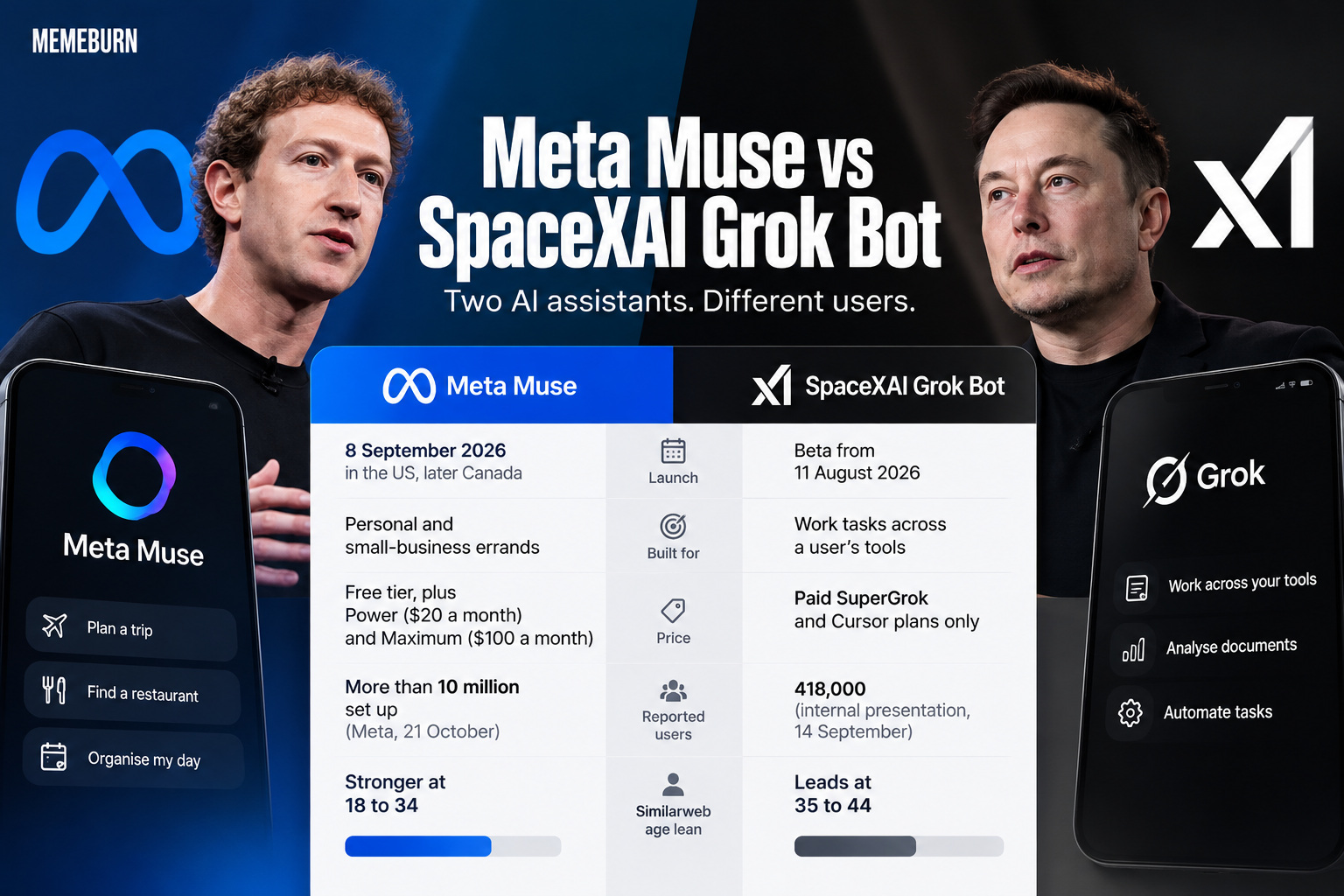 Muse’s 10 Million Users Are Mostly There to Shop
Shopping is the activity that turns Muse’s audience into revenue, and Zuckerberg called it “the most common use case,” with “more than 25% of people who are using Muse engaging in this with an average purchase size of over $200.” Chief financial officer Susan Li put the same share against Muse’s weekly actives rather than everyone who has set it up, and Zuckerberg said Meta will “build commerce tools so we get paid a fee based on the transactions that we help facilitate,” a plan Memeburn looked at against Meta’s cash flow in why Muse could still win the agent war.
The usage numbers are strong for a product that is barely two months old. Muse reached 10 million US downloads within 40 days, a pace only 11 other apps have matched since Sensor Tower started tracking in 2015, and it kept 30% of users after seven days and 23% after 14, according to 9to5Mac. The weak point is where those purchases can happen, since banks and retailers can still refuse agent traffic, as JPMorgan’s move against agents like Muse showed earlier this month.
What a Transaction Fee Is Worth in Each Age Group
Households headed by someone aged 35 to 44 spent an average of $91,229 in 2024, compared with $74,475 for households headed by 25-to-34-year-olds and $47,283 for those under 25, according to US Bureau of Labor Statistics data published through FRED. Only households aged 45 to 54 spent more, at $100,327.
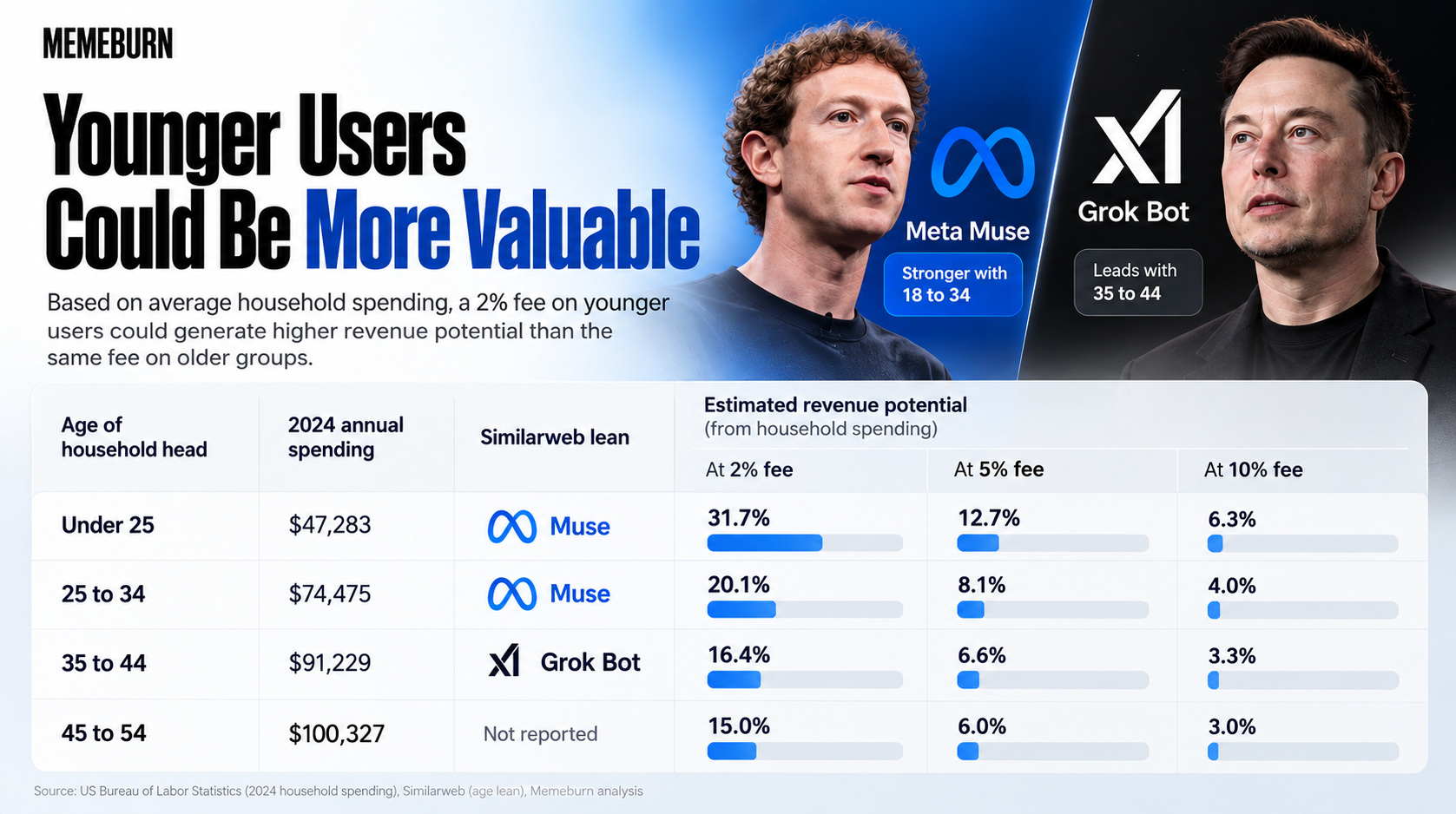
Meta has not disclosed its fee rate, so Memeburn tested three hypothetical rates against a target of $300 a year per user, the low end of the “several hundred dollars” Zuckerberg cited as the annual revenue Meta’s existing apps already earn from Muse users. At each rate, the table shows the share of a household’s total annual spending that would have to pass through Muse.
Age of household head2024 annual spendingSimilarweb leanAt 2% feeAt 5% feeAt 10% feeUnder 25$47,283Muse31.7%12.7%6.3%25 to 34$74,475Muse20.1%8.1%4.0%35 to 44$91,229Grok Bot16.4%6.6%3.3%45 to 54$100,327Not reported15.0%6.0%3.0%
Total spending includes rent, healthcare and other bills an agent will rarely touch, so the shares are best read against each other rather than as realistic targets.
Wang Is Mocking the Age Group Muse Most Needs
Memeburn’s reading of the Similarweb split is that Alexandr Wang is cheering the wrong cohort, because Muse is meant to earn a cut of each purchase, and households in the 35-to-44 bracket that leans toward Grok Bot spend about 22% more a year than those headed by 25-to-34-year-olds and almost twice as much as those under 25. At a 5% fee, Memeburn calculated that $300 a year would take 30 purchases of $200, which is 6.6% of a 35-to-44 household’s spending but 12.7% of an under-25 household’s, so the younger Muse’s audience stays, the harder each user has to shop to match what Meta already earns from them through ads. Memeburn expects the age gap Similarweb measured to narrow by mid-2027 as Muse spreads beyond its own app into WhatsApp and onto Meta Glasses, which Zuckerberg said will get Muse next month, and if it has not narrowed by then, Muse will look more like a young-adult habit than the household shopping agent Meta is pitching. The call has a clear limit, since Similarweb’s figures are modelled estimates and part of Grok Bot’s older lean simply reflects a paid product for people at work.
FAQsWhat did Alexandr Wang say about Grok Bot?
Alexandr Wang, Meta’s Chief AI Officer, quoted a Similarweb chart on X comparing the ages of Muse and Grok Bot users and wrote “muse gang, say hi to the boomers on grok bot,” referring to Grok Bot’s lead among users aged 35 to 44.
Which age group uses Meta’s Muse most?
Similarweb said Muse is much stronger than Grok Bot among users aged 18 to 34, while Grok Bot leads by almost 10% in the 35-to-44 group, although the firm’s post did not give Muse’s full age distribution.
How many users does Meta’s Muse have?
Mark Zuckerberg said on Meta’s third-quarter 2026 earnings call that more than 10 million people in the US and Canada had set up Muse personal agents in about a month and a half, and that about 25% of them use it on any given day.
Is Grok Bot free?
Grok Bot has no free tier, as SpaceXAI sells it only inside paid SuperGrok and Cursor subscriptions, whereas Meta’s Muse has a free tier alongside paid plans at $20 and $100 a month.
Marko is a tech journalist covering AI, consumer technology, crypto, and digital innovation. His work focuses on clear, accessible reporting that helps readers understand how new technologies are shaping business, finance, and everyday life.