
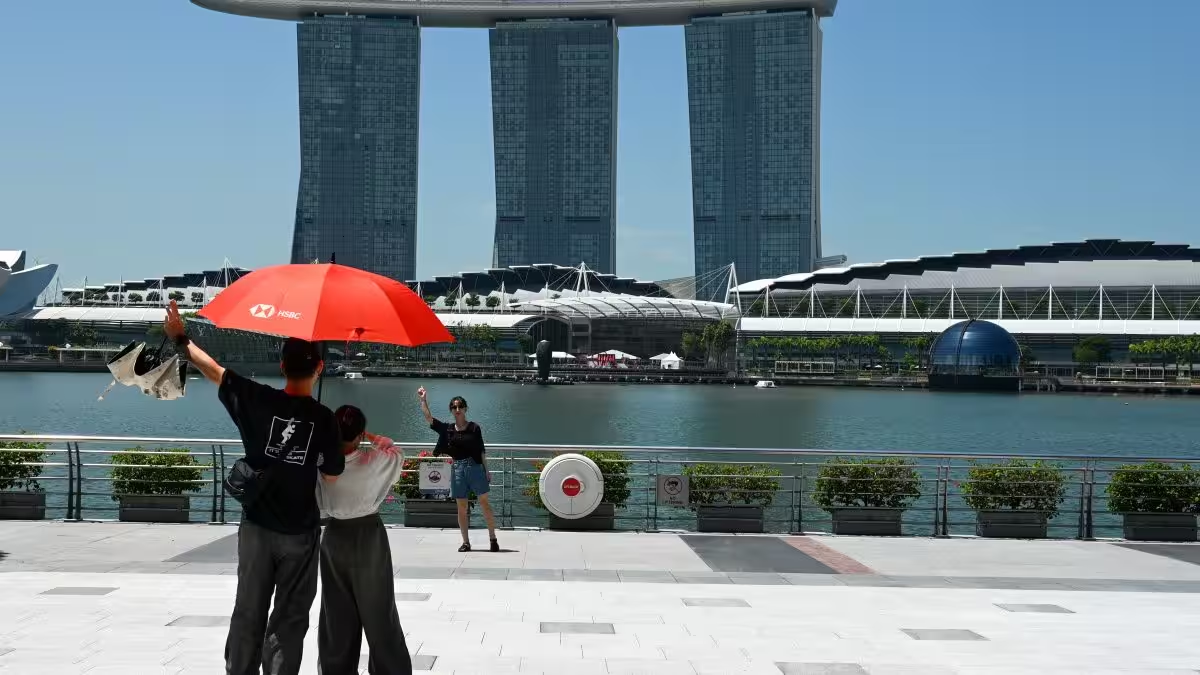
The former chief technology officer of US cryptocurrency exchange Coinbase explains why he left the United States for Singapore, arguing that the city-state offers a more innovation-friendly environment as the global technology landscape undergoes a major shift
Indian-American tech entrepreneur and investor Balaji Srinivasan, who quit the US citizenship to become a Singaporean national, has raised several questions as to why some successful immigrants are leaving America. Srinivasan explains why he moved from the United States to Singapore, saying the decision was driven by his belief that the Asian city-state offered a more favourable environment for technology, entrepreneurship and innovation — and also by the racial discriminatory experiences he faced as an Indian-origin immigrant in America.
In a post titled “Why did WSJ Stu Woo follow me to Singapore”, Srinivasan argued that the centre of global technological progress was shifting away from traditional Western hubs and towards countries that were more open to rapid innovation and digital transformation.
Srinivasan, a former chief technology officer at Coinbase and former general partner at Andreessen Horowitz, said he chose Singapore because of its reputation for stability, efficient governance, business-friendly policies and strong focus on technology.
Why Srinivasan says America’s innovation edge is slipping
Srinivasan has been openly critical of parts of the US technology ecosystem, arguing that some areas of American society have become less welcoming towards ambitious technological projects.
Earlier, after moving to Singapore, he said entrepreneurs no longer needed to relocate to the US to build major companies, arguing that countries such as India and Singapore were becoming increasingly attractive destinations for technology-led growth.
 More from World
He has also criticised what he views as excessive bureaucracy, cultural resistance to innovation and declining confidence in America’s technology ecosystem.
From facing racism as a child to finding belonging in Singapore
For Srinivasan, the decision to leave the US was not only about politics, technology or economics. It was also tied to his experience as an Indian-origin immigrant growing up in America.
The tech entrepreneur, whose parents migrated from Tamil Nadu and were physicians in the US, recalled being bullied as a child for being the “lone brown kid” in school. He said those experiences shaped his belief that minorities often have to fight to be accepted and defend their place in society.
In defending his decision to become a Singaporean citizen, Srinivasan highlighted the country’s multicultural identity and its recognition of his Indian heritage. He pointed specifically to Tamil being one of Singapore’s official languages and the presence of Hindu temples where he could practise his faith freely.
“Singapore honors Tamil as an official language, hosts Hindu temples where we can worship, has many people of Indian origin,” Srinivasan said, arguing that Indian-origin citizens there were treated as full members of society rather than facing persistent racial hostility.
His comments reflect a broader concern he has raised about the challenges faced by immigrants and minorities in parts of the West. Srinivasan argued that rising political polarisation in the US—from anti-immigrant rhetoric on the far right to hostility towards technologists on the far left—had created an environment where many people were looking for alternatives.
The former Coinbase chief technology officer said his move represented a choice to live in a country he believed better aligned with his values of meritocracy and social stability. “I voted with my feet,” he said, describing his relocation as a personal choice rather than a rejection of his American upbringing.
Srinivasan’s argument is part of his larger “Network State” philosophy, which advocates for people forming communities around shared values and eventually creating new societies.
The Lion City pull
According to Srinivasan, Singapore’s appeal lies in its combination of economic freedom, infrastructure, public safety and government support for emerging technologies.
The city-state has positioned itself as a global hub for finance, artificial intelligence, blockchain and biotechnology, areas that align with Srinivasan’s interests.
He has also promoted ideas around “network states”—communities built around technology, entrepreneurship and shared values—and has used Singapore as a base for experimenting with new models of education and innovation.
A broader shift among tech leaders
Srinivasan’s move has added to a larger conversation in Silicon Valley about where the next wave of breakthrough technology companies will be built and whether the future of innovation will continue to be led by the US.
While the US remains home to many of the world’s largest technology firms, some entrepreneurs have increasingly explored locations in Asia and other regions, citing lower regulatory barriers and faster adoption of new technologies.
Singapore’s growing influence among global investors and founders has made it a popular destination for technology entrepreneurs seeking a more predictable business environment.
For Srinivasan, the move was not simply a relocation but part of a broader argument that the future of innovation may be increasingly global, with cities like Singapore competing with traditional technology centres such as Silicon Valley.