
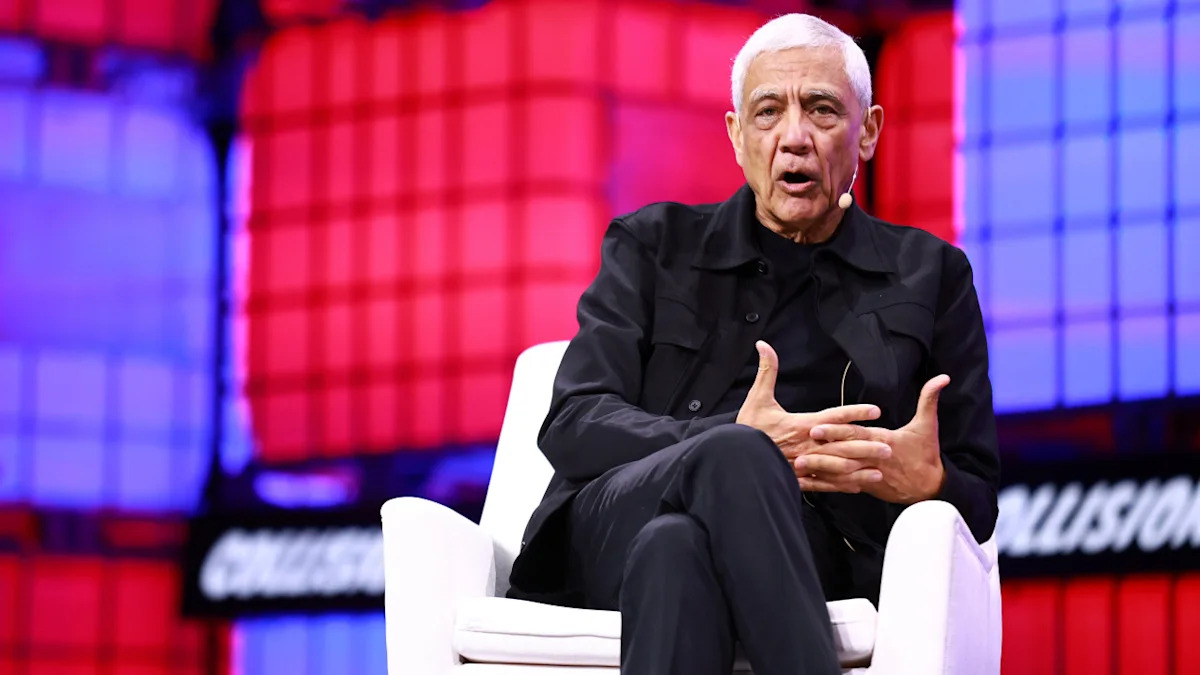
 Vaughn Ridley/Sportsfile for Collision via Getty Images
Billionaire entrepreneur and investor Vinod Khosla has found himself in the middle of a public dispute at AI startup Factory, taking exception to the company’s claim that it terminated a board adviser over his dealings with a rival.
Factory CEO Matan Grinberg took to X on Sept. 30 to announce that board observer and adviser Chris Degnan had been terminated for “unethical conduct involving Cognition,” a rival AI company. Degnan is a longtime tech executive who previously served as chief revenue officer at cloud data company Snowflake before retiring in March 2025.
Must Read
Grinberg alleged that Degnan was advising his company while secretly having recurring discussions with its biggest competitor, which Grinberg found unacceptable.
Degnan immediately disputed Grinberg’s interpretation of events, saying he was not terminated but had “resigned” from his adviser role and was joining Cognition. “In response, you asked me to consider a full time role at Factory. I told you I wasn’t interested,” Degnan said.
Khosla, who ironically is an investor in both Factory and Cognition, then defended Degnan, accusing Grinberg of lying about the circumstances of Degnan’s departure.
“You are a struggling second tier competitor that is more unethical and lying just because you have no decency or sense of proper behavior and shows your desperation,” Khosla wrote in response to Grinberg’s post. “Straight out lying about if Chris being fired I thought would be below even you.”
Although the public spat veered into personal accusations about integrity, it goes well beyond how Degnan left Factory, exposing a fierce competition among AI companies for talent.
Talent, poaching and a battle for market share
On the surface, it’s easy to see why Khosla, who built his fortune through Sun Microsystems and a highly successful career in venture capital, would be interested in both Factory and Cognition.
Both companies are competing in the fast-growing market for AI coding agents, which are taking on a larger role in software development.
Factory, whose enterprise software platform is built around its autonomous “Droids” coding agents, raised $200 million in September in a round co-led by Khosla Ventures. The funding valued Factory at $5 billion, more than triple its $1.5 billion valuation in April, when Khosla Ventures also backed the company’s $150 million Series C round.
Story Continues
Meanwhile, Cognition is best known for its “Devin” coding agent, which is designed to automate software development tasks. The company raised $2 billion in September at a $48 billion valuation and said it had reached a nearly $900 million revenue run rate.
The growing rivalry between the two companies is arguably at the heart of Grinberg’s accusations. His gripe with Degnan quickly widened into claims that Cognition was trying to obtain information about Factory, including by conducting “feigned interviews with us to pry information about our product.” He also claimed that Cognition “has fallen behind us on the capabilities that matter most to customers: cost, quality and security.”
Cognition CEO Scott Wu publicly responded to Grinburg’s allegations, saying his company had “no interest in Factory’s info” and that Degnan had never shared information about the company. He acknowledged that both companies wanted Degnan, calling him a “living legend with an unmatched reputation for results and integrity.”
Why the AI agent market is worth fighting over
The public spat involving Factory and Cognition comes as venture capital investors pour billions into companies building AI agents, betting that autonomous software could reshape the much larger enterprise software market.
Data from Crunchbase shows that more than 1,100 companies classified as agentic AI startups have raised $212.3 billion in total funding, though the figure includes companies with broader AI businesses, not just pure-play agentic AI. Meanwhile, New Market Pitch found that 99 leading agentic AI startups had collectively raised $25.3 billion as of September.
Part of the appeal is that AI agents can perform tasks that businesses currently use traditional software to handle, potentially reducing the need for recurring software subscriptions. The perceived threat helped fuel the so-called “SaaSpocalypse,” or the sharp selloff in software stocks this year as investors reassessed their valuations amid the rise of AI.
Forbes estimated that roughly $300 billion was wiped from SaaS and other software-related companies during the height of the selloff in February, while Reuters pegged the losses in the overall software sector at “about $1 trillion” between January 28 and February 5.
The decline continued well beyond February and wasn’t limited to SaaS names. Between January and early April, the S&P 500 Software Services Index fell more than 25%, according to Reuters.
The potential impact goes well beyond software development. Boston Consulting Group said early adopters are already using AI agents for everything from marketing and sales to customer service and research and development.
These use cases help explain just how large the market could become. In August, the World Economic Forum cited industry estimates that the agentic AI market could reach $236 billion by 2034, up from just $5.4 billion in 2024.
What To Read Next
Join 250,000+ readers and get Moneywise’s best stories and exclusive interviews first — clear insights curated and delivered weekly. Subscribe now.
This article originally appeared on Moneywise.com under the title: ‘You have no decency’: Billionaire Vinod Khosla just called a $5B AI startup ‘unethical,’ even though he’s an investor
This article provides information only and should not be construed as advice. It is provided without warranty of any kind.