
Credit: R&D World, from Anthropic’s R&D Automation Index
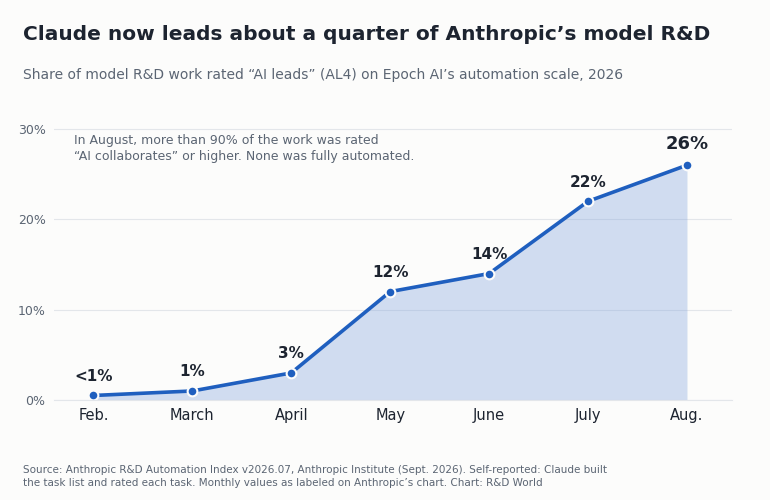
Anthropic uses Claude to run experiments, prepare training data and test the models that will succeed it. After spending nearly $28 billion on R&D since the start of 2024, the company says AI could soon double the pace of its model development.
In its November 2 amended IPO prospectus, Anthropic says its internal estimates and expectations for future models indicate that “we may imminently meet” its threshold for dramatically accelerated progress attributable to AI. Its Responsible Scaling Policy defines that as roughly two years of baseline progress in one year. The company is still assessing whether its models have crossed that threshold.
Claude already writes and reviews code, automates evaluations and safety audits, and helps researchers build the next generation of models. Anthropic calls this “closing the loop.” Measured at list prices, the value of its internal model use grew more than 250-fold from January to September 2026, according to the filing.
Credit: R&D World, from Anthropic’s S-1 and amended S-1 filings
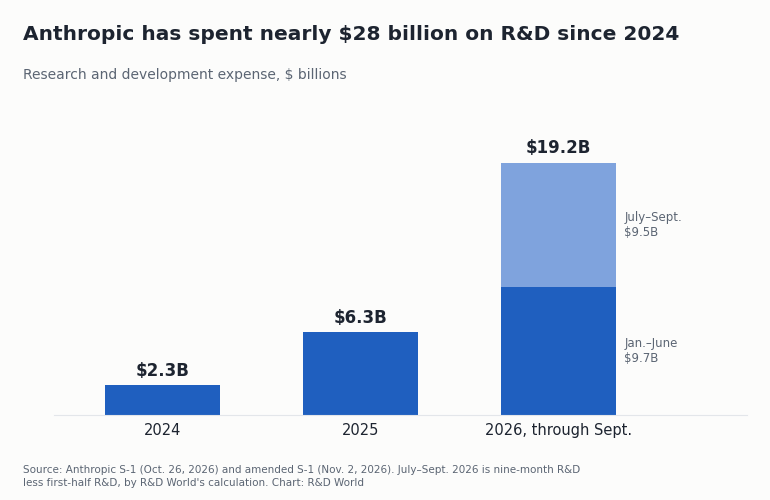
Anthropic spent $2.3 billion on R&D in 2024, $6.3 billion in 2025 and $19.2 billion in the first nine months of 2026. About $9.5 billion of the 2026 spending came in the third quarter alone.
How close is recursive self-improvement?
In an October 3 interview with MTS, Vals AI co-founder and CEO Rayan Krishnan predicted that Anthropic could reach full recursive self-improvement around July or August 2027, based on tasks in his company’s RSI Index. “It means that the work required by machine learning engineers at Anthropic would be automated,” he said. Krishnan acknowledged that chip design and other constraints could limit further acceleration.
Thinking Machines chief scientist John Schulman raised a specific obstacle in a September 11 discussion on the Dwarkesh Podcast: models still struggle to judge their work and check it. “Even if the model can write way more code than a person, it doesn’t make you 100X more productive,” he said.
Anthropic insiders and researchers at other frontier labs have pointed to mounting signs that the threshold for recursive self-improvement is near. In mid-October, Anthropic co-founder Jack Clark wrote that he now thinks full RSI is more likely to become possible in 2027 than in 2028, pulling his earlier estimate forward. Alignment Science Lead Evan Hubinger has said the process is “happening faster than we thought.” Most of the roughly half-dozen researchers inside top AI companies whom Gladstone AI interviewed for an October report expect RSI to start within the next 3 to 12 months, “and possibly sooner, assuming there’s no U.S. government intervention or slowdown.” Google CEO Sundar Pichai said in an October Big Technology interview that Google runs “RSI loops along with AI researchers in various aspects of model development,” while “we are pretty far from the end state of RSI.” Anthropic has not yet designated any current model as having crossed its Responsible Scaling Policy threshold, but the internal signals it has published and the public comments of its own people point in the same direction.
Amodei has called for a slower pace
In his September essay “We Must Pace the Frontier,” Anthropic CEO Dario Amodei wrote: “We must slow the pace at which we improve the capabilities of AI models,” arguing that safeguards needed time to catch up with AI-assisted development.
Amodei proposed outside evaluators with continuing access to frontier labs and coordinated limits on capability advances. Possible controls included limits on companies’ internal use of AI to improve AI. Anthropic committed to embedded evaluators; the broader pacing proposals require cooperation from other companies and governments.
The prospectus describes the competitive cost: “These measures could slow our capability gains relative to competitors that do not adopt similar constraints.” It also warns that AI-assisted research could advance model capabilities faster than Anthropic can develop and validate safeguards.
Anthropic expects human supervision and understanding to remain necessary even if Claude becomes technically capable of building successive frontier models independently. It is considering policy changes to keep people in control of that development.