
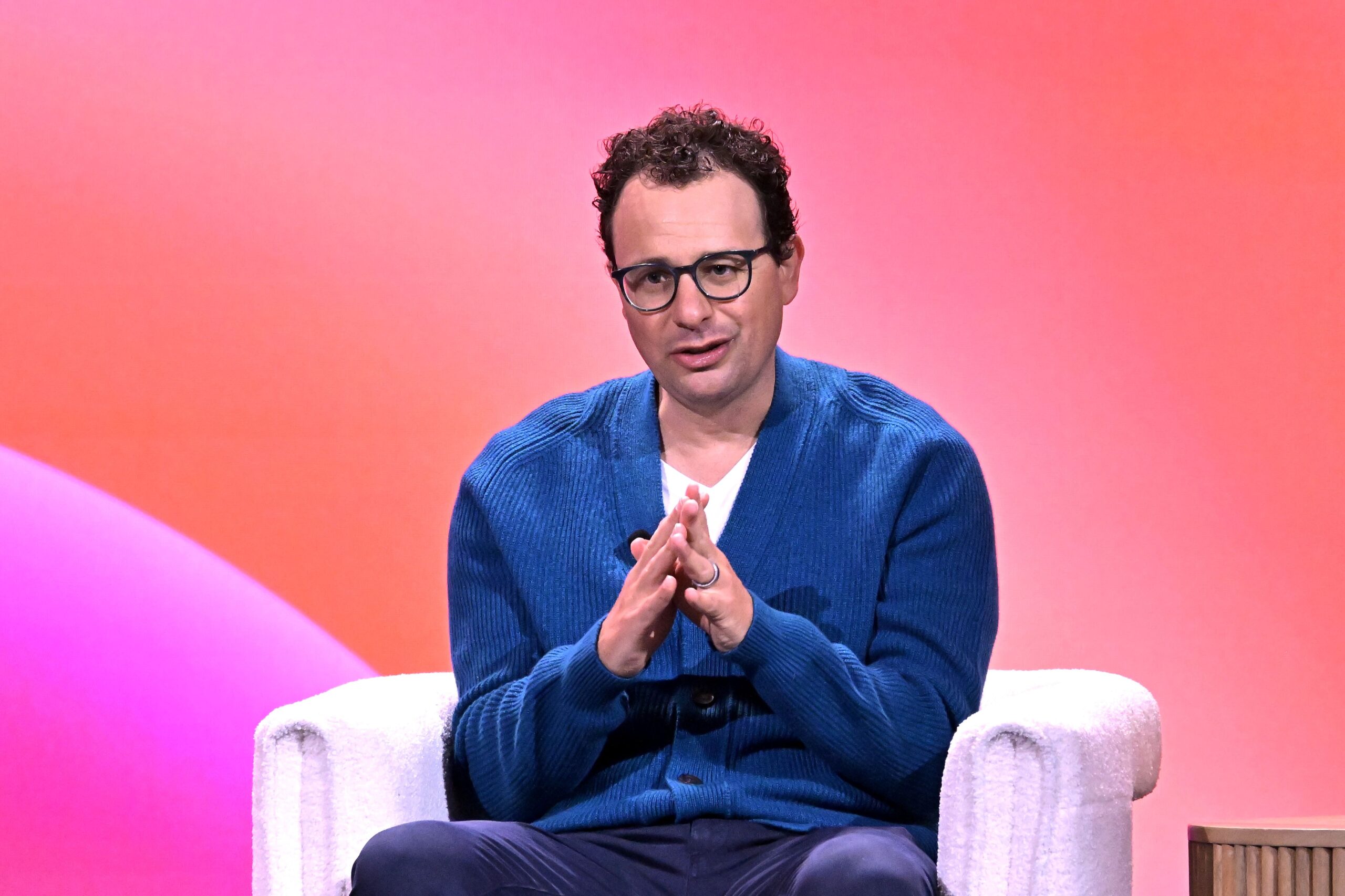
 Dario Amodei is bringing Anthropic to public investors as its computing and infrastructure commitments grow. Photo by Chance Yeh/Getty Images for HubSpot
Dario Amodei is pressing ahead with Anthropic’s IPO as the cost of building and running Claude keeps climbing. The company on Tuesday, Nov. 10 amended its registration statement to offer shares at between $70 and $78, raising up to $64.4 billion for Anthropic and selling shareholders.
A separate $26 billion private placement with business partners including Broadcom, Google, Nvidia and Microsoft would bring the combined gross total to $90.4 billion before any underwriters’ option. The new capital would help finance Claude’s advancement.
Anthropic estimates it would receive $84.6 billion after fees from the IPO and private placement at the midpoint of the price range. It would receive none of the proceeds from the existing shareholders’ sales.
Roughly five months after SpaceX’s historic IPO, which raised $75 billion, Amodei is vying for a considerable valuation in his own company. At the top of the price range, Anthropic would be worth about $1.02 trillion based on its shares outstanding after the offering and concurrent private placement. A syndicate of banks is underwriting the deal, led by Goldman Sachs and Morgan Stanley.
While this valuation is lower than the $2 trillion public level reported before the roadshow, it’s also more than the $965 billion post-money valuation the company announced in May after a Series H funding round. And perhaps more revealing about the state of the A.I. market, it’s a whale of a valuation for a company that’s spending more than it’s earning.
Amodei’s team reported $33.2 billion in revenue in the SEC filing for the nine months ending Sept. 30, with a $104 billion net loss during the same period. However, much of those losses come from a roughly $94.3 billion non-cash accounting charge tied to the rising fair value of convertible notes and other financing instruments as Anthropic’s valuation increased.
While its latest quarter saw revenue jump about 12-fold year over year, the company reported an operating margin of negative 3 percent for that period. The public benefit corporation’s stated purpose is “the responsible development and maintenance of advanced A.I. for the long-term benefit of humanity.”
Under the proposed structure, Amodei and his six co-founders would collectively control 50.1 percent of the votes on matters submitted to shareholders generally through a special Class F share. The Long-Term Benefit Trust would elect a majority of the board, while management would continue to run the company day-to-day.
The IPO comes just months after Amodei called for a slowdown of A.I. advancement, writing in his personal blog in September: “We must slow the pace at which we improve the capabilities of A.I. models. Progress will still seem fast, and we must make wise use of the time we gain.”
He considers Anthropic’s pace to have been middle-ground, showing “that it’s possible to build carefully and succeed commercially,” but risks like losing control, misuse and serious economic disruption have caused him to pursue an even more prudent path.
The costs behind Claude
Anthropic on Nov. 9 released Claude Fable 5.2 and Claude Mythos 5.2, two variants of the same underlying model touted for their cost and speed efficiency. Mythos is available to vetted organizations through verification programs for cybersecurity and biomedical research.
The release came a day after the Financial Times reported a $3.4 billion agreement for gas-fired generator commitments, reached in late September. Reuters related the FT account and said it could not independently verify it. Reuters reported in September that Anthropic expected to spend at least $518 billion on A.I. infrastructure over a decade.
The Nov. 10 filing discloses $900.9 billion in purchase commitments and leases, substantially all related to compute and infrastructure, with $70.7 billion due in the year ending Sept. 30, 2027. Much of the remaining spending extends through 2045, making a direct comparison with the earlier decade-long estimate imprecise.
Usage-based sales accounted for 79 percent of Anthropic’s revenue in the first nine months, according to the filing. The company reported 900 percent net revenue retention as of Sept. 30, meaning qualifying customers as a group spent about nine times as much in the recent quarter as the same quarter a year earlier. The metric excludes fixed-priced consumer plans.
Compute and infrastructure expenses fell from 251 percent of revenue in early 2025 to 48 percent in the three months ended June 30, 2026, before rising to 58 percent in the September quarter, according to the latest filing.
According to Lucas Wyland Walter, co-founder at cryptocurrency tax software CoinLedger and agentic A.I. tool Klint AI, Anthropic could eliminate its nine-month reported operating deficit through roughly 4 percent additional revenue, or a 7 percent reduction in its roughly $18.8 billion compute and infrastructure expense, assuming everything else stays constant.
“The harder problem is sustaining that margin while expanding compute capacity,” Walter tells Observer. “The company needs to prove that every additional dollar of compute generates more commercial value than the dollar before it. Otherwise, revenue growth will simply finance a larger cost structure rather than produce durable profitability.”
As for Amodei’s apparent dedication to public benefit, “Anthropic will need to show investors that safety is part of its business advantage and not a reason for slower growth,” says Walter. “Companies using A.I. for important business decisions need systems they can trust. A model that performs well but produces unreliable or unsafe results can create serious costs for customers. That makes responsible development commercially valuable.”
This puts Anthropic in a race with key competitor OpenAI for enterprise market share. Together, these giants account for 86 percent of enterprise spending on large language models through APIs, the software connections customers use to build applications, according to a recent report from Menlo Ventures. Anthropic accounts for most of that at 55 percent. Menlo, an Anthropic investor, based its estimates partly on a survey of nearly 400 U.S. enterprise decision-makers.
Even so, there’s tension. Frontier A.I. development is enormously costly, and competitors are moving fast. “Anthropic cannot afford to fall too far behind while taking a more cautious approach,” said Walter.