
Key Takeaways
Investor Patrick O’Shaughnessy said he heard secondhand that Larry Page, co-founder of Google and its parent Alphabet, expects 99.999% of compute to end up in orbit, and Elon Musk called it one of Page’s many accurate predictions.
Andreessen Horowitz’s Martin Casado says the reason is regulation, so each new local data center ban makes SpaceX’s case for compute in space stronger.
Analysts expect SpaceX revenue of $335 billion in fiscal 2028, almost all of it from compute rented out on the ground, and SpaceX’s capex reached $19.6 billion in the third quarter.
Orbital compute is years away from earning real revenue, but the squeeze on ground data centers already helps the capacity SpaceX runs today, and Starship’s Nov. 13 flight is the next test.
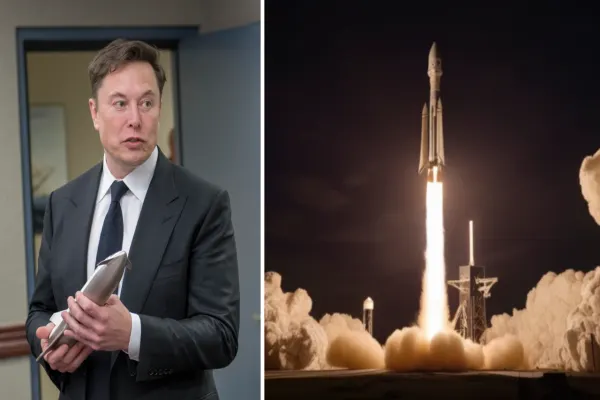
SpaceX (SPCX) has an unlikely new supporter for its plan to put AI data centers in space: Larry Page, co-founder of Google and its parent, Alphabet (GOOG).
On a recent episode of the Invest Like the Best podcast, host Patrick O’Shaughnessy repeated something he’d heard secondhand: “Someone asked Larry Page how much of compute will be orbital, and he said five-nines.”
That’s 99.999%.
Elon Musk’s response on X? “Larry Page has made many accurate predictions and this is one of them.”
Alrighty then.
TIKR tracks 40 analysts on SpaceX. How many say “Buy”?
See the full breakdown of Buy, Hold, and Sell ratings on SpaceX, along with Wall Street’s revenue and earnings estimates, all in one place. More than 500,000 investors use TIKR to research stocks like this one. See SpaceX’s Analyst Ratings
Follow the bills
On the same episode, Martin Casado, a partner at Andreessen Horowitz, explained why it might happen: “It’s just basically regulatory.” He thinks there are 500 proposed bills to stop data center building in the US, Texas included.
Musk argues something else. He has predicted that “the lowest cost place to put AI will be space. And that’ll be true within two years, maybe three at the latest.” His reasoning is physics: solar panels pointed at the sun and radiators pointed away from it give cheap power and cooling.
Casado’s case works even if that math never does. If towns and states keep blocking new data centers, the compute has to go somewhere, and SpaceX owns the rockets. Musk already said data centers in space looked “pretty appealing right now” after Democrats swept Congress last week.
Five-nines isn’t in anyone’s numbers yet
Musk has also put a price on orbital compute: 100 gigawatts a year of orbital AI compute at $10 per watt would add $1 trillion of annual revenue each year, and it would stack up because the satellites keep running.
That’s a lot of gigawatts. SpaceX had about 2.2 gigawatts of compute running at the end of October. Musk’s math needs about 45 times that much launched every single year.
Analysts’ revenue estimates for SpaceX come nowhere near that:
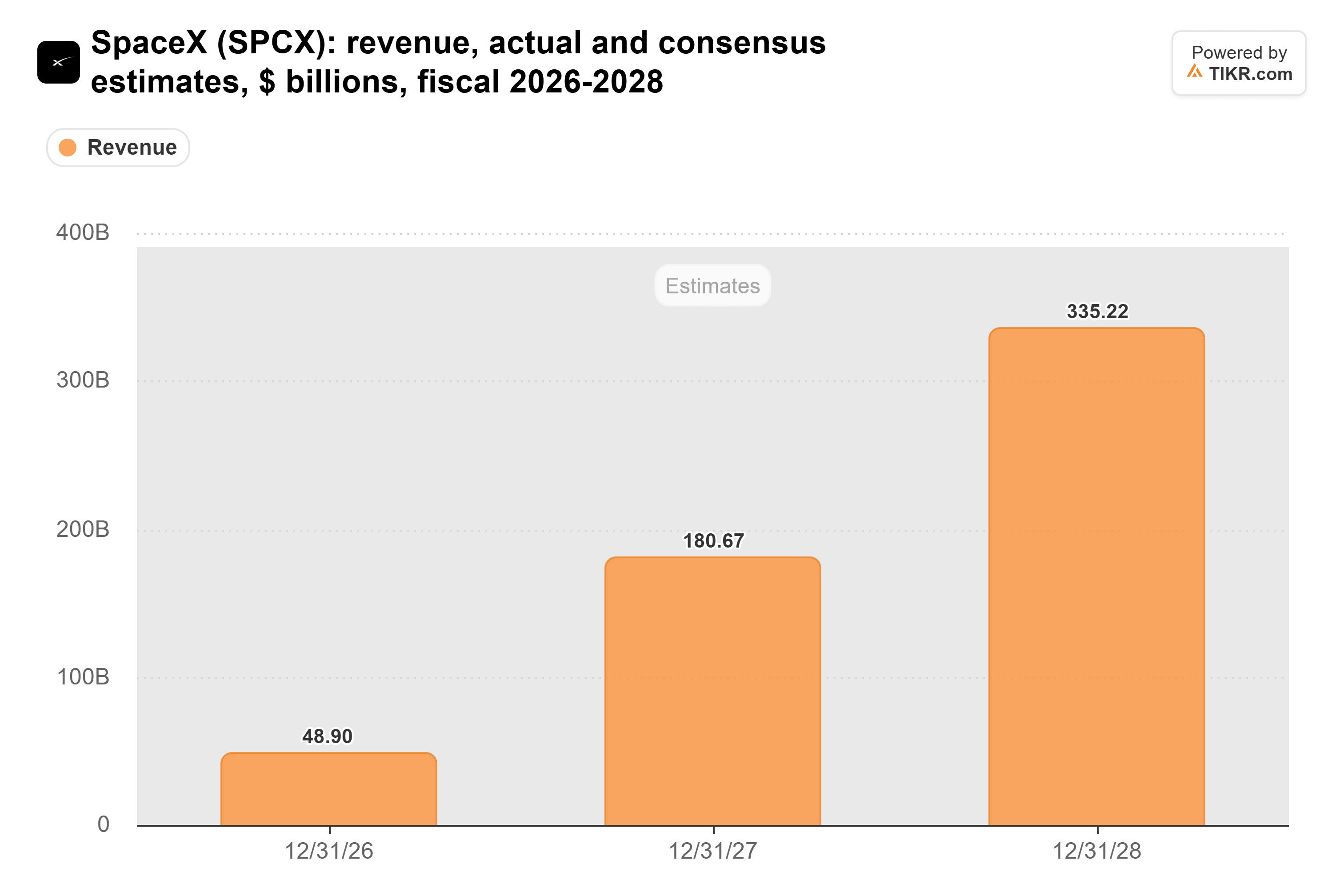 SpaceX (SPCX): revenue, actual and consensus estimates, $ billions, fiscal 2026-2028 (TIKR)
Even the $335 billion estimate for fiscal 2028 is about a third of one year of Musk’s orbital trillion. The growth in those estimates comes from renting out compute on the ground. That business nearly tripled SpaceX’s Super Intelligence revenue in a single quarter, to $7.56 billion in the third quarter from $2.56 billion in the second.
SpaceX is still building on the ground
Of course, the Page quote is secondhand, and SpaceX is spending like a company that expects its data centers to stay on Earth for a while. The Super Intelligence segment, which holds the data centers, took $40.0 billion of the $48.1 billion SpaceX spent on capex in the first nine months of 2026.
SpaceX’s quarterly capex has climbed fast:
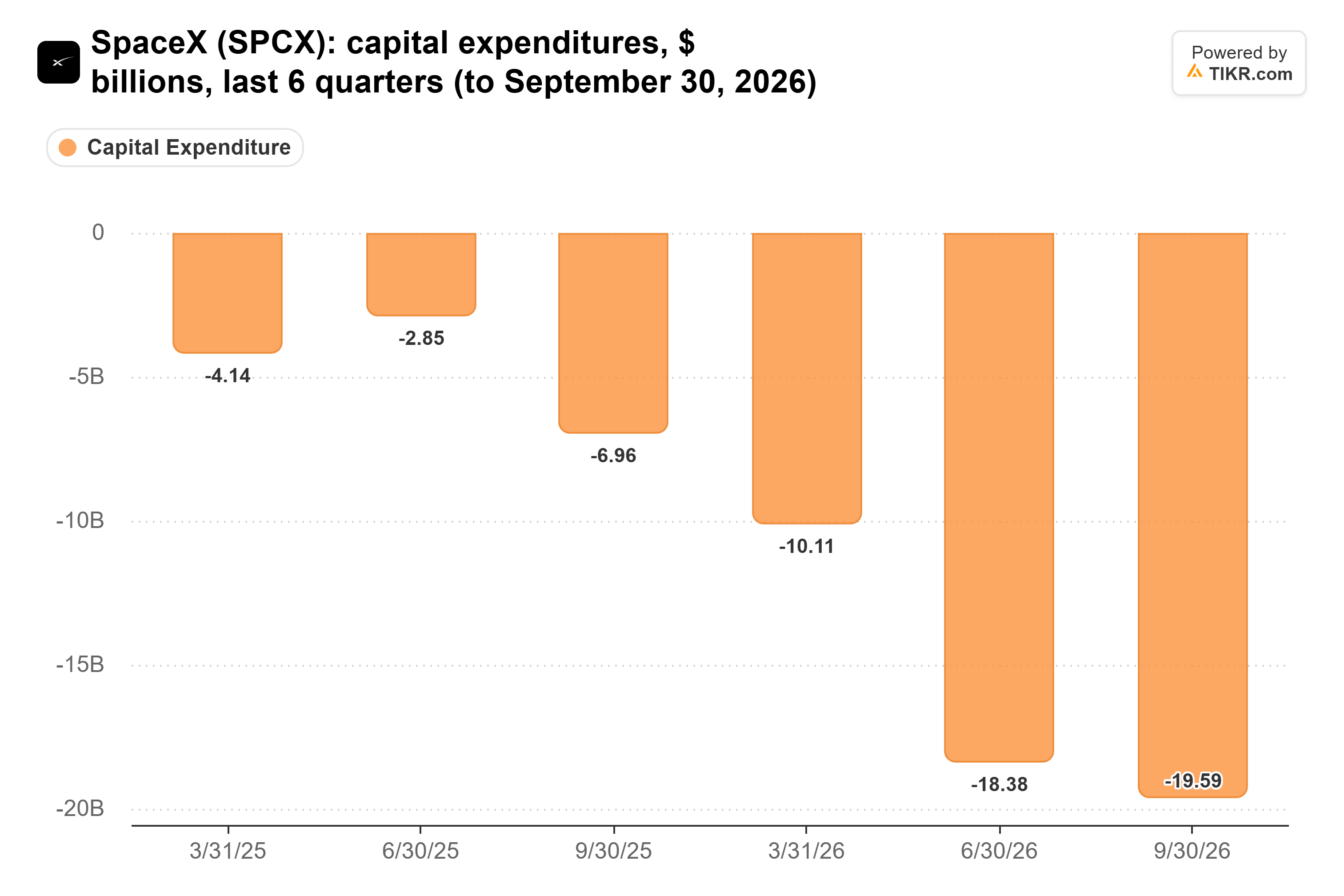 SpaceX (SPCX): capital expenditures, $ billions, last 6 quarters (to September 30, 2026) (TIKR)
Management expects fourth-quarter capex of $35 billion to $40 billion, nearly double the third quarter’s $19.6 billion.
Page’s own company is doing the same thing. Alphabet’s capex nearly quadrupled from 2021 to 2025:
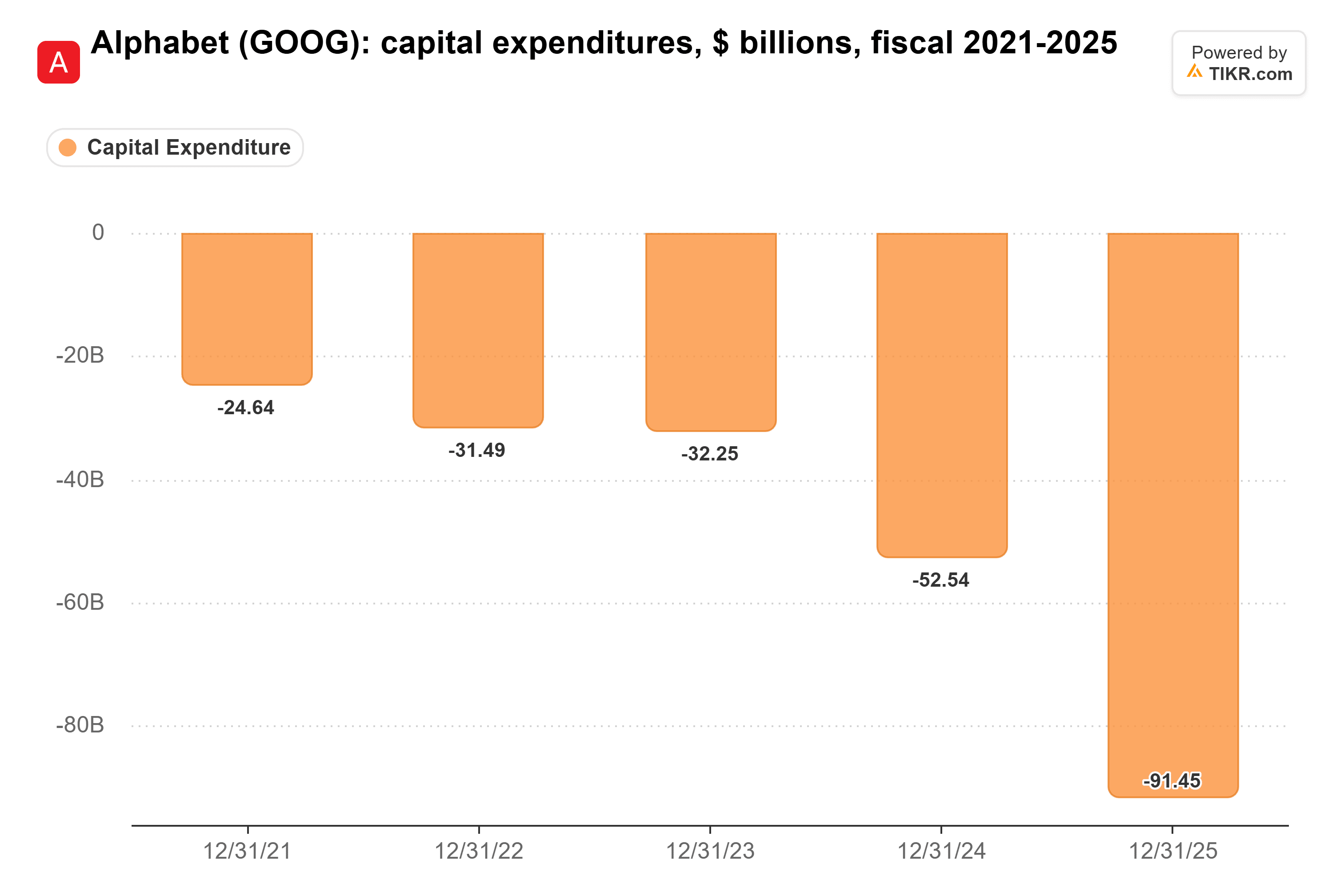 Alphabet (GOOG): capital expenditures, $ billions, fiscal 2021-2025 (TIKR)
Page may still be right about where compute ends up. But for the next few years, it’s getting built on the ground.
Every ban helps SpaceX twice
Plus, the squeeze Casado describes helps SpaceX long before any data center reaches orbit. Musk admitted on X that “If compute becomes plentiful and cheap, SpaceX revenue will drop.”
Local bans push the other way. Each blocked project keeps compute scarce, and SpaceX expects to have 2.5 to 3 gigawatts of capacity to rent out by the end of the year. Over time, the same bans also make the orbital case for whatever demand the ground can’t handle. So SpaceX can charge more for the capacity it runs today and gets a bigger market for what Starship is built to launch.
Watch the bills, and Starship
I find Casado’s argument more convincing than the cost math. Musk’s two-to-three-year timeline for space to become the cheapest place to run AI depends on Starship flying often and cheaply, and his own dates have slipped. In August, he spoke of a flight a day within a year. In October, he guided to weekly flights in the first half of 2027. Casado’s case needs no rocket breakthrough, only more of those 500 bills becoming law.
Five-nines is a reason to keep an eye on SpaceX. The reason to own it today is the squeeze on ground data centers, with orbit as upside that no estimate includes yet. Of course, Starship’s Flight 15, set for Nov. 13, is the next real test of how soon that upside could start. Fourth-quarter results in early 2027 will show how much cash the biggest capex quarter in SpaceX’s history used up.
So what is SpaceX stock actually worth?
TIKR lets you forecast the future price of any stock in less than a minute. Just enter a few assumptions into TIKR’s valuation model and see what SpaceX could be worth. Start from Wall Street consensus estimates, or adjust the inputs to reflect your own view of the business. It’s free to use.
Disclaimer:
Please note that the articles on TIKR are not intended to serve as investment or financial advice from TIKR or our content team, nor are they recommendations to buy or sell any stocks. We create our content based on TIKR Terminal’s investment data and analysts’ estimates. Our analysis might not include recent company news or important updates. TIKR has no position in any of the stocks mentioned. Thank you for reading, and happy investing!