
Anthropic just put a price tag on what’s on pace to be one of the biggest IPOs ever. But the most interesting number in its updated filing may not be the $70-to-$78 price range, or even the $1.4 trillion max valuation it implies.
It’s $26 billion.
That’s how much Google, Nvidia, AMD, Broadcom, Micron, Microsoft, and TSMC have agreed to pour into Anthropic through a concurrent private placement at the IPO price.
So while Anthropic’s public debut is supposed to be a defining public-market referendum on the AI trade, the companies powering the boom will have already cast their votes.
That sidecar is what makes this more than a potentially record-breaking IPO story. It shows that the companies selling the cloud capacity, chips, and memory behind the AI boom are also helping to bankroll one of its biggest spenders.
The upside is that the arrangement gives Anthropic a huge financing backstop. The catch is that it brings the AI trade’s circular-capital question into sharper focus: Suppliers invest in labs, which then use that money to buy more products from those same suppliers.
Including the private placement, Anthropic’s combined share sale could total more than $90 billion. If the full overallotment option is exercised, that figure could reach roughly $100 billion, enough to make the overall deal the biggest share offering in history.
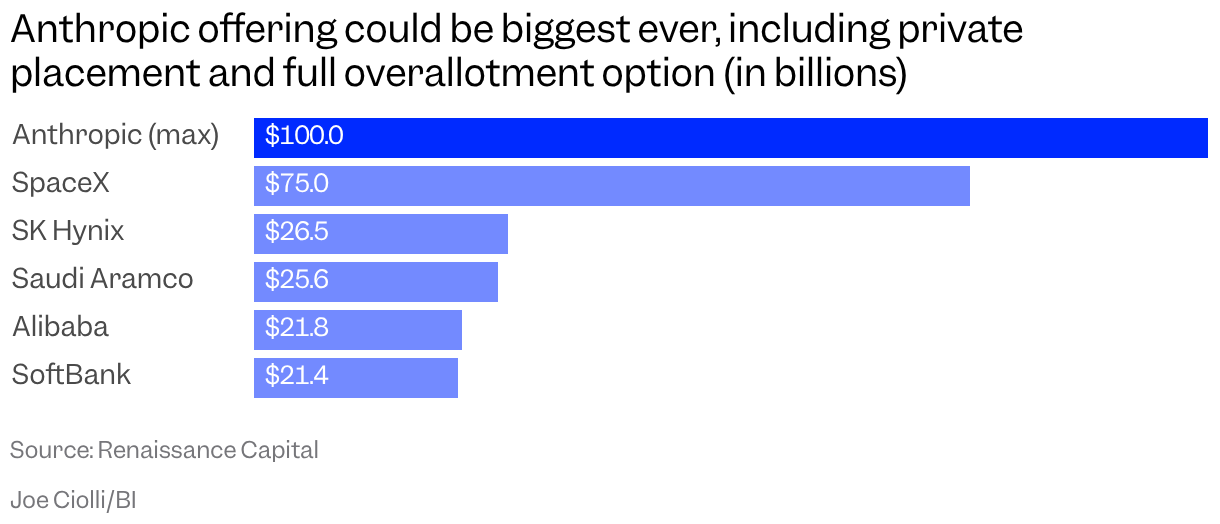
How unprecedented is the private placement?
IPOs running concurrent with private placements are not entirely unprecedented. Arm Holdings, for instance, lined up many of these same companies as cornerstone investors in its 2023 offering.
But Anthropic’s version is in a different universe in terms of both scale and setup.
Want more Business Insider in your news feed?
Add BI in Google so our reporting is easier to find when you’re searching for what matters.
Arm’s strategic investors signaled interest in buying up to $735 million of stock within the IPO. Anthropic’s backers, meanwhile, are buying $26 billion of separate non-voting stock through a separate deal, although at the same per-share price as the IPO.
Pros and cons
So is the private placement a good or bad thing for everyday investors?
The upside is quite straightforward: Anthropic gets $26 billion of fresh capital without having to pay underwriting fees on it. And it’s coming from deep-pocketed partners who all have a financial interest in its expansion. It’s not the type of fickle money that tends to flip an IPO at the first sign of trouble.
But public investors should not confuse that support with a clean, independent vote of confidence. Some of the demand was already spoken for. Google exercised a pre-existing IPO option, while AMD’s purchase fulfills part of an earlier supply commitment.
And in terms of mechanics, the private placement makes it so that public IPO buyers will own a smaller slice of Anthropic than they otherwise could. The company will have a relatively smaller pool of publicly traded stock at the outset, which could make early trading more volatile.
Anthropic’s IPO will still be a major test for the AI trade, but investors should remember what they’re testing. It’s not whether the AI industry can keep financing itself. It’s whether Anthropic can eventually fund itself once the training wheels come off.
Your guide to what’s moving markets