
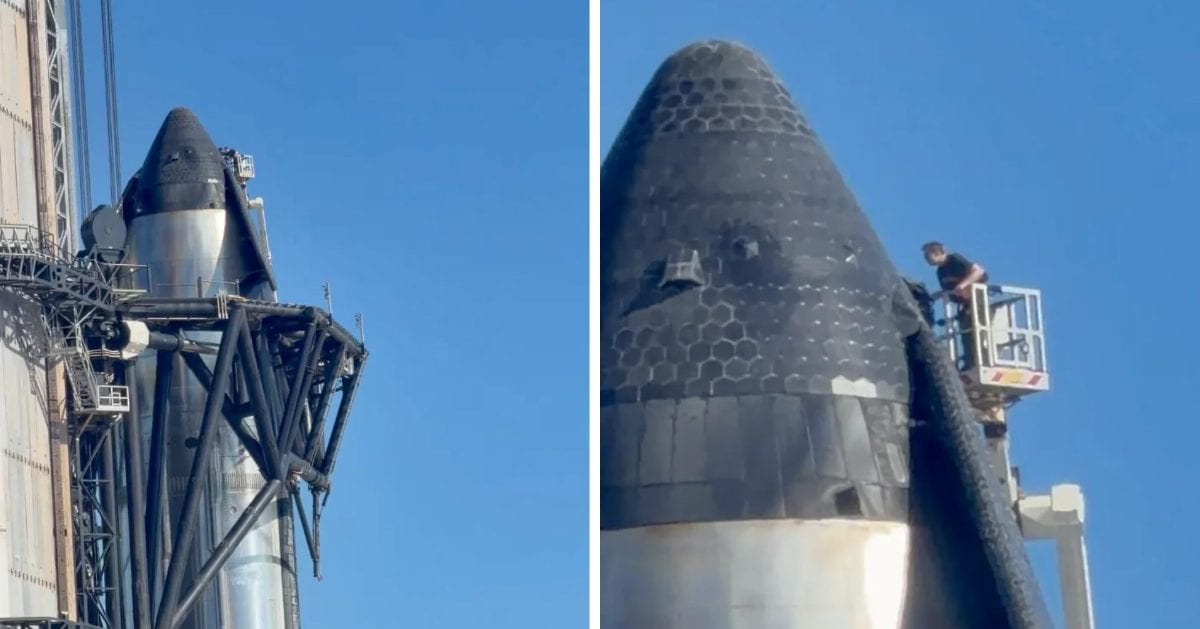
Musk said that “Ship 42 brings back a motherlode of data for further improvements to the heat shield,” as he inspected the upper stage after a successful catch.
SpaceX CEO Elon Musk was seen at the launch pad a day after the conclusion of Flight 15, inspecting the heatshield tiles of the Starship upper stage (Ship 42), which survived its punishing reentry prior to the historic catch on November 14. In a video shared on X, Musk can be seen standing on a platform with fellow SpaceX personnel assessing the tiles, with Ship 42 placed at the base of the launch tower. Musk even reacted to the video and said, “Ship 42 brings back a motherlode of data for further improvements to the heat shield.” The ship has now been transported back to Production for further inspection.
Elon Musk is currently inspecting heat shield tiles on Starship https://t.co/WIGJYVBa7n
— Mina Gawargious (@MinaGawargious) November 15, 2026
Musk was, in fact, quite happy with how Ship 42 looked after being caught. “Overall, it (heatshield) looks great. The engines look great too. Ship 42 could probably be reflown within a few weeks of refurbishment,” he said, reacting to another video of him at the pad. “However, many small fixes are needed to achieve immediate reusability (like an airplane), which requires zero expected refurbishment, apart from scheduled maintenance.” He also shared close-up views of Ship 42 taken from atop the launch tower and on the ground after the catch.
Yeah, I was going over the whole Starship heat shield earlier today. Overall, it looks great. The engines look great too. Ship 42 could probably be reflown with a few weeks of refurbishment.
However, many small fixes are needed to achieve immediate reusability (like an airplane), which requires zero expected refurbishment, apart from scheduled maintenance.
— Elon Musk (@elonmusk) November 15, 2026
Starship lifted off at 4:47 pm CST from Starbase, Texas, and the mission lasted over 22 hours. Ship 42 was the first upper stage to be caught using the launch tower, which has caught the Super Heavy Booster three times before. SpaceX, however, has not recovered the Booster of Starship V3 (Version 3)—the current iteration. The original plan was to catch the Booster using the tower as well, but certain issues prevented that from happening.
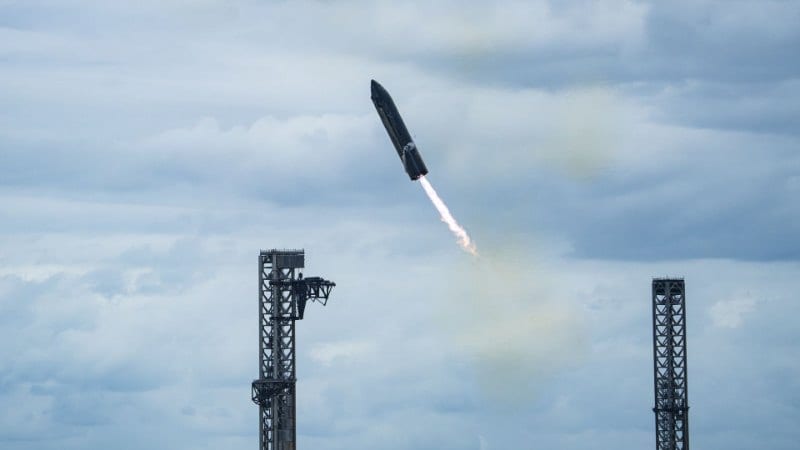 Starship’s upper stage steers itself toward the launch tower for a catch, November 13, 2026. (Image Source: SpaceX)
According to the Flight 15 report, the boostback burn of the first stage ended early due to low fuel mass, and its guidance, navigation, and control (GNC) triggered an automated abort of the catch. It then diverted to an offshore landing location and activated the flight termination system as it hovered over the Gulf of America. One of its 33 Raptor engines also failed to reignite for the boostback burn.
Mechazilla catches Starship! Congratulations to the entire SpaceX team on this incredible achievement! https://t.co/YJzmGUZb2B
— SpaceX (@SpaceX) November 14, 2026
The rest of the mission was smooth sailing as the upper stage ascended to about 170 miles (275 km) altitude and deployed 26 Starlink V3 satellites just like on Flight 14. “Contact was made soon after with every satellite, which are already beginning to raise their orbits to join the Starlink constellation,” SpaceX said. The spacecraft then spent more than 20 hours in the coast phase and made approximately 14 orbits of Earth. As the deorbit sequence began, Ship 42 fired a single Raptor engine and began the process of reentry, which took about an hour. At T+22 hours and 32 minutes, the spacecraft had reached the launch site and fired three of its engines to steer itself between the tower’s ‘chopstick arms’ for a catch. On its way back to the launch site, Ship 42 flew over sparsely populated areas in northern Mexico and southern Texas.
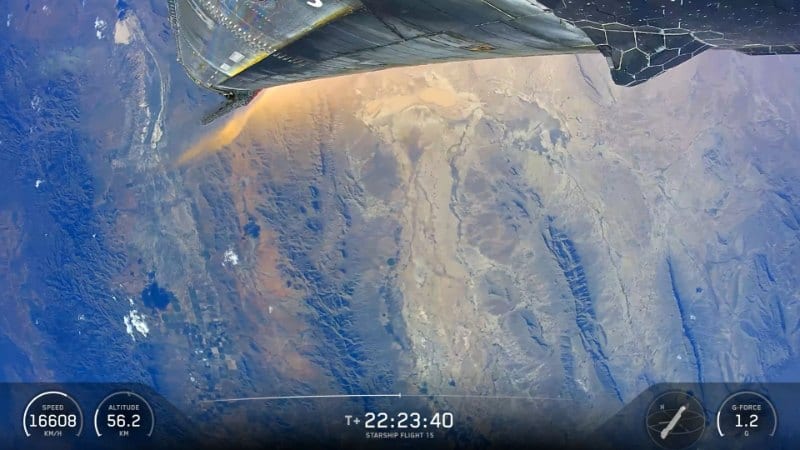 Starship flying over land minutes before it’s caught by the launch tower. (Image Source: SpaceX)
Flight 15 was a huge improvement from the previous mission, which was supposed to last 10 hours but ended in three hours after liftoff. The upper stage suffered an early engine shutdown, which forced mission controllers to deorbit it prematurely. It still managed to deploy the Starlink V3 satellites, which significantly boosted the constellation’s capacity. The booster also suffered engine issues then, as it failed to relight two engines for the boostback burn. Also, during the landing burn, it only ignited 11 of the planned 13 engines before a splashdown in the Gulf.
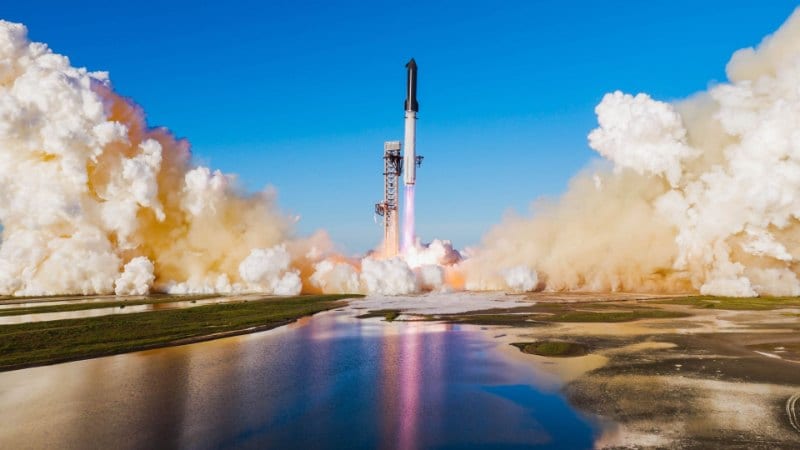 Starship lifts off on its 15th test flight from Starbase, Texas, November 13, 2026. (Image Source: SpaceX)
Flight 16, which is reportedly targeted for December, may launch from Starship’s new launch pad at NASA’s Kennedy Space Center in Florida. Moreover, SpaceX is also planning to refly an upper stage (could be Ship 42) starting in early 2027 and begin carrying out weekly launches in the first half of the year itself.
More on Starlust
ULA’s Vulcan rocket suffers anomaly on return flight, fails to deploy 40 Amazon Leo satellites
Rocket Lab completes 100th mission of Electron rocket faster than any commercial launch vehicle