
01.Key Takeaways
•Biomedicine is the next high-value direction that Anthropic will focus on intensive investment after Coding. Drug R&D itself requires top-tier intelligence, and every key progress in the drug R&D process can generate considerable asset value, making it possible for AI’s charging model to shift from API-based pricing to outcome-based payment.
•The current priority of Anthropic is to close the loop as soon as possible. As the small loop of molecular design driven by improved computing power runs faster, the bottleneck has shifted more to wet experiments. Since molecular design can now be generated rapidly, the fastest field for Anthropic to close the loop is to use Claude to call molecular design models such as BoltzGen and accelerate the efficiency of models on GPU. At the same time, molecular verification is still constrained by wet experiments, so Anthropic has also started to build its own laboratories and actively cooperate with external laboratories to obtain reliable feedback loops faster to advance research.
•We believe Anthropic is the strongest and most serious key player in the AI for science direction. Compared with OpenAI, Anthropic is more focused. Compared with Eli Lilly, Anthropic is more AI Native. Although OpenAI started early in the biological field, its layout spans personal health, medical services and life sciences, which is less focused than Anthropic. As an example of a pharmaceutical company deploying AI drug development, Eli Lilly owns its own data and pipelines, and mainly deploys AI by co-building platforms with partners. At present, its pace and organizational form are still relatively conservative.
•Anthropic is gradually participating in pharmaceutical development, but out of consideration for its relationship with pharmaceutical companies, it currently focuses on pre-clinical stages and rare diseases. Anthropic is advancing its own pipelines to understand the role and limitations of AI models in the real R&D process, and it does not rule out the possibility of entering the pharmaceutical manufacturing field in the long run. But at this stage, they need to balance the relationship with pharmaceutical companies. Since they cannot become competitors with their large pharmaceutical clients, Anthropic limits its current R&D to pre-human trials and focuses on rare diseases that large pharmaceutical companies do not invest many resources in.
•The improvement of Claude’s capabilities is also changing the organizational form of Biotech, making “pipeline in a person” possible. The future Biotech will most likely be an experienced lead, with the help of a large number of AI Agents, cooperating with external laboratories to complete the drug R&D and management work that previously required a huge team. Mithril, which Anthropic acquired this year, provides a good example.
•Anthropic will change the industry pattern and value distribution in the pharmaceutical field, and its final positioning may be TSMC in the pharmaceutical field: Anthropic is responsible for early drug discovery and R&D, while pharmaceutical companies are responsible for later clinical trials and sales. In the first half of this year, they provided an entry for scientists to work through Claude Science, and unified the scientific laboratory ecosystem through MHS. These layouts in the scientific research ecosystem are the beginning of their pattern change in this field. In the second half of the year, they began to accelerate protein design, support one-person pipelines, and go deep into biopharmaceutical workflows, which made us start to see signals of changes in value distribution.
02.Why Does Anthropic Attach So Much Importance to Biomedicine
Compared with OpenAI, Anthropic’s betting style is more focused. The company’s previous all-in on Coding brought huge success, allowing Anthropic to achieve a counterattack against OpenAI. Now after Coding, biomedicine has become the next high-value breakthrough paradigm. It is also clearly written in Anthropic’s S1: Agents oriented to scientific discovery will gradually become a reality in 2026. The company lists life science and robotics as the new businesses most worthy of investment. Dario himself also said in Anthropic’s roadshow that he believes diseases including cancer, Alzheimer’s disease and heart disease will become a thing of the past within ten years.
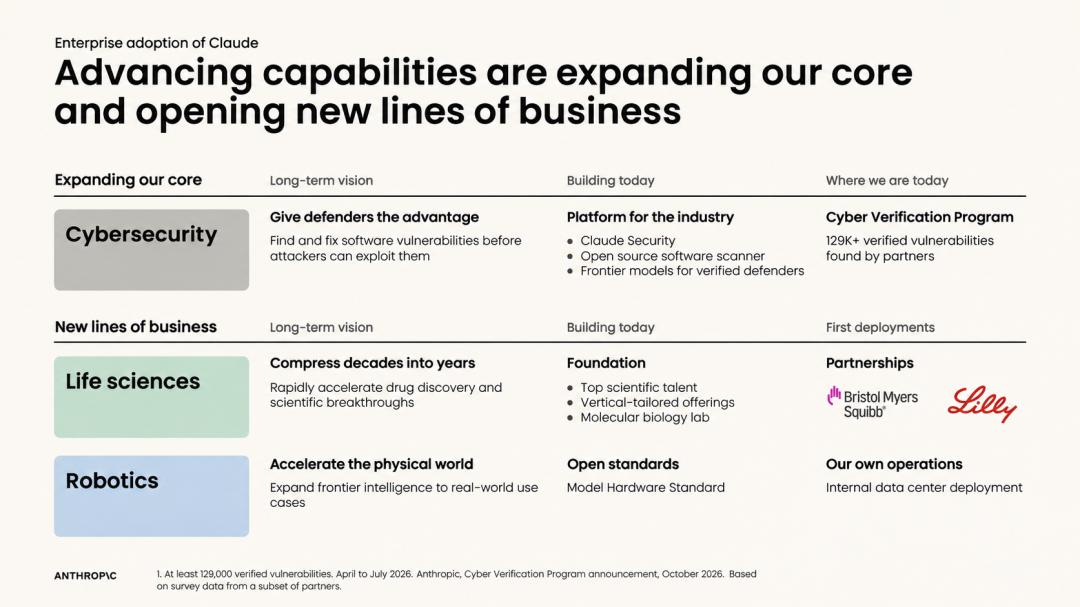
Anthropic’s roadshow slides list Life Sciences as one of the two major new directions in the future
We believe that Anthropic attaches so much importance to biomedicine mainly for several major reasons:
Biomedicine may be the most promising field for AI to explore outcome-based payment.
Anthropic clearly stated in its prospectus that it will become a virtual collaborator in the next step, with the core capability of directly delivering task results. Among many tracks, biomedicine is the best model for outcome-based payment. Every key progress in the drug R&D process can form tradable asset value: as candidate molecules reach the agreed standards and clinical trials achieve positive results, partners can obtain considerable milestone payments accordingly.
Drug discovery is the next high-value task after AI Coding, and it is also the jewel on the crown of intelligence.
In 2026, global annual pharmaceutical expenditure exceeds 2 trillion US dollars, and a single successful drug can bring considerable commercial returns. Taking GLP-1 drugs as an example, the main products of Eli Lilly and Novo Nordisk alone have a sales scale of nearly 100 billion US dollars calculated on an annualized basis in the first three quarters of this year. The attractiveness of drug discovery is not limited to the market size: it requires understanding complex biological mechanisms, putting forward hypotheses in incomplete information, and continuously correcting judgments through experiments, which puts forward extremely high requirements for cutting-edge intelligence.
Dario himself has a strong interest in biology, and biology is one of the few bets Anthropic has made.
Before devoting himself to AI, Dario was engaged in biophysics research and did postdoctoral research at Stanford University School of Medicine. In his early years, his father died of hepatitis, and less than five years after his death, medical progress reduced the fatality rate of this disease from 50% to 5%. This incident shaped Dario’s view of technology and time. In Machines of Loving Grace, he listed biology and health as the top of the most anticipated AI application directions: the AI he envisioned is a “virtual biologist” that can put forward hypotheses, design experiments, and invent research methods. Today’s Anthropic is gradually getting closer to this goal step by step.
03.Core Objectives
Anthropic hopes to replicate the leap of Coding in life sciences: from becoming an assistant to scientists to completing research tasks end-to-end. Eric Kauderer-Abrams, Head of Life Sciences, said in a public interview that he hopes scientists can get the experience that software engineers already have: someone to discuss with, and tasks can be delegated. He described the goal as a “research assistant with capabilities beyond human beings”.
Behind this goal, there are two main lines for the life science team:
Accelerate scientific discovery as a tool
Claude Science: AI Research Assistant
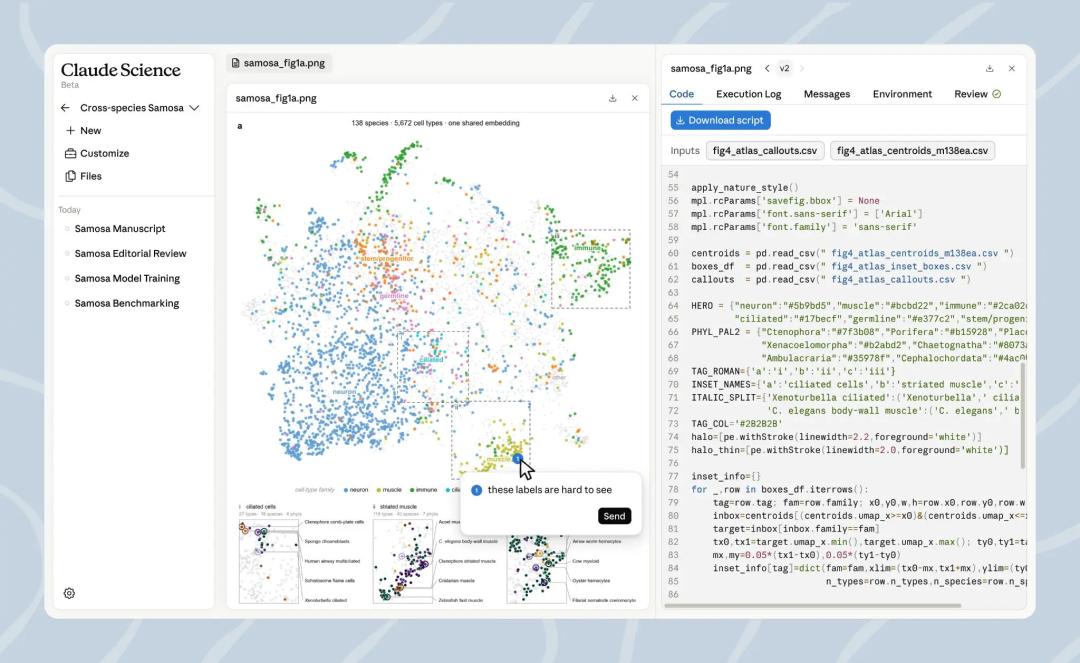
In June 2026, Anthropic launched Claude Science, integrating literature retrieval, data analysis and paper writing into the same scientific research workbench, allowing scientists to delegate multi-step research tasks.
The company lists Claude Science alongside Claude Code and Claude Cowork, corresponding to scientific research, software development and knowledge work respectively. It supports the display and interaction of various scientific results; retains analysis history; schedules computing tasks; connects to scientific research databases and professional tools; allows users to expand according to their own research fields.
With built-in Skills and connectors, the product can access more than 60 databases and scientific resources, covering proteomics, structural biology, chemistry, genomics and literature research. Users can add Skills through conversation, write and upload ZIP files by themselves, or import from GitHub. Existing local and remote MCP services can also be accessed.
MHS: Claude Enters the Lab Bench
If Claude Science carries the workflow of researchers in software, then MHS (Model Hardware Standard) is Anthropic’s attempt to extend AI to laboratory equipment and physical operations.
On August 27, 2026, Anthropic opened the MHS research preview. This specification, which originated from its cooperation with non-profit organizations, tries to provide a common interface for different devices, so that AI can discover instruments, read status, call operations, and understand the functions and safety restrictions of devices. It is not bound to models, and can also be used by agents through methods such as MCP.
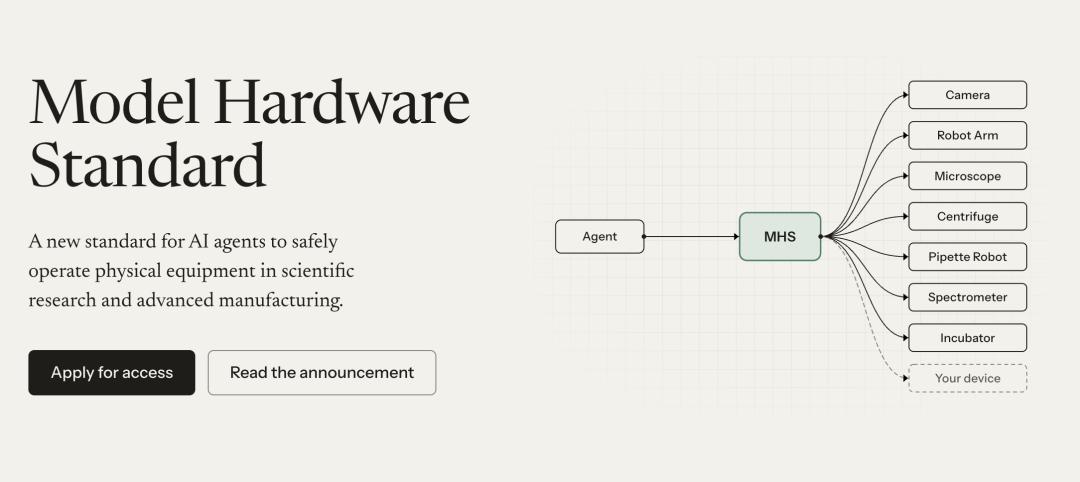
At present, a major bottleneck of automated laboratories lies in the integration cost. The automation degree of individual instruments has been continuously improved in the past, but how to combine them together has become a new problem. An experiment usually requires the cooperation of multiple instruments. If instruments can describe their own capabilities in a common way, experimental software will have the opportunity to call equipment according to tasks, pass execution results back to the model, and then decide the next step.
This is also a key step towards the “unmanned laboratory”, reducing errors caused by manual operations and improving experimental reproducibility. Claude can obtain as much information of the instrument as possible through MHS for analysis. And truly close the loop in the laboratory, shortening the feedback loop.
We believe that this is very likely to become a unified standard for laboratory hardware to access AI tools, similar to AWS in laboratories. In the future, researchers will have the opportunity to call experimental capabilities through software, without having to build laboratories and connect instruments one by one for each research. Links such as pipetting, culturing, imaging and analysis may gradually become composable experimental services.
At present, Anthropic has announced the first batch of cooperation cases:
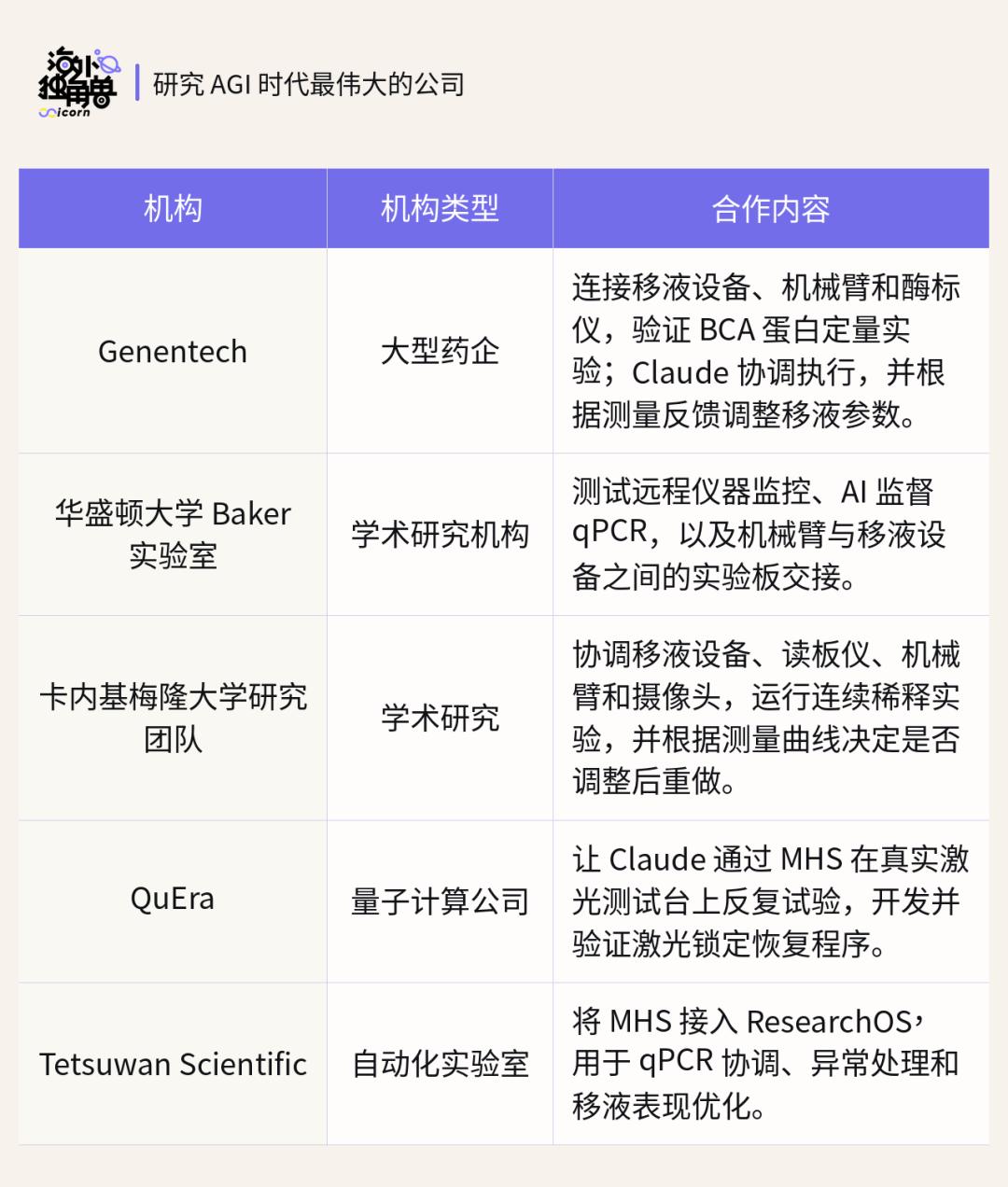
Develop drugs in person but stop at pre-clinical stage, focus on rare diseases
On the other hand, Anthropic is participating in drug discovery, but it has also drawn boundaries for its own R&D activities. Eric Kauderer-Abrams, Head of Life Sciences, said in an interview that the company will carry out early drug discovery. Only by participating in drug R&D in person can we truly understand where models and products fail. By taking on projects directly, the company can get closer feedback, instead of only relying on customers to describe problems. The boundary here is before the start of Phase I human trials.
In terms of disease selection, Anthropic focuses more on indications that traditional commercial institutions lack motivation to invest in. Eric links this choice to the company’s positioning as a PBC (public benefit corporation): avoid projects that customers find attractive, and invest in researches that have therapeutic value but may not be carried out. This not only provides a mission-level reason for the company to participate in R&D in person, but also helps reduce conflicts of interest with pharmaceutical clients.
We speculate that this arrangement may serve two strategic purposes at the same time.
1.Concentrate resources on R&D links where AI has more opportunities to accelerate, and explore the organizational form of “super biotech”. Early drug discovery involves a lot of work that can be assisted or gradually undertaken by AI. By participating in these links in person, Anthropic can obtain a large amount of data in real projects, and close the loop to improve model capabilities. It also explores advancing more R&D projects with a smaller team. In contrast, steps after human trials rely on the execution capabilities accumulated by pharmaceutical companies for a long time. Stopping its own R&D before clinical trials may mean that Anthropic hopes to concentrate on the links where it has more advantages, and then let other institutions take over subsequent development.
2.Clarify business boundaries with customers, and strive to become TSMC in the pharmaceutical industry. If pharmaceutical companies want Claude to go deep into the R&D process, they need to trust that Claude will not become a direct competitor of core pipelines at the same time. From this perspective, TSMC can be used as a reference: by focusing on wafer manufacturing and emphasizing that it will not compete with customers, it supports chip design companies to hand over key production links to itself. If Anthropic can build similar trust, more pharmaceutical companies will be willing to adjust their R&D workflows around Claude.
Participate in cutting-edge scientific discovery
In spring 2026, the company established an internal basic biology research group, putting model training, computational analysis and wet experiments in the same team. On September 18, Eric Kauderer confirmed to Reuters that the company was already operating a wet laboratory. He believes that biological research must eventually be tested by real experiments, and some work will be done faster by itself, and first-hand research experience can be obtained. Therefore, the company adopts a method similar to most Biotechs: part of the experiments are completed in its own facilities, and work suitable for outsourcing is handed over to external cooperative institutions.
In September 2026, Anthropic announced its internal life science research team and laboratory, and disclosed an early discovery: after researchers gave the task of finding new reverse transcriptase systems, about 950 Claude agents ran for 21 hours and identified a system with special repeating sequences, which the team named ART.
In November 2026, Anthropic demonstrated the ability of its new model to solve complex biological computing problems. In the AAV capsid structure prediction task, Mythos 5.2, based on the two open-source models OpenFold3 and ESMFold2, developed a method to predict the complete structure using the symmetry of the protein shell. The AAV capsid is composed of dozens of protein chains and is an important delivery vector for gene therapy. Complete structure prediction usually requires a large amount of computing resources. According to the company’s disclosure, among the 34 natural or engineered capsids tested, 28 of the methods developed by Claude reached the preset structural accuracy standards, demonstrating the potential of the model to expand the capabilities of open-source scientific research tools by writing codes and improving calculation methods.
But at this stage, all experimental operations are completed by human scientists. Although Anthropic is trying automation solutions such as MHS, the molecular biology research of this team often requires temporary adjustment of experimental processes, which is not very suitable for this automation method at this stage.
Acquire Biotech and its pipelines
In April 2026, Anthropic completed the acquisition of Coefficient Bio, focusing on supplementing the team and technical capabilities of AI and biomedicine. This is a typical talent acquisition. CEO Aris Theologis became Anthropic Lead of Life Sciences, and CTO Nathan Frey joined Anthropic to lead drug discovery and development research.
In July 2026, Anthropic acquired Mithril Medicine. Mithril develops bispecific antibodies, trying to repair the connection between muscle fibers and surrounding supporting structures. Its research directions include advancing two early bispecific antibody R&D pipelines, targeting LAMA2-related congenital muscular dystrophy and α-dystroglycanopathy respectively. This is a one-person Biotech company. Founder Cody Tranbarger confirmed that these projects became Anthropic’s first internal drug R&D pipelines, and he joined the company to continue advancing the projects and lead broader internal drug development work.
04.Key Figures

该文观点仅代表作者本人,36氪平台仅提供信息存储空间服务。