
ASM, Philippine Canadian Inquirer
November 23, 2026
Photo courtesy: BBC News
Seven former OpenAI employees who left to establish their own artificial intelligence company in 2021 have seen their combined stock holdings reach nearly $140 billion following Anthropic’s historic debut on the US stock market.
The company behind the Claude AI chatbot began trading on the Nasdaq on November 19, with shares initially priced at $83 each. The offering valued Anthropic at approximately $1.5 trillion, marking a remarkable rise for a company founded just five years ago.
At the offering price, each of Anthropic’s seven co-founders held shares worth between $19 billion and $20 billion, according to estimates reported by the BBC.
The group includes siblings Dario and Daniela Amodei, alongside Tom Brown, Jack Clark, Jared Kaplan, Chris Olah and Sam McCandlish.
Their wealth reflects the rapid commercial growth of artificial intelligence, with Anthropic emerging as a major competitor to OpenAI, the developer of ChatGPT.
Why the founders left OpenAI
Anthropic was established in 2021 after its founders departed OpenAI amid concerns about the direction of advanced AI development.
Dario Amodei, who previously served as OpenAI’s vice president of research, had become concerned about whether the development of increasingly capable AI systems was receiving sufficient attention to safety.
He subsequently left the company with his sister Daniela and five colleagues to build an organization that would place responsible AI development at the centre of its operations.
Dario became Anthropic’s chief executive officer, while Daniela took on the role of president.
Their company was established as a public benefit corporation, a structure that requires its leadership to balance shareholder interests with its stated public benefit mission.
Anthropic says its purpose is to develop and maintain advanced AI systems responsibly for humanity’s long-term benefit.
Meet the seven founders
The founders came from different academic and professional backgrounds, including physics, engineering, journalism, literature and technology policy.
Their estimated equity values at Anthropic’s $83 IPO price were:
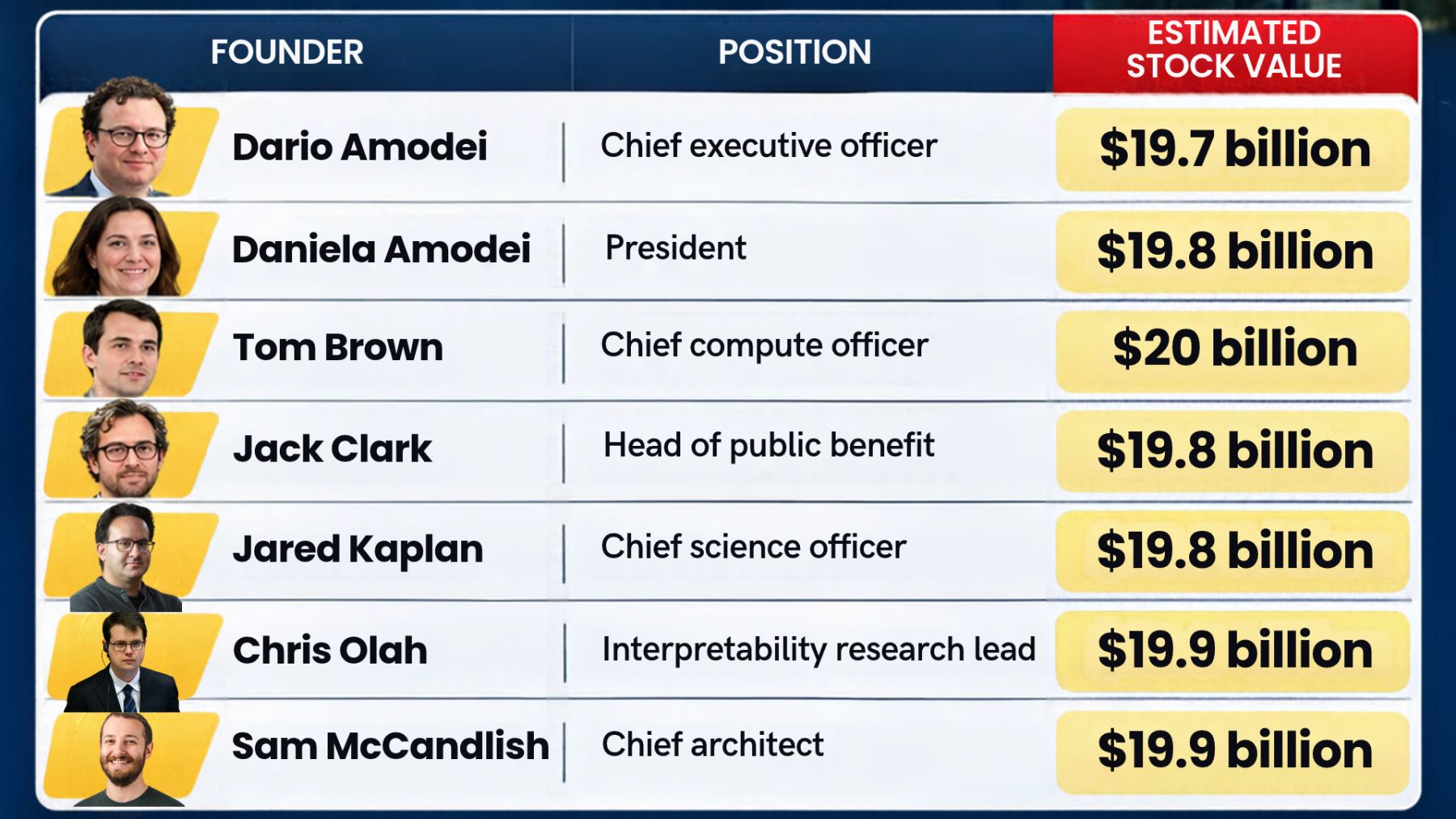
Photo courtesy: PCI
Dario Amodei studied physics at Princeton and Stanford before moving into biological sciences. He later worked at Baidu and Google before joining OpenAI.
His sister Daniela studied English literature at the University of California, Santa Cruz. Before her work in artificial intelligence, she held positions in politics and at financial technology company Stripe.
Tom Brown previously led engineering work on OpenAI’s GPT-3 model and worked on Google’s DeepMind project. At Anthropic, he oversees the computing infrastructure needed to develop and operate its AI systems.
Jack Clark, originally from Brighton, England, began his career as a technology journalist before joining OpenAI, where he eventually became policy director. He now leads Anthropic’s public benefit initiatives and its research-focused Anthropic Institute.
Jared Kaplan, a physicist and associate professor at Johns Hopkins University, leads Anthropic’s scientific research. His work on AI scaling laws has helped researchers understand how model performance changes as computing resources and training data increase.
Canadian researcher Chris Olah specializes in AI interpretability, a field focused on understanding how artificial intelligence systems process information and produce outputs. He previously worked at Google Brain and OpenAI.
Sam McCandlish, who holds a doctorate in physics from Stanford University, serves as Anthropic’s chief architect. His work includes designing systems and policies intended to manage the risks associated with advanced AI.
Founders pledge 80% of their equity to philanthropy
Despite the substantial value of their holdings, the founders have pledged to dedicate 80% of their personal Anthropic equity to philanthropic causes.
At the company’s IPO valuation, that commitment represents a potential charitable contribution exceeding $100 billion.
The pledge is documented in Anthropic’s filings with the US Securities and Exchange Commission.
However, the company states that the commitments are voluntary, may be revoked and are not legally binding. The amount ultimately donated will depend on factors including future stock prices, financial circumstances and the timing of transfers.
Anthropic has separately established a public benefit fund intended to support initiatives addressing the broader effects of artificial intelligence.
The company committed an initial 5% equity allocation to the fund and developed a framework that could increase its stake as Anthropic’s share price rises.
Among the issues the company has identified for potential support are AI safety, the economic effects of automation and initiatives intended to distribute the benefits of advanced technology more broadly.
A historic stock market debut
Anthropic’s IPO marked one of the largest milestones in the rapid expansion of the artificial intelligence industry.
The company’s shares opened at $111.50 on November 19, above the $83 offering price, before closing their first trading session at $97.17.
The stock market debut also allowed the founders to sell part of their holdings while retaining substantial equity in the company.
Their remaining shares, worth nearly $140 billion collectively at the IPO price, demonstrate the scale of the financial stakes involved in developing advanced AI technology.
Anthropic’s prospectus also makes clear that its public benefit commitments may sometimes reduce profits compared with decisions made solely to maximize financial returns.
The company’s governance arrangements and charitable commitments will therefore remain important considerations as Anthropic operates as a publicly traded business.
In addition to the founders’ personal pledges, Anthropic has allocated 5% of its fully diluted shares to its public benefit fund, with a framework allowing further contributions when specified share-price milestones are reached.