
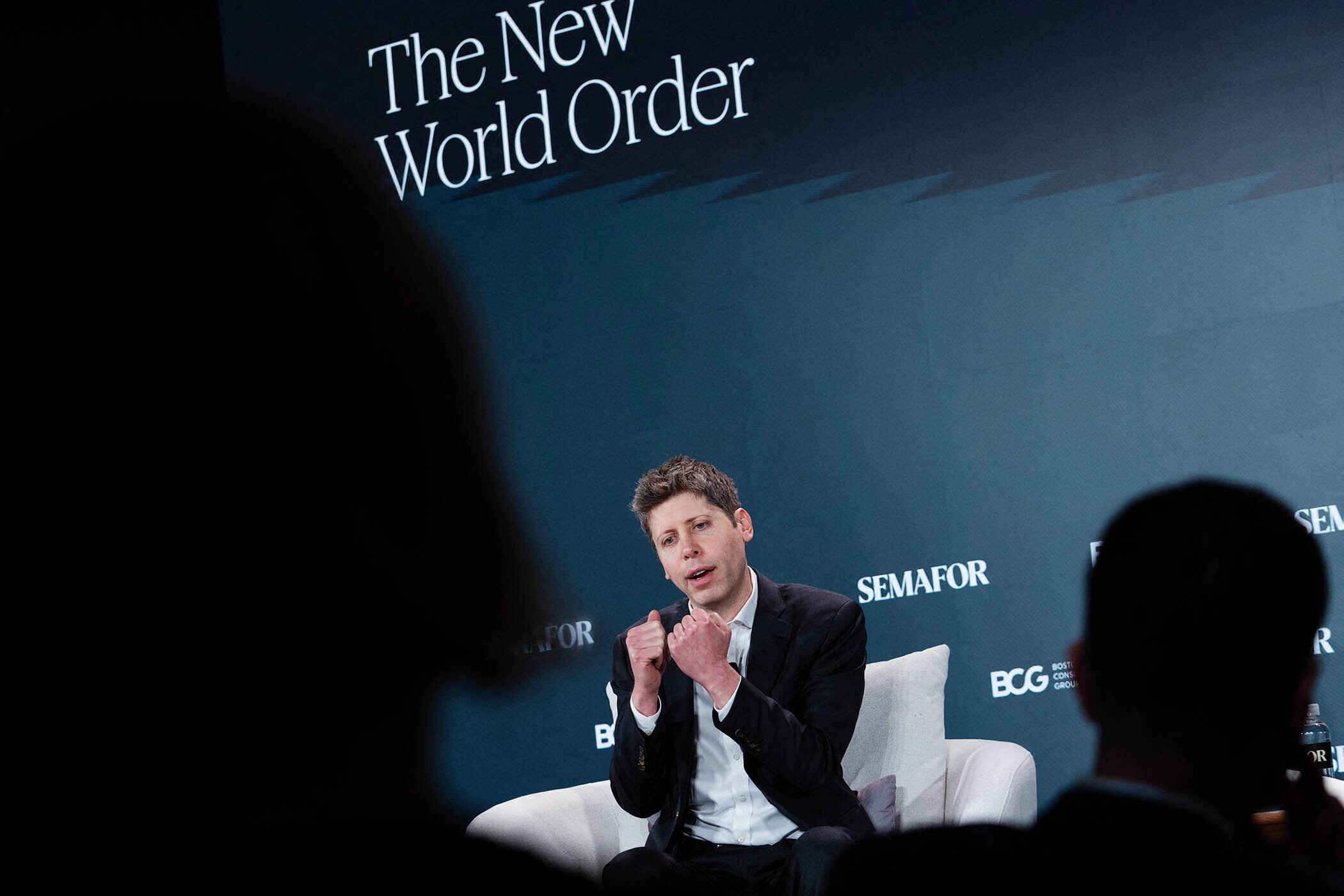
Sam Altman knows why we’re worried about AI. He says people don’t want to end up “living like a labrador”, petted and groomed by the nice AIs that take care of us. We’re uncertain about “what people’s role in society is going to be… what the balance of power is going to be”, people vs AI; those with access to AI vs those without. We don’t like what people in the tech world are describing as a “handover”. We really want to know if “the people building AI really are on ‘team human’”.
He’s right. But as he spoke, sitting brittle and bolt upright, I found myself wondering why the CEO and founder of OpenAI, the creator of ChatGPT, can be so accurate in diagnosing public fears, but so ineffectual in addressing them. Why is it that we’re not remotely reassured that these guys are on ‘team human’?
Altman was speaking at a conference in Palo Alto at the start of the week put on by Semafor, the news media startup founded by Ben Smith and Justin Smith. This was their first “live journalism” event on the west coast and it was quite a room of people: Jeff Bezos came to talk about his new AI manufacturing business, Prometheus; South Africa president Cyril Ramaphosa was there with a few words of life advice for Elon Musk – perhaps it’s time to give something back to the country that made him; Andy Jassy, the Amazon CEO, talked about the agentic economy that’s coming; Divesh Makan did little to allay the fear of an AI bubble, when he said that his investment firm, Iconiq Capital, was now putting 80% of its money into AI, 90% of that in and around San Francisco.
The event was called “Silicon Valley and the World”. And, over a couple of days, I came to think that the clue was in the title: Silicon Valley is another planet, apart from the world, one that can feel like it’s in a galaxy far, far away.
The language in Silicon Valley is different. Not just the acronyms that are part of every industry, but words that reveal a different way of thinking. Bezos described the daily dopamine hit of developing “AI for atoms” as “type-2 fun”, like the fun of climbing up a mountain, something you enjoy in hindsight (type-1 being fun at the time). Several of the big investors have stopped talking about Artificial Intelligence. It’s now just called “intelligence”: it’s a product. And, of course, there are impenetrable phrases that reveal mind-bending ideas: “Model Autophagy Disorder” (MAD) is the latest term for those in the know, used to describe AI eating itself by feeding on past AI-generated content and becoming less and less effective.
Money is the chief metric of success. Silicon Valley is a self-reinforcing circle of innovators and investors, each making the other extraordinarily rich. And, in turn, the economics of Silicon Valley justify the politics. Technology enables wealth creation that enriches Americans and empowers the US; the stock price is in the national interest. Jacob Helberg, the undersecretary of state for economic affairs in the Trump administration (and whose wedding, incidentally, was officiated by Sam Altman) made a not-so-veiled argument for Jensen Huang’s return to the helm at Nvidia. It’s “very hard to get people who can run 5 trillion companies,” he said. “There are very strong national security reasons to see Nvidia succeeding.”
In Silicon Valley the world is seen through the lens of business, eating up other businesses. Altman’s view of whether or not we’re witnessing a financial bubble is that, yes, “like any boom, there is going to be a lot of foam on the top that needs to come off,” but that, overall, “the whole industry will create such value”. Altman says: “We are underpricing… what can happen with the next generation of products,” citing how chatbots have already been followed by agents, how AI is now remaking science and maths. “We are going to see what a lot of compute can do.” Likewise, Bezos says they’re seeing manufacturing projects that would take a team of 10 to 20 engineers six months to complete being done in 12 hours. “Miniature miracles,” he calls it, “The entire manufacturing economy is going to be transformed by AI in the coming years.”
For a place of such brilliant competing minds, there is one dominant view of the world: it’s the US vs China. The two are locked in a race to AI supremacy and it’s zero-sum. Whoever wins, wins everything. It justifies light-touch, if any, regulation; it explains the huge risk appetite when it comes to releasing AI models to the public; and it warrants waiving the normal rules of corporate governance, viz the founders of Anthropic keeping voting control over 50% of the company after the IPO.
When I spoke to Bill Gates last month, he said the AI race is unwinnable, that neither the US nor China comes out on top because AI will be such an embedded technology everywhere. If he’s right, a lot is being sacrificed on the altar of the US-China AI race. But, in Silicon Valley, Gates’s view is not so much heresy; it doesn’t get a hearing.
There is, understandably, a belief among the AI innovators that time is moving faster than the world realises. David Schwimmer, CEO of the London Stock Exchange Group, said to me that what strikes him when he comes to the US west coast is the “existential urgency”. That feels exactly right. It’s what the tech bosses sound like, that they’re in a battle for survival and running out of time.
And so it all follows that the view I heard most commonly this week in Silicon Valley was not whether Jensen Huang should come back to Nvidia, but when. That’s because the place believes in genius, measured in trillion dollar valuations. It believes in what I came to think of as “Edison exceptionalism” – you hear people say that Jensen or Elon, they’re the Thomas Edisons of our times and if they don’t adhere to some of the norms or rules, the value they create means it’s worth the price. Altman’s formula was this: Jensen is a hero of mine and “heroes have flaws”.
Last week I wrote about cult capitalism, the idea that the Jensen Huang affair exposed the personality cult inside Nvidia and the extent to which the Anthropic IPO is entrenching founder power through voting rights. Spending a few days in Silicon Valley this week, I came to think that cult capitalism isn’t an accident of one man’s success in one company – it’s an attitude towards success across the tech industry, viz Elon, Zuck, Steve Jobs back in the day: visionary = value (and the more unreasonable the visionary, often the greater the value). Which, in turn, is why Sam Altman can diagnose our fears of AI, but not deliver the prescription. We want to know that Silicon Valley is team human. But it’s “team value”.
Nvidious
Is it possible that there will be a criminal investigation into Nvidia on national security grounds, looking into whether it exported high quality AI chips to Chinese businesses in breach of US export rules? Or is it possible that investors and employees will press for Jensen Huang’s return to restore the share price and he’ll be back as CEO before too long?
Who knows? But both possibilities tell us a lot about where we are.
It’s possible that the New York Times’ stories about Alice Huang were both less and more right: less right, because it turns out she’s not a Chinese spy; more right, because it leads to the discovery of widespread Nvidia exports of high quality AI chips to Chinese companies, in part, enabled by Alice Huang. This opens up a question: what do we say about journalism built around a fact – Alice Huang is a Chinese spy – that turns out to be wrong, but paves the way to a much bigger story; that Nvidia’s pursuit of sales led the company to being a wholesale national security risk?
It’s possible, too, that Nvidia is soon on a very different path. Investors and employees have lost hundreds of billions of dollars. The US, as a whole, is less wealthy today than it was a couple of weeks ago. And many people start to ask: for what? Because Jensen Huang had an affair, three affairs, maybe more? If shareholders have to choose between tolerating an exceptional leader who doesn’t operate by the rules – on sex with a customer, sex with a junior employee, lying to the company’s general counsel, lying to the board, enabling the business to strengthen China’s tech-industrial complex, operating a corporate dictatorship inside the business – but builds a $5trn business that makes many people staggeringly rich and the US economically stronger, many Americans would choose success over the rules. If Huang is back in six weeks or 18 months, what will have been revealed, among many other things, is that people are much more ambivalent about sex and power than they say they are.
RSI, etc.
One final AI tidbit. The tech bosses, to their credit, tell us we should be worrying about things that we can’t see. The one people keep talking about is Recursive Self-Improvement, AI’s ability to teach itself, exponentially and possibly out of control. My colleague Patricia Clarke wrote about it earlier this week. Sam Altman says: “This technology may get so powerful so quickly… people have not wrapped their head around what RSI means. We could be pushing more towards the RSI model, but not safely.” So far, they’re not rolling it out as fast as they could. That’s a “tactic”, Altman says. But who decides? Team Human, whoever that is.
Photograph by Godofredo A Vasquez/AFP/Getty Images