
 사진 확대 Bloomberg
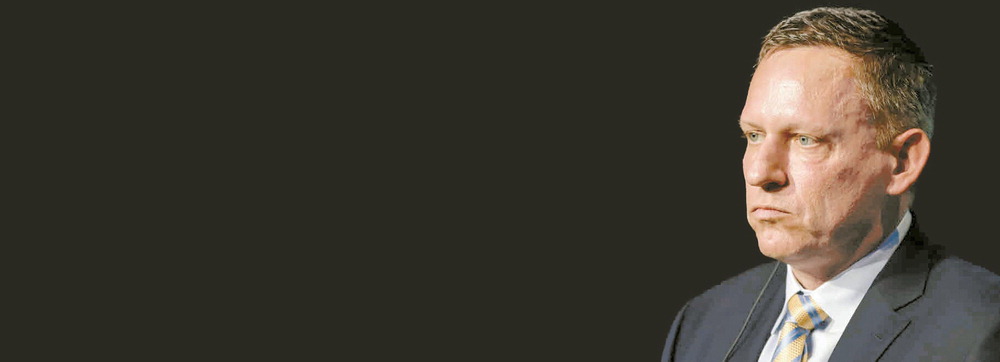
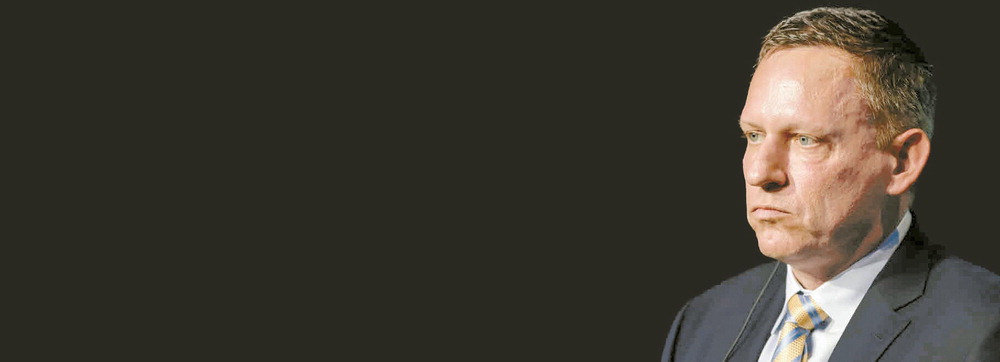
The world of Peter Thiel, PayPal and Palantir Technologies co-founder and Silicon Valley billionaire, was built on the rubble of the established order and conventional wisdom. “Competition,” a virtue that drives capitalism, becomes the lot of losers, while “monopoly,” its most feared ill, symbolizes victory. A university education is useless, while young people starting businesses are immensely valuable to individuals and society. The state, which protects civil liberties, instead becomes an oppressor, blocking entrepreneurs’ freedom to operate and technological progress.
Yet his actions often contradict his claims. He criticized Google, the undisputed leader in the search market, for pursuing “monopoly,” an ideal for entrepreneurs, and expanded his business and influence through connections he built at his alma mater, Stanford University. While criticizing the state, he grew Palantir Technologies by supplying information systems software to the government and military. In return for declarations of support and donations, he joined the U.S. administration of Donald Trump and moved into the heart of political power.
Why did Silicon Valley’s “rebel,” who rejected the established order, go on to enter the political arena? The book The Lord of Palantir by Max Chafkin, a senior reporter at Bloomberg Businessweek, traces the life of Peter Thiel, so full of contradictions, and examines how Silicon Valley’s technological capital expands into political influence.
 사진 확대 The Lord of Palantir By Max Chafkin, translated by Park Se-yeon Published by Willbook, 33,000 won
According to the author, the foundation of Thiel’s thinking is “libertarianism”: the idea that individual and entrepreneurial freedom must be protected from interference by the state and democratic majority rule. That is because politics obstructs technological advances needed for disruptive innovation and progress. “Political correctness,” which sparks ethical debates, is also something he believes must be dismantled. This is where Thiel’s thinking becomes dangerous: it leads to “technological authoritarianism,” the idea that risks or harms to society need not be considered so long as technology advances. In his view, entrepreneurs who build businesses by circumventing regulations, exploiting loopholes in the system, or simply ignoring norms deserve praise. His long-held principle says it all: “It is better to look evil than to look incompetent.”
The account in the book of Palantir Technologies’ growth is clear evidence. After the September 11, 2001, terrorist attacks, demand grew among law enforcement and intelligence agencies for the collection and analysis of terrorism-related information to counter threats. The company supplied Gotham, data and intelligence analysis software used to identify terrorists. Concerns about civil liberties and privacy violations that came with it were not among Thiel’s concerns.
His actions on the transition team during the first Trump administration followed the same pattern. He was responsible for selecting the heads of regulatory agencies, including the Federal Trade Commission (FTC), the Food and Drug Administration (FDA), and the National Institutes of Health (NIH). Most of the people he backed were staunchly anti-regulation. Nine out of ten of them were so extreme they could not secure President Trump’s approval, but his conviction that one must take risks to achieve “disruptive innovation” had reached the threshold of political realization.
Palantir Technologies benefited by aligning itself with the Trump administration’s policies. Under the Trump administration’s policy of deporting immigrants, the company secretly took part in building the U.S. Immigration and Customs Enforcement (ICE) database and intelligence analysis system, and provided software to identify people targeted for deportation and support investigations. Thiel thought little of the ethical concerns and conflict-of-interest allegations raised in connection with this work. For him, political power was a “stage” on which to put his convictions into practice, increase his influence, and grow his company.
The author argues that Thiel’s actions have helped shape Silicon Valley’s ethos today, across the political spectrum. He points to the criminal tendencies of the cryptocurrency industry, the monopolistic ambitions of Google and Apple, and Amazon’s anti-labor practices. He also warns that Silicon Valley as a whole treats these activities as a price worth paying for social progress. A “Thiel universe” seeking to realize a techno-authoritarian worldview that uses technological capital and political power to undermine democracy and ethics is now gaining strength. The author writes: “They [Silicon Valley’s elites] are celebrities who represent the most privileged class, and they are the oligarchs of our society. And Thiel is their founder.”
[Reporter Choi Hyun-jae]
This article has been translated by GripLabs Mingo AI.