
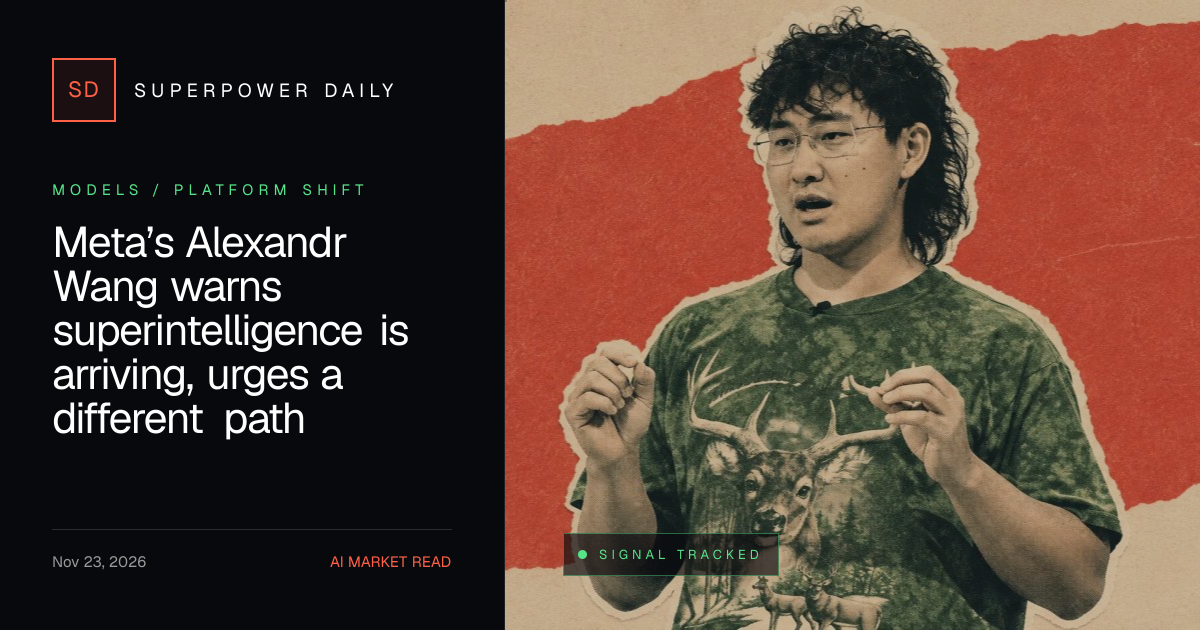
Meta’s chief AI officer Alexandr Wang says AI is nearing capabilities humanity may struggle to control. In a November 22, 2026 post on X, he declared that “superintelligence is arriving,” citing a claimed Claude-assisted proof of the Riemann hypothesis. His warning rests partly on a mathematical claim that has not been independently established.
The post followed an Anthropic employee’s announcement that he had used Claude to solve the hypothesis, according to Al Jazeera. Wang treated that claimed achievement as a turning point. He described its intellectual difficulty as exceeding anything humanity had previously accomplished and argued that its implications reach far beyond mathematics.
There is a distinction between the new claim and Anthropic’s earlier mathematical announcement. On August 10, the company explicitly said Claude had tried—and failed—to prove the Riemann hypothesis. Instead, an unreleased research version had made progress on a related question about the Riemann zeta function, which describes the distribution of prime numbers.
Related on X
History was made today. Humanity will look back on 2026 and think: this was the threshold we crossed, the moment the future changed for everyone, forever.
People probably first sensed that something was shifting in late 2025 with Claude Code, when agentic AI became truly tangible for them. In the first half of 2026, things picked up speed. Model releases became more frequent, and everyone could feel the gaps between models and the improvements becoming more and more tangible. In the second half of 2026, however, there was a qualitative leap. It was no longer just the models getting better. It was the insights, the results, the outputs, the scientific solutions produced with AI that became more impressive, and today they have probably reached their absolute peak.
OpenAI led the way and solved the Navier-Stokes problem, a Millennium Prize Problem that humans had failed to solve for a very, very long time. A few weeks later, they published results on more than 300 open mathematical problems, many of which had also gone unsolved for decades. The entire scientific world was stunned, frozen in shock. But today Anthropic went a step further. Levent Alpöge, working with Claude, has almost certainly proven the Riemann Hypothesis. This is, and it’s hard to put into words, incredible and unfathomable. Today, I would say, is the proof of superintelligence. One of the greatest mathematical problems, if not the greatest, unsolved for 167 years, the holy grail of mathematics and science, has fallen. And it follows, and this should be clear to everyone, that all other problems will fall too.
We know that the development of AI models keeps moving forward relentlessly, and that this is just one step on the path to ever better models. And if the Riemann Hypothesis has already been proven today, there is simply no telling what even better models will solve. Dario Amodei said that AI will in all likelihood cure diseases, perhaps even all diseases. And although these are two different scientific disciplines, the significance of these breakthroughs shows that this is becoming more and more likely. 2026 will go down in human history as a turning point, the moment the singularity became tangible. And 2027 will be the year the singularity breaks into reality with full force and full impact.
I am in shock and excitement and I don’t know what to think. But deep inside if feel joy.
This day is one of the best days ever for all of us.
— Chubby♨️ (@kimmonismus) View post
The hypothesis concerns where certain zeros—points where the function equals zero—lie. It predicts that all the zeros determining the primes sit on a particular vertical line. Anthropic said Claude had raised the established minimum proportion on that line from 41.6% to 67.2%. That was a partial result, rather than a proof that all the relevant zeros satisfy the hypothesis.
Anthropic said two of its mathematicians studied and validated that earlier paper. It also said a computer-checkable version of the argument passed a standard validation tool. Those checks concerned the narrower result. The company cautioned in August that it did not expect the techniques Claude used to lead to a proof of the full hypothesis.
Wang’s argument draws on an earlier comparison. In the post reproduced by The Times of India, he recalled OpenAI’s o3 beginning to ace American Invitational Mathematics Examination problems in December 2024. He argued that the hardest questions in that competition for teenagers demanded more raw intellectual effort than much everyday engineering, cybersecurity or business work.
In his account, improvements since then have come from filling in practical gaps around that underlying ability. He now sees a similar pattern at a much higher level: the remaining barriers to AI surpassing humans across fields are not intelligence, he argued, but specialized knowledge, infrastructure and experimentation. That is his interpretation of what mathematical progress implies for other work.
His most consequential prediction concerns AI research itself. Wang argued that models will become capable of automating that research and improving themselves beyond human ability. He also predicted faster work in biology, weapons and economics, potentially advancing fields at a pace people cannot understand or monitor. These are forecasts, not capabilities demonstrated by the claimed mathematical proof.
That prospect underpins his concern about recursive self-improvement: AI repeatedly advancing its own capabilities. Wang said it was hard to imagine humanity retaining control if that process were fully unconstrained. He expressed the same concern about a hypothetical system 1,000 times smarter and more capable than humans in every field.
How humanity acts over the next year will have great consequence on what future world we live in.
Alexandr Wang, in his November 22 post on X
Wang called safety, alignment and security extremely urgent priorities. But he also challenged what he called “lazy thinking” in the industry: assuming superintelligence is inevitable and that making it safe is the only remaining problem. His objection was to accepting a handover of society to AI, rather than deliberately choosing the future people want.
He said a positive outcome should give all humans greater agency and empowerment. Achieving that, Wang argued, likely requires the whole industry to take meaningfully different actions from its current “default path.” His appeal was not merely to manage more powerful AI, but to preserve people’s ability to shape what it becomes.