
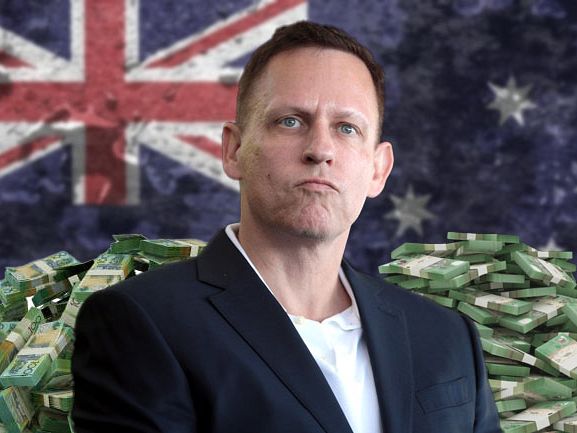
Peter Thiel’s pursuit of unchecked corporate power offers a disturbing parallel to the erosion of democratic accountability in Australia, writes Dr James Schuurmans-Stekhoven.
WHEN CRITICS in the United States or Australia recoil at the unchecked political clout of Silicon Valley billionaires, Peter Thiel almost always stands at the centre of the frame.
Yet as Max Chafkin’s biography The Contrarian: Peter Thiel and Silicon Valley’s Pursuit of Power makes brutally clear, treating Thiel as an eccentric anomaly misses the point entirely. Chafkin strips away the glossy mythology of the lone tech visionary to expose something far colder: a deliberate, decades-long strategy to accumulate monopoly power, neutralise democratic constraints and treat public accountability as an obstacle to be engineered out of existence.
Reviews of The Contrarian – from The New York Times to The Guardian and The New York Review of Books – highlight the core deception at the heart of Thiel’s brand. In Silicon Valley, “contrarianism” is marketed as intellectual courage: the daring refusal to follow the herd. In Chafkin’s reporting, it functions as an alibi for raw power.
Whether building monopolistic networks, bankrolling ideological protégés or declaring that freedom and democracy are no longer compatible, Thiel’s worldview rests on a simple premise: that the wealthy and powerful should be free from the messy interference of ordinary voters.

Contrarianism as a weapon against oversight
In The Contrarian, Chafkin traces Thiel’s trajectory from his combative student days at Stanford – where The Stanford Review served as an early testing ground for grievance-fuelled ideological warfare – through PayPal, Facebook, Palantir and his deep-pocketed political interventions. What emerges is not a philosophy of universal liberty, but a blueprint for impunity.
Contrarianism looks seductive when it backs an unloved startup. It turns sinister when aimed at the institutions designed to restrain concentrated wealth. When majority rule, public regulation and democratic scrutiny are framed as enemies of “innovation”, freedom ceases to mean collective self-government. It becomes the private privilege of an untouchable elite.
The quiet capture: Canberra’s own oligarchic drift
Australians like to fool themselves that compulsory voting, preferential ballots and independent electoral commissions render us immune to the kind of rot Chafkin chronicles. It is a comforting delusion — and a potentially lethal one.
Oligarchy does not require a Silicon Valley messiah; it only requires a political class willing to sell access, institutions too timid to resist and a public lulled into mistaking routine elections for genuine accountability.
In Chafkin’s telling, Thiel’s true genius lies not in tearing down democratic institutions in daylight, but in hollowing them out from within — cultivating loyal networks, operating in the shadows and treating public oversight as a nuisance for lesser mortals. Look closely at Australia today and that slow-motion hollowing is happening in plain sight.
Behind the polite theatre of Question Time sits a thriving shadow ecosystem of commercial lobbyists, party insiders and former ministers who walk straight out of public office and onto corporate payrolls, monetising their insider proximity before the ink on their resignation letters is dry.

Meanwhile, our transparency mechanisms have been starved into irrelevance: ministerial diaries are redacted or delayed into uselessness, Freedom of Information laws are treated by departments as an adversarial war of attrition and major donors buy proximity to decision-makers long before voters ever learn who footed the bill.
Even the civic institutions meant to serve as democratic counterweights have been steadily gutted.
Australia’s public universities – once engines of critical inquiry and independent thought – have been remade in the image of corporate conglomerates, governed by executive managerialism, dependent on commercial revenue, and increasingly hostile to the very academic freedom and dissent that once kept democracy honest.
Our public service has been hollowed out by decades of outsourcing to private consultancies that profit from the state while remaining insulated from public scrutiny.
Whenever Parliament threatens to impose even modest guardrails on tech monopolies, extractive industries, or tax-dodging multinationals, corporate envoys descend on Canberra with the same ideological script Chafkin dissects: that public accountability is somehow a brake on progress and that concentrated wealth – extracted from the public like leeches drawing blood – deserves freedom from democratic interference.
This is how democracies actually die in the 21st Century — not in a sudden coup, but through a quiet, methodical transfer of sovereignty from the public sphere to the boardroom.
If Australia continues to tolerate dark money, revolving-door lobbying, state secrecy, and the corporatisation of our universities and public institutions, we will not need to import America’s billionaire authoritarians. We will have replicated their system all on our own.
Dr James Schuurmans-Stekhoven is a psychologist, academic and multi-disciplinary researcher.
Support independent journalism Subscribe to IA.

