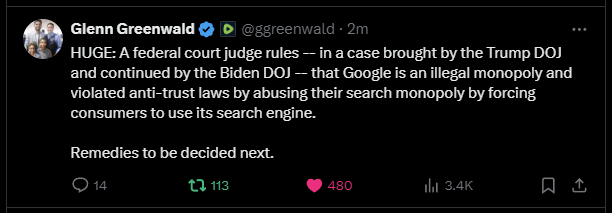
> HUGE: A federal court judge rules — in a case brought by the Trump DOJ and continued by the Biden DOJ — that Google is an illegal monopoly and violated anti-trust laws by abusing their search monopoly by forcing consumers to use its search engine.
>
> Remedies to be decided next.
shouldIworkremote on
Can someone explain what this means? Will Google most likely be forced to stop biasing its results? Or will they just get fined?
I don’t understand how anyone is forced to use their search engine? Even on mobile devices weren’t you always able to just download an aftermarket browser
Angelic_Mayhem on
When did google ever force people to use its search engine?
Background-Agent007 on
Wonder when this will happen to black rock, state street and vanguard.
braddicu5s on
as stated by Claude:
The key decision in this ruling was that Google was found to have violated antitrust law, specifically Section 2 of the Sherman Act. Here’s a concise breakdown of the main decision:
1. Google was found guilty of illegally maintaining monopolies in two markets:
a) General search services (i.e., web search)
b) General text advertising
2. The court determined that Google maintained these monopolies through exclusive distribution agreements, which likely prevented competitors from gaining significant market share.
3. The court ruled in favor of the plaintiffs (the U.S. government and some states) on Counts I and III of their complaint, which presumably dealt with these monopoly issues.
4. However, the court ruled in Google’s favor on Count II of the complaints, as well as some additional claims made by the state plaintiffs.
In essence, this decision represents a significant antitrust ruling against Google, finding the company guilty of illegally maintaining monopolies in its core business areas of search and advertising. However, it wasn’t a complete victory for the plaintiffs, as some claims against Google were dismissed.
This ruling is likely to have major implications for Google’s business practices and could potentially lead to remedies or penalties, though those aren’t specified in this excerpt.

7 Comments
SS:
[From tweet:](https://x.com/ggreenwald/status/1820540822489571460)
> HUGE: A federal court judge rules — in a case brought by the Trump DOJ and continued by the Biden DOJ — that Google is an illegal monopoly and violated anti-trust laws by abusing their search monopoly by forcing consumers to use its search engine.
>
> Remedies to be decided next.
Can someone explain what this means? Will Google most likely be forced to stop biasing its results? Or will they just get fined?
[From X:](https://x.com/matthewstoller/status/1820541238560620566)
> Apple is about to lose $20B+ in pure revenue from its rev share with Google.
I don’t understand how anyone is forced to use their search engine? Even on mobile devices weren’t you always able to just download an aftermarket browser
When did google ever force people to use its search engine?
Wonder when this will happen to black rock, state street and vanguard.
as stated by Claude:
The key decision in this ruling was that Google was found to have violated antitrust law, specifically Section 2 of the Sherman Act. Here’s a concise breakdown of the main decision:
1. Google was found guilty of illegally maintaining monopolies in two markets:
a) General search services (i.e., web search)
b) General text advertising
2. The court determined that Google maintained these monopolies through exclusive distribution agreements, which likely prevented competitors from gaining significant market share.
3. The court ruled in favor of the plaintiffs (the U.S. government and some states) on Counts I and III of their complaint, which presumably dealt with these monopoly issues.
4. However, the court ruled in Google’s favor on Count II of the complaints, as well as some additional claims made by the state plaintiffs.
In essence, this decision represents a significant antitrust ruling against Google, finding the company guilty of illegally maintaining monopolies in its core business areas of search and advertising. However, it wasn’t a complete victory for the plaintiffs, as some claims against Google were dismissed.
This ruling is likely to have major implications for Google’s business practices and could potentially lead to remedies or penalties, though those aren’t specified in this excerpt.