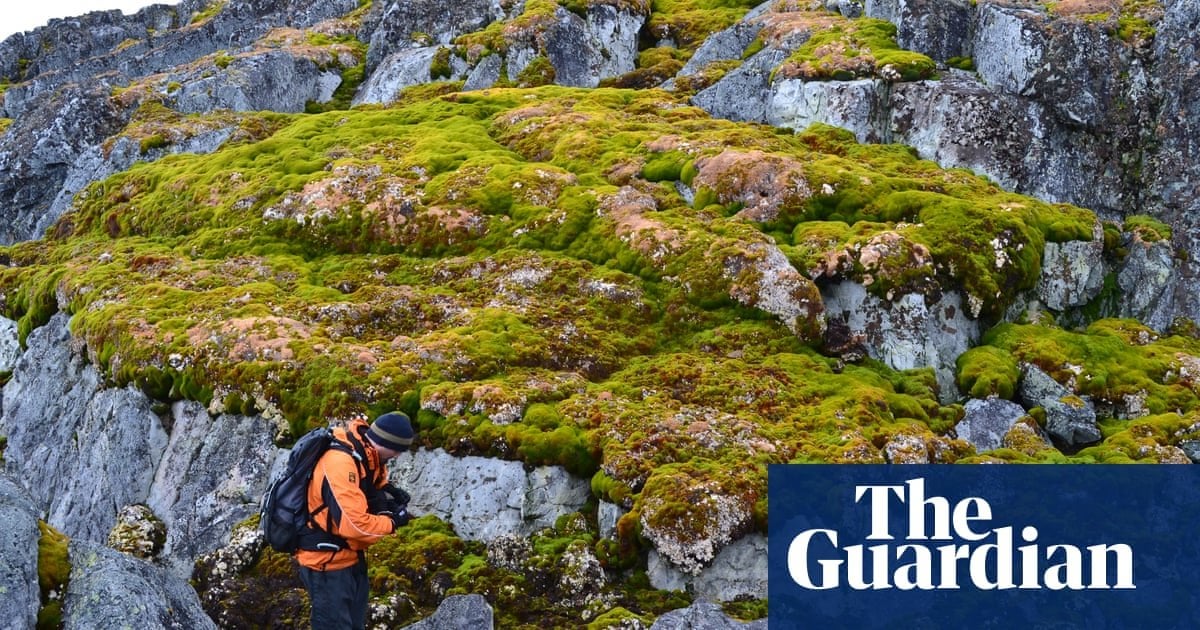
Plant cover across the Antarctic Peninsula, a long, mountainous extension of Antarctica that points north towards South America, has increased more than 10 times over the past few decades due to rising temperatures, a new study says.
>Analysis of satellite data found there was less than one sq kilometre of vegetation in 1986 but there was almost 12km2 of green cover by 2021. The spread of the plants, mostly mosses, has accelerated since 2016, the researchers found.
>The growth of vegetation on a continent dominated by ice and bare rock is a sign of the reach of global heating into the Antarctic, which is warming faster than the global average. The scientists warned that this spread could provide a foothold for alien invasive species into the pristine Antarctic ecosystem.
>“The Antarctic landscape is still almost entirely dominated by snow, ice and rock, with only a tiny fraction colonised by plant life,” said Dr Thomas Roland, at the University of Exeter, UK, and who co-led the study. “But that tiny fraction has grown dramatically – showing that even this vast and isolated wilderness is being affected by human-caused climate change.” The peninsula is about 500,000km2 in total.
>Roland warned that future heating, which will continue until carbon emissions are halted, could bring “fundamental changes to the biology and landscape of this iconic and vulnerable region”. The study is [published in the journal Nature Geoscience](https://www.nature.com/articles/s41561-024-01564-5) and based on analysis of Landsat images.
>Prof Andrew Shepherd, at Northumbria University, UK, and not part of the study team, said: “This is a very interesting study and tallies with what I found when I visited Larsen Inlet [on the peninsula] a couple of years ago. We landed on a beach that was buried beneath the Larsen Ice Shelf until the shelf collapsed in 1986-88. We found it to now have a river with green algae growing in it!”
>“This place had been hidden from the atmosphere for thousands of years and was colonised by plants within a couple of decades of it becoming ice free – it’s astonishing really,” he said. “It’s a barometer of climate change but also a tipping point for the region as life now has a foothold there.”
**What has the study found?**
Researchers used satellite imagery and data to conclude that the extent of vegetation in the Antarctic Peninsula has increased 14 times in just 35 years. Vegetation — mostly mosses and lichen — covered less than 1 sq km of the roughly 5,00,000-sq-km peninsula in 1986, but had spread to almost 12 sq km by 2021, according to the study. The rate of greening has increased by more than 30% between 2016 and 2021.
Although the actual area covered by plant life is tiny, the percentage increase in cover is astonishing, according to the researchers. Study co-author Thomas Roland, an environmental scientist at the University of Exeter, told CNN, *“Our findings confirm that the influence of anthropogenic climate change has no limit in its reach… Even on the Antarctic Peninsula — this most extreme, remote and isolated ‘wilderness’ region — the landscape is changing, and these effects are visible from space.”*
Rising temperatures in Antarctica have also resulted in a rapid decrease in the extent of sea ice — the 2024 extent was the second smallest of the satellite record, only slightly more than the record low set in 2023, the US National Oceanic and Atmospheric Administration (NOAA) said on Tuesday. Warmer open seas may be leading to wetter conditions that favour plant growth, according to the study.

1 Comment
Plant cover across the Antarctic Peninsula, a long, mountainous extension of Antarctica that points north towards South America, has increased more than 10 times over the past few decades due to rising temperatures, a new study says.
>Analysis of satellite data found there was less than one sq kilometre of vegetation in 1986 but there was almost 12km2 of green cover by 2021. The spread of the plants, mostly mosses, has accelerated since 2016, the researchers found.
>The growth of vegetation on a continent dominated by ice and bare rock is a sign of the reach of global heating into the Antarctic, which is warming faster than the global average. The scientists warned that this spread could provide a foothold for alien invasive species into the pristine Antarctic ecosystem.
>Greening has also been reported [in the Arctic](https://www.nature.com/articles/s41558-019-0688-1), and in 2021 [rain, not snow, fell on the summit](https://www.theguardian.com/world/2021/aug/20/rain-falls-peak-greenland-ice-cap-first-time-on-record-climate-crisis) of Greenland’s huge ice cap for the first time on record.
>“The Antarctic landscape is still almost entirely dominated by snow, ice and rock, with only a tiny fraction colonised by plant life,” said Dr Thomas Roland, at the University of Exeter, UK, and who co-led the study. “But that tiny fraction has grown dramatically – showing that even this vast and isolated wilderness is being affected by human-caused climate change.” The peninsula is about 500,000km2 in total.
>Roland warned that future heating, which will continue until carbon emissions are halted, could bring “fundamental changes to the biology and landscape of this iconic and vulnerable region”. The study is [published in the journal Nature Geoscience](https://www.nature.com/articles/s41561-024-01564-5) and based on analysis of Landsat images.
>Prof Andrew Shepherd, at Northumbria University, UK, and not part of the study team, said: “This is a very interesting study and tallies with what I found when I visited Larsen Inlet [on the peninsula] a couple of years ago. We landed on a beach that was buried beneath the Larsen Ice Shelf until the shelf collapsed in 1986-88. We found it to now have a river with green algae growing in it!”
>“This place had been hidden from the atmosphere for thousands of years and was colonised by plants within a couple of decades of it becoming ice free – it’s astonishing really,” he said. “It’s a barometer of climate change but also a tipping point for the region as life now has a foothold there.”
**What has the study found?**
Researchers used satellite imagery and data to conclude that the extent of vegetation in the Antarctic Peninsula has increased 14 times in just 35 years. Vegetation — mostly mosses and lichen — covered less than 1 sq km of the roughly 5,00,000-sq-km peninsula in 1986, but had spread to almost 12 sq km by 2021, according to the study. The rate of greening has increased by more than 30% between 2016 and 2021.
Although the actual area covered by plant life is tiny, the percentage increase in cover is astonishing, according to the researchers. Study co-author Thomas Roland, an environmental scientist at the University of Exeter, told CNN, *“Our findings confirm that the influence of anthropogenic climate change has no limit in its reach… Even on the Antarctic Peninsula — this most extreme, remote and isolated ‘wilderness’ region — the landscape is changing, and these effects are visible from space.”*
Rising temperatures in Antarctica have also resulted in a rapid decrease in the extent of sea ice — the 2024 extent was the second smallest of the satellite record, only slightly more than the record low set in 2023, the US National Oceanic and Atmospheric Administration (NOAA) said on Tuesday. Warmer open seas may be leading to wetter conditions that favour plant growth, according to the study.
!ping ECO