
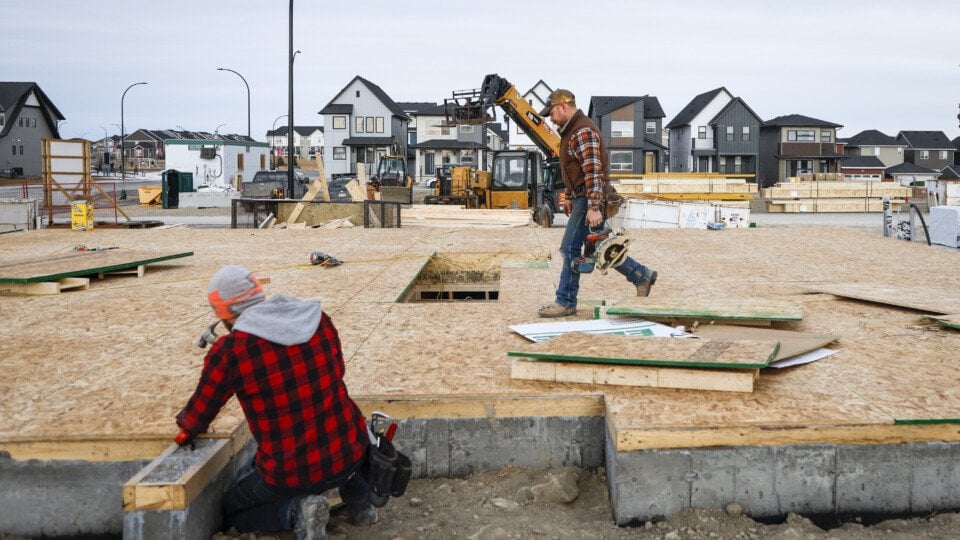
Every Canadian home builder would have to double their number of homes built to achieve Trudeau’s housing plan—output not seen in 25 years
Posted by IHateTrains123
Every Canadian home builder would have to double their number of homes built to achieve Trudeau’s housing plan—output not seen in 25 years
Posted by IHateTrains123
2 Comments
>One residential construction worker would have to produce nearly three-quarters of a home each year to meet the federal government’s 2031 housing goal, a number of homes-per-worker nearly two-times higher than today’s average, given major challenges around innovation and supply chains.
>Last April, the Trudeau government announced its new housing plan, which included the promise of 3.87 million new homes by 2031.
>The plan pledged 2 million homes more than the 1.87 million expected by Canadian Housing and Mortgage Corporation (CMHC).
>The goal of nearly 4 million new homes in the next seven years, along with lower housing prices, depends on the construction sector’s rate of housing starts-per-residential construction worker. A housing start reflects the number of privately owned new homes that has to be built.
>Given the sector’s current job growth, between 2024 and the end of 2030, for 3.87 million new homes to be built, each year, one residential construction job would have to complete nearly three quarters (0.73) of a housing start, according to Statistics Canada analysis by The Hub.
>That number of housing starts-per-worker is a far cry from recent averages. Between 2019 and 2023, one residential construction job produced an average of just 0.4 housing starts.
>From now until the end of 2030, if houses were built with the 2019-to-2023 average number of housing starts-per-worker, there would be just 2.13 million housing starts. That’s 1.74 million short of the government’s housing plan goal.
>[…]
>In each of the three scenarios above, The Hub assumed residential construction jobs grow 3.6 percent each year. It has been the industry’s average annual job growth both from 2019 to 2023 and from 1999 to 2023. Surprisingly recent record-setting immigration has left job growth in residential construction and skilled trades relatively untouched, instead boosting service sector jobs.
>Residential construction job growth is relatively high compared to total Canadian job growth, yet evidently hasn’t resulted in more Canadian homes being built.
>Between 1999 and 2023, residential construction jobs grew a total of 143 percent, from 265,130 to 645,995 jobs. During the same time, total Canadian jobs grew just 39 percent, from 14.7 million to 20.5 million jobs.
>Despite this growth in residential construction workers, the number of housing starts-per-worker has tanked, so much so that the government’s recent housing goals seem untenable.
>[…]
>An additional nearly 500,000 construction workers would be required to bring Canadian homes back to the affordability level of the 2000s, according to a report from BuildForce Canada, an advocacy organization for construction labour market development. Given its current resources and jobs, Canada should be building more than 400,000 housing starts per year according to another CMHC report.
>As the number of housing starts per residential construction worker fell, so did residential construction productivity. Productivity is defined by Statistics Canada, as the ratio between value (GDP) produced and hours worked in a given sector.
>In 2020, residential construction productivity reached its highest levels in the last 25 years, $60.50 per hour. Three years later it fell to $43.70 per hour.
>Housing starts per worker and worker productivity (value per hour worked) are implicitly connected, according to the CMHC.
# Cracks in the foundation: Innovation and supply chains
>There are several reasons why residential construction productivity has cratered.
>For one, Canada’s construction industry has become remarkably dispersed. Sixty-nine percent of construction companies employ less than five people, while only one in the country employs more than 500.
>According to the same CMHC report, this dispersal of the residential construction sector stunts investment in construction research and development that could otherwise produce or adapt technology to make Canadian home building more efficient.
>For another, the home-building supply chain is facing notable issues.
>In the second quarter of 2024, virtually nine in 10 (88 percent) of construction businesses said supply chain challenges have worsened and increased delays for necessary deliveries, according to a survey by Statistics Canada. In a survey of all Canadian businesses, 63 percent reported the same problems.
>Beyond shortages of materials (such as timber, drywall, wiring, or piping), housing “supply” includes issues around design concepts, feasibility studies, permits, and quality control.
>Taken together, these factors negatively impact residential construction productivity, meaning some construction firms will build just one home in a year, according to CMHC.
!ping Can&YIMBY
You know you can add builders and construction workers.