
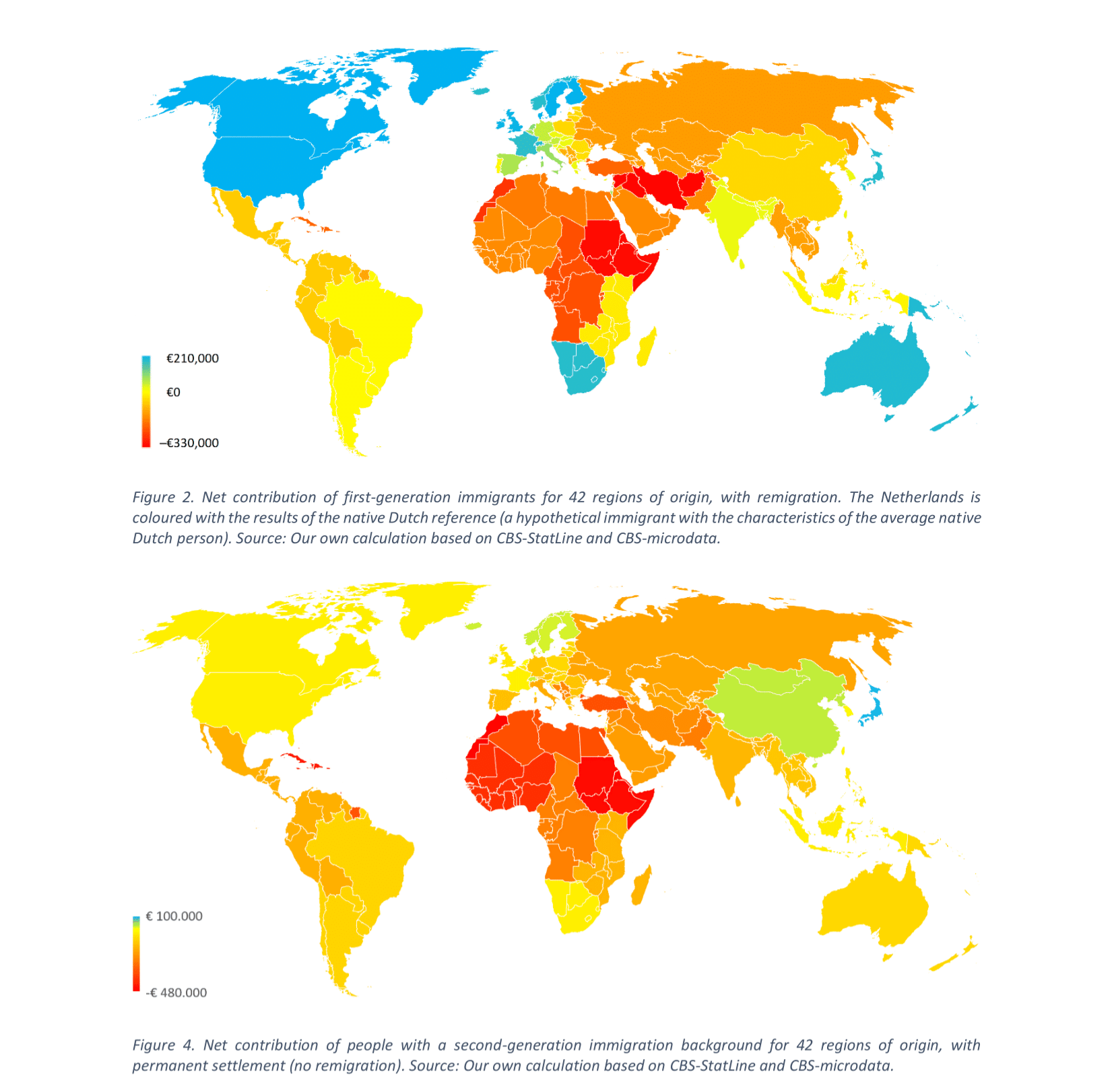
Net contribution of both first generation migrants and people with a second-generation immigration background for 42 regions of origin, with permanent settlement (no remigration) [Dutch study, linked in the comments].
Posted by BO978051156
Net contribution of both first generation migrants and people with a second-generation immigration background for 42 regions of origin, with permanent settlement (no remigration) [Dutch study, linked in the comments].
Posted by BO978051156
5 Comments
[https://www.iza.org/publications/dp/17569/the-long-term-fiscal-impact-of-immigrants-in-the-netherlands-differentiated-by-motive-source-region-and-generation](https://www.iza.org/publications/dp/17569/the-long-term-fiscal-impact-of-immigrants-in-the-netherlands-differentiated-by-motive-source-region-and-generation)
I think this bit is particularly important given that far too many succs in this sub support an extravagant universal welfare state *and* open borders.
>As shown in Table 2 (i.e. the static approach) for **Western immigrants, total expenditures per capita** amount to **98%** of those for **native Dutch**, for **non-Western immigrants this is 108%**. For revenues, these ratios are 100% and 60%.
>
You can’t eat your 🥮 and have it too.
The Danes have a similar story to tell: [https://www.economist.com/europe/2021/12/18/why-have-danes-turned-against-immigration](https://www.economist.com/europe/2021/12/18/why-have-danes-turned-against-immigration)
https://preview.redd.it/yb1028xwauae1.png?width=694&format=pjpg&auto=webp&s=2f33a364981f4283f7ce02c91a2df6594111d894
Does this map means that immigrants **from** X country contribute more or less (eg Red means immigrants from Ethiopia don’t contribute a lot), or that immigrants as whole **in** X country (eg Red means immigrants in Ethiopia (who migrates to Ethiopia?) don’t contribute a lot) contribute more or less?
Also lol at Afghanistan for defying the trend
Interesting that 2nd generation Africans get *worse*. Seems to go against the nurture explanations and be evidence for the hereditarian position.
That is why the CDU wants to decide the following:
“If you want to stay in the country permanently, you have to earn enough to earn a pension that is above the basic old-age pension,” Frei said in an interview with Stern magazine. “In my view, that would be the minimum.”
Frei: “Work alone is not enough”
The majority of Syrians in Germany work in unskilled jobs and many have no training. “These people may be able to support themselves, but certainly not a family. Not to mention their own pension provision,” said Frei: “Work alone is not enough.”
I think we should keep in mind positive external effects of immigration on the economy. I think generally Immigrants increase income and decrease prices for the average other person in the economy.
Factoring those external effects in would probably create a more positive picture of immigration.
However it’s probably not going to change that asylum seekers (which are most immigrants from all the places that are red on the map), especially from outside of Europe have a net negative effect on the economy of European countries.