> Kemi Badenoch, the new leader of Britain’s Conservatives, enters 2025 with what should be a tempting target in her sights: Labour Prime Minister Sir Keir Starmer, whose poll ratings have fallen faster than those of any premier in recent memory since his election triumph last July.
>
> Instead, Badenoch is facing a painful question: do the Tories have even further to fall? After collapsing to the worst election defeat in the party’s history, the Conservatives — supposedly the most successful political party in the world — are now fighting to defend their status as Britain’s main opposition.
>
> Bookmakers reckon that Nigel Farage, leader of the populist, rightwing Reform UK party, has more chance of succeeding Starmer as prime minister than Badenoch. The leader of the opposition spent Boxing Day contesting Reform’s membership numbers, which the party’s tracker claims now exceeds the Conservatives. In response, Farage threatened to channel resources into unseating her at the next general election.
>
> Both appear to be attempting to curry favour with US billionaire Elon Musk, who has taken a growing interest in British politics — and has the finances and platform to shape public opinion. Badenoch and Farage have both called for a public inquiry into the historic grooming scandal that Musk has become preoccupied with. In the first half of 2025, the Tories face a daunting set of local elections that could see them suffer another round of heavy defeats. “It will look really bad,” admits one Badenoch ally. “It will be really tough.”
>
> The media-averse Badenoch has yet to land significant blows on an underperforming Starmer or have an impact against Farage, a natural political performer who has become a TikTok celebrity, despite the fact that his own party has just five MPs. An ally concedes: “We are struggling to be heard and everyone is fascinated by Farage.” “The next few months are going to be squeaky bum time for Kemi,” says one leading Tory MP.
>
> Even Badenoch’s own MPs seem to have their doubts about whether she can turn this around. Out of a parliamentary rump of 121 Tory MPs, only 42 backed her for the top job, which she won on November 2 in a ballot of party members.
>
> Despite a campaign in which she refused to set out specific policies, Badenoch’s enthusiasm for principles such as a small state, lower taxes, “net zero scepticism” and antipathy to “woke” causes chimed with the views of Tory activists.
>
> But even as she closed in on victory, some MPs were not convinced. “Maybe the party needs to elect Kemi, get the madness out of its system early on and then have someone else,” said one senior Tory in October, before accepting a job in Badenoch’s shadow cabinet.
>
> In the weeks following her election, she has made little effort to introduce herself to the British public, conducting only a handful of big broadcast interviews — although an interview with the Spectator magazine, her former employer, drew some attention after she announced that she does not believe “sandwiches are a real food,” she declared. “It’s what you have for breakfast.”
>
> Badenoch remains an enigma to many voters. But the Tory leader’s supporters say she is biding her time and that in 2025 she will come out swinging. That at least will come as little surprise at Westminster, where Badenoch is known for her abrasive style. As she told the Financial Times last year, “I don’t look for confrontation. However if people bring it, I’m not going to run away.”
>
> Badenoch, born in London in 1980 to middle-class Nigerian parents, became Tory leader in the ashes of Rishi Sunak’s calamitous election defeat in July, after a protracted leadership competition that lasted four months.
>
> The 45-year-old was elected MP to the traditionally solid Tory seat of Saffron Walden in 2017, quickly carving out a career as a minister and ultimately business and trade secretary.
>
> She sets great store by the fact that she is “an engineer” — she studied computer systems engineering at Sussex university — who likes to understand a problem before setting out solutions. Yet it is still far from clear how she intends to pull the party out of its predicament.
>
> “She wants to take her time, to think hard about how she wants to do things,” says one ally. “She won’t be rushed into anything. You have to earn the right to be heard again. That will take some time.”
>
> But as previous Conservative leaders have discovered, time is a precious commodity. The party’s taste for regicide may also be unsated: since David Cameron quit in the aftermath of the Brexit vote in 2016, the party has had five leaders. Even Badenoch’s closest team members admit she needs to start making her mark soon.
>
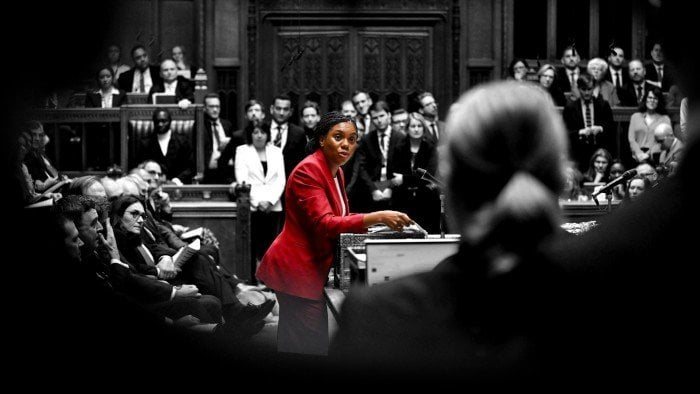
> On the face of it, Badenoch should have been helped by the dire start made by Starmer, whose poll ratings have collapsed while taxes have risen by £40bn and the economy has stagnated. But in their weekly exchanges in the House of Commons, it is the prime minister who often has the upper hand. One Labour minister says: “Number 10 is a bit fearful that if Kemi goes, somebody else comes in and it won’t be such an easy ride.”
>
> But Badenoch’s bigger challenge in 2025 will be to tackle the threat on her right flank. Having finally become an MP, Farage has succeeded in winning over Tory donors and some previous Conservative supporters. He is eyeing the local elections in May as a chance to show that Reform UK — which has virtually no presence in UK town halls — can become a serious force.
>
> Badenoch’s problem is that the last time these elections were fought in 2021, then prime minister Boris Johnson was enjoying a “vaccine bounce” at the end of the pandemic and riding high in the polls. On that occasion, the Tories won 2,345 seats while Farage’s party secured a grand total of two. Even allowing for Tory expectation management, it is easy to see how things might play out in May. Recent surveys have shown Farage snapping at the heels of the two main parties. A Techne UK poll in December put Labour on 27 points, the Tories on 26 and Reform on 21.
>
> Farage has said that building a local government base is an essential staging post in achieving his ultimate goal: running the country. Farage has made his intentions clear, naming his party after the Canadian Reform party that usurped the Progressive Conservatives in the 1990s. “They are the model,” he said before this year’s election. “That’s the plan.”
>
> Badenoch has signalled that dealing with the Reform UK threat is her first priority. Her only press conference, in November, focused on migration, in a sign that she is prepared to fight Farage on his own terrain. “I, as the new leader, accept responsibility and say truthfully, ‘We got it wrong’,” Badenoch said then.
>
> It is a high-risk strategy, but Tory strategists argue she has no choice. Matt Warman, a former Tory MP who lost his Boston and Skegness seat to Reform in July, says, “You have to unite the right to win elections. Doing that before Reform gets even greater momentum is an important part of where we are in the cycle.” A Badenoch ally agrees. “Kemi is not going to walk away from the tough stuff and leave the ground for Farage.”
>
> Badenoch’s problem is that Farage does not have a record to defend on immigration, while the Tories’ own history on the issue is disastrous. The day after that press conference, official data was released that showed net migration to the UK topped 900,000 in the year ending June 2023 — part of the period Sunak was in Number 10. In the year ending June 2016, the month that Britain voted for Brexit and “control” over its borders, the equivalent figure was 335,000.
>
> And Badenoch’s own history in this area is far from straightforward. In 2018, she gave a speech in parliament supporting looser immigration controls. Tory rightwingers unconvinced about her credentials have shared clips of it on WhatsApp message groups.
>
> Badenoch now says she wants to impose a cap on migration numbers — though she will not say where it will be set — and hints at a revival of a scheme like the Rwanda policy, Sunak’s flagship “deterrent” which saw only four volunteers flown to the African state before July’s election. One member of Badenoch’s team says she had little choice but to trash the Sunak government’s record: “She’s not here to praise the last Tory government, she’s here to bury it.”
>
> Badenoch’s response to the immigration question goes to the heart of her political dilemma. Tory MPs admit she can never “out-Farage Farage” on the issue. Meanwhile, centrist Conservatives fear that if she fights on Farage’s terrain she is likely to see a further loss of moderate Tory support, notably to the resurgent Liberal Democrats, who in July marched through former Conservative seats in wealthy areas of southern England.
>
> She is thus caught in the middle. Robert Jenrick, who lost to Badenoch in the final round of the leadership contest, wanted to go further and withdraw Britain from the European Convention on Human Rights, a move which Badenoch argued would not fix the problem of soaring immigration. Leaving the ECHR would also have split her party, with more liberal centrists peeling off.
>
> On other issues, too, Badenoch has shown a practical streak which has alienated those on the right and potentially leaves her exposed to Reform UK.
tiger1296 on
No she’s a moron
fkatenn on
The Rotherham scandal should be an open goal for Labour messaging-wise, since Tories were the ones in power nationally at the time. Someone like Blair would have used it as an opportunity to triangulate against Conservatives and hurt their right-wing standing among Reform voters while pushing a more generally popular stance.

3 Comments
> Kemi Badenoch, the new leader of Britain’s Conservatives, enters 2025 with what should be a tempting target in her sights: Labour Prime Minister Sir Keir Starmer, whose poll ratings have fallen faster than those of any premier in recent memory since his election triumph last July.
>
> Instead, Badenoch is facing a painful question: do the Tories have even further to fall? After collapsing to the worst election defeat in the party’s history, the Conservatives — supposedly the most successful political party in the world — are now fighting to defend their status as Britain’s main opposition.
>
> Bookmakers reckon that Nigel Farage, leader of the populist, rightwing Reform UK party, has more chance of succeeding Starmer as prime minister than Badenoch. The leader of the opposition spent Boxing Day contesting Reform’s membership numbers, which the party’s tracker claims now exceeds the Conservatives. In response, Farage threatened to channel resources into unseating her at the next general election.
>
> Both appear to be attempting to curry favour with US billionaire Elon Musk, who has taken a growing interest in British politics — and has the finances and platform to shape public opinion. Badenoch and Farage have both called for a public inquiry into the historic grooming scandal that Musk has become preoccupied with. In the first half of 2025, the Tories face a daunting set of local elections that could see them suffer another round of heavy defeats. “It will look really bad,” admits one Badenoch ally. “It will be really tough.”
>
> The media-averse Badenoch has yet to land significant blows on an underperforming Starmer or have an impact against Farage, a natural political performer who has become a TikTok celebrity, despite the fact that his own party has just five MPs. An ally concedes: “We are struggling to be heard and everyone is fascinated by Farage.” “The next few months are going to be squeaky bum time for Kemi,” says one leading Tory MP.
>
> Even Badenoch’s own MPs seem to have their doubts about whether she can turn this around. Out of a parliamentary rump of 121 Tory MPs, only 42 backed her for the top job, which she won on November 2 in a ballot of party members.
>
> Despite a campaign in which she refused to set out specific policies, Badenoch’s enthusiasm for principles such as a small state, lower taxes, “net zero scepticism” and antipathy to “woke” causes chimed with the views of Tory activists.
>
> But even as she closed in on victory, some MPs were not convinced. “Maybe the party needs to elect Kemi, get the madness out of its system early on and then have someone else,” said one senior Tory in October, before accepting a job in Badenoch’s shadow cabinet.
>
> In the weeks following her election, she has made little effort to introduce herself to the British public, conducting only a handful of big broadcast interviews — although an interview with the Spectator magazine, her former employer, drew some attention after she announced that she does not believe “sandwiches are a real food,” she declared. “It’s what you have for breakfast.”
>
> Badenoch remains an enigma to many voters. But the Tory leader’s supporters say she is biding her time and that in 2025 she will come out swinging. That at least will come as little surprise at Westminster, where Badenoch is known for her abrasive style. As she told the Financial Times last year, “I don’t look for confrontation. However if people bring it, I’m not going to run away.”
>
> Badenoch, born in London in 1980 to middle-class Nigerian parents, became Tory leader in the ashes of Rishi Sunak’s calamitous election defeat in July, after a protracted leadership competition that lasted four months.
>
> The 45-year-old was elected MP to the traditionally solid Tory seat of Saffron Walden in 2017, quickly carving out a career as a minister and ultimately business and trade secretary.
>
> She sets great store by the fact that she is “an engineer” — she studied computer systems engineering at Sussex university — who likes to understand a problem before setting out solutions. Yet it is still far from clear how she intends to pull the party out of its predicament.
>
> “She wants to take her time, to think hard about how she wants to do things,” says one ally. “She won’t be rushed into anything. You have to earn the right to be heard again. That will take some time.”
>
> But as previous Conservative leaders have discovered, time is a precious commodity. The party’s taste for regicide may also be unsated: since David Cameron quit in the aftermath of the Brexit vote in 2016, the party has had five leaders. Even Badenoch’s closest team members admit she needs to start making her mark soon.
>
> On the face of it, Badenoch should have been helped by the dire start made by Starmer, whose poll ratings have collapsed while taxes have risen by £40bn and the economy has stagnated. But in their weekly exchanges in the House of Commons, it is the prime minister who often has the upper hand. One Labour minister says: “Number 10 is a bit fearful that if Kemi goes, somebody else comes in and it won’t be such an easy ride.”
>
> But Badenoch’s bigger challenge in 2025 will be to tackle the threat on her right flank. Having finally become an MP, Farage has succeeded in winning over Tory donors and some previous Conservative supporters. He is eyeing the local elections in May as a chance to show that Reform UK — which has virtually no presence in UK town halls — can become a serious force.
>
> Badenoch’s problem is that the last time these elections were fought in 2021, then prime minister Boris Johnson was enjoying a “vaccine bounce” at the end of the pandemic and riding high in the polls. On that occasion, the Tories won 2,345 seats while Farage’s party secured a grand total of two. Even allowing for Tory expectation management, it is easy to see how things might play out in May. Recent surveys have shown Farage snapping at the heels of the two main parties. A Techne UK poll in December put Labour on 27 points, the Tories on 26 and Reform on 21.
>
> Farage has said that building a local government base is an essential staging post in achieving his ultimate goal: running the country. Farage has made his intentions clear, naming his party after the Canadian Reform party that usurped the Progressive Conservatives in the 1990s. “They are the model,” he said before this year’s election. “That’s the plan.”
>
> Badenoch has signalled that dealing with the Reform UK threat is her first priority. Her only press conference, in November, focused on migration, in a sign that she is prepared to fight Farage on his own terrain. “I, as the new leader, accept responsibility and say truthfully, ‘We got it wrong’,” Badenoch said then.
>
> It is a high-risk strategy, but Tory strategists argue she has no choice. Matt Warman, a former Tory MP who lost his Boston and Skegness seat to Reform in July, says, “You have to unite the right to win elections. Doing that before Reform gets even greater momentum is an important part of where we are in the cycle.” A Badenoch ally agrees. “Kemi is not going to walk away from the tough stuff and leave the ground for Farage.”
>
> Badenoch’s problem is that Farage does not have a record to defend on immigration, while the Tories’ own history on the issue is disastrous. The day after that press conference, official data was released that showed net migration to the UK topped 900,000 in the year ending June 2023 — part of the period Sunak was in Number 10. In the year ending June 2016, the month that Britain voted for Brexit and “control” over its borders, the equivalent figure was 335,000.
>
> And Badenoch’s own history in this area is far from straightforward. In 2018, she gave a speech in parliament supporting looser immigration controls. Tory rightwingers unconvinced about her credentials have shared clips of it on WhatsApp message groups.
>
> Badenoch now says she wants to impose a cap on migration numbers — though she will not say where it will be set — and hints at a revival of a scheme like the Rwanda policy, Sunak’s flagship “deterrent” which saw only four volunteers flown to the African state before July’s election. One member of Badenoch’s team says she had little choice but to trash the Sunak government’s record: “She’s not here to praise the last Tory government, she’s here to bury it.”
>
> Badenoch’s response to the immigration question goes to the heart of her political dilemma. Tory MPs admit she can never “out-Farage Farage” on the issue. Meanwhile, centrist Conservatives fear that if she fights on Farage’s terrain she is likely to see a further loss of moderate Tory support, notably to the resurgent Liberal Democrats, who in July marched through former Conservative seats in wealthy areas of southern England.
>
> She is thus caught in the middle. Robert Jenrick, who lost to Badenoch in the final round of the leadership contest, wanted to go further and withdraw Britain from the European Convention on Human Rights, a move which Badenoch argued would not fix the problem of soaring immigration. Leaving the ECHR would also have split her party, with more liberal centrists peeling off.
>
> On other issues, too, Badenoch has shown a practical streak which has alienated those on the right and potentially leaves her exposed to Reform UK.
No she’s a moron
The Rotherham scandal should be an open goal for Labour messaging-wise, since Tories were the ones in power nationally at the time. Someone like Blair would have used it as an opportunity to triangulate against Conservatives and hurt their right-wing standing among Reform voters while pushing a more generally popular stance.
But instead Labour has polarized themselves into some sort of [weird anti-anti-exploitation stance](https://www.spectator.co.uk/article/whats-the-real-reason-labour-is-reluctant-to-hold-a-grooming-gangs-inquiry/). Whether it’s because of their left flank, pressure from academic/activist interest groups, or to combat recent Muslim voter attrition, it’s a bad look.