
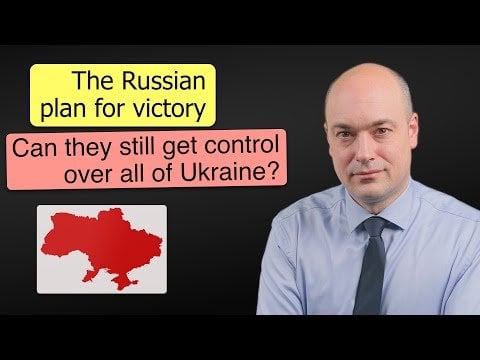
Been thinking of writing a post on this for a while because of all the discussions around it. It's not my area of expertise, so I won't try to pretend it's an effortpost, but I feel like the view I hold and have seen presented by actual experts is pretty logical.
For an actual expert's take on this, I'll link to Anders Puck Nielsen's videos, particularly this one. Probably best to go there for more concrete information: https://youtu.be/MhpoNL1gZbw. He particularly emphasises the point that many western leaders and politicians themselves are probably dangerously misunderstanding this.
So overall, I'm increasingly seeing arguments on here but also coming from politicians in the real world that Ukraine should at this point be pushed to accept a ceasefire with Russia that ends the fighting on current lines, gives Russia control of territory it currently holds and simply ends the war where it is without NATO membership for Ukraine or similar security guarantees. This has obviously come to a head with Trump's recent apparent plans to bring about a ceasefire. The discussion tends to centre around territory, with an implication being that Ukraine is stubbornly refusing to accept territorial losses and should just get over it and accept a ceasefire since they can't retake them militarily. I think this whole way of looking at the issue is missing the key part of the picture.
At some point a couple years ago, it probably was the case that Ukraine outwardly pushed for complete retaking of its territory when that seemed an option. Since then, they've begun to admit that militarily reclaiming territory is very unlikely. It's not the key issue here. The key issue here is, as the Ukrainian government has increasingly said, security guarantees. Some kind of security arrangement, either some kind of NATO membership or, more likely, NATO troops stationed in Ukraine as a deterrent, is the the only way to truly end the war.
Ultimately the key factor in this is Ukraine's future security, not territory, and a simple ceasefire would do nothing to help that: in fact, it would make Ukraine's security position instantly worse, and I think, likely doom it. Russia's modus operandi in modern times is to use ceasefires as a breather when things aren't going well, rebuild their strength, and then strike again when they have the opportunity, regardless of any peace agreements they signed up to. They did this in Chechnya, where Putin decided to go back on an agreement Russia had made with the de facto Chechen government and launch an attack. They did this in 2022 which, after all, followed on from an invasion in 2014 that 'ended' in a ceasefire. Why wouldn't they simply do so again? They absolutely would. Putin's goal remains the complete conquest of Ukraine and maximising Russia's imperial reconquest more broadly. As soon as he believes Russia can win, he will restart the war, and if there isn't any security guarantee to stop him, there'll be no more, and probably a lot less, to stop him than there is now. Ukraine would be destroyed, and the security of Europe placed in jeopardy with a strengthened and ascendant Russia now increasingly confident and with a key opponent removed.
And what would a ceasefire do? It'd advantage Russia. It's simple maths. If Russia is 'winning' while taking 2:1 or 3:1 losses against Ukraine, what would happen if suddenly both sides aren't taking any losses? The net advantage would go to Russia. I'm frankly quite confused why there's the common belief that Ukraine, to avoid losing, must agree to a disadvantageous ceasefire, when their biggest advantage, the one thing keeping them at least relatively safe from destruction right now, is that Russia's forces are being attrited almost as fast as they're being built. Once that's no longer the case, it's a matter of time before Putin completes his conquest.
Security guarantees are what makes the difference, not really arguments over where exactly the new line of control will fall. Ukraine has indicated it would accept 'temporarily' conceding control of territory if it meant gaining security guarantees, and has called for just that. There have been some whispers about European troops being deployed into Ukraine, which would be good, but the allegedly leaked Trump plan doesn't seem to have any of that. This dooms Ukraine, so they probably won't accept, even if refusing risks facing an end to US aid, simply because the alternative is near certain doom in the long term. Of course, the problem is as it stands Russia won't accept a peace agreement that does results in Ukraine getting security guarantees because they want to conquer Ukraine. They must be compelled to do so by stronger economic warfare and backing Ukraine until they're willing to negotiate on this. The alternative, I think, is destruction for Ukraine and decades of insecurity and ruin for Europe. If we're going to push Ukraine into a disadvantageous ceasefire, we might as well accept Ukraine as a state is dead and prepare accordingly, which will be much more costly.
Posted by AP246
4 Comments
There are security guarantees that exist outside of NATO. Ukraine could enter into security agreements with the EU, with France/Germany/UK, or with a “Coalition of the Eastern European Willing” in Poland and the Baltics.
Which country wants to kill and die for Ukriane. List them right here.
That is the difficulty of trying to find a security guarantee.
There are two problems that complicate this:
1. No country wants to send soldiers to fight and die in Ukraine. If one existed, they’d already be there.
2. Russia will not accept a deal that involves such a security guarantee. They might as well accept a deal including Ukraine’s NATO ascension.
The **key issue** in Ukraine underlying EVERYTHING is that the conflict is 10000x more important to Russia than it is to any other country in the West. That’s it. That’s the bottom line. You cannot escape that. There appears to be no cost too great for Russia here. No price they aren’t willing to pay.
So more “sanctions and Ukraine backing” is not going to change this, and unfortunately, that’s all you have to offer in your post to bring Russia to the table.
Since you’re making at full blown post, I’ll reply here as well.
The example of Chechnya is a terrible one. After the first Chechen war (1994-1996), where Russia suffered a minor (albeit humiliating) loss against an army of 10.000, they took **3 years** to reconstitute before going to war again in 1999 against an army that was barely 20.000 strong. Ukraine is not Chechnya, nor is it Georgia, both Ukrainian military forces and Russian losses are worlds apart in both conflicts.
The notion that Russia can reconstitute in a few years an army strong enough to do what they failed to do in 2022 is pure nonsense not “basic maths”. They have burned through most of their Soviet stocks, they’ve already sold their oil and gas for years to come, their economy is in the absolute shitter, their demography is awful, they have lost access to western technologies that are essential to most of their modern military equipment, they will remain under sanctions, … Russia will not come back stronger in 2030 than they were in 2022.
Russia cannot expect much better circumstances in 5 years, unless the Ukrainian army is significantly weakened, either in compliance with Putin’s objective of limiting Ukraine’s military to 80.000 personnel, or through cutting off Western support, financial and military, forcing Ukraine to demobilize to avoid bankruptcy.
Both of these options seem off the table, Ukraine will keep it’s military, and the West will keep providing support.
These few years can be very effectively used to reform the Ukrainian military, have them adopt NATO standards, fire the old Soviet generals, rationalize their equipment, streamline their logistics, stockpile ammunition, harden their infrastructure, connect their energy grid to the European one, fight corruption, … It will also allow European countries to enjoy the fruits of their rearmaments efforts which would allow them to support Ukraine even more effectively in a couple of years than they are able to do now.
A peace that allows Ukraine to maintain it’s current military, continue receive support, is allowed to join the EU and is funded for it’s reconstruction is a Ukraine whose future, both political and economic is secured.
Would immediate NATO membership be better, sure. Would getting back all the territories be nice, sure.
But right now, the outlines of this almost purely speculative deal, seems to be a real and viable solution to the conflict (which is why Putin will not accept it, even if this deal actually existed), and normalizing life in Ukraine should be the priority.
Even if all of the leaks are true, and all the parameters end up being used, but it is still a good minimalist position. I’d like to see Ukraine’s recognition of Russian’s sovereignty over the lost territories dropped though. But aside from that, it is the best deal we could offer Russia while still securing Ukraine’s existence and future.
I don’t know what the negotiating strategy is, if this proposition is made to be further negotiated with Russia, that’s a problem, because that’s as close as I’m willing to cut it personally. However, if the point is to make our best offer first, and then bully Russia into accepting gradually worsening terms, I think that’s a good (overly) generous starting position.
The more the war lasts, the less likely it is refugees will come back, the more soldiers will die, the more money will be used for ammo instead of investments, the fewer babies will be born, … Fighting for 2 or 3 more years just to get NATO membership and not just EU membership isn’t worth demographic collapse in 20 years because an entire generation skipped on having kids, either through emigration of by holding off for better days.