
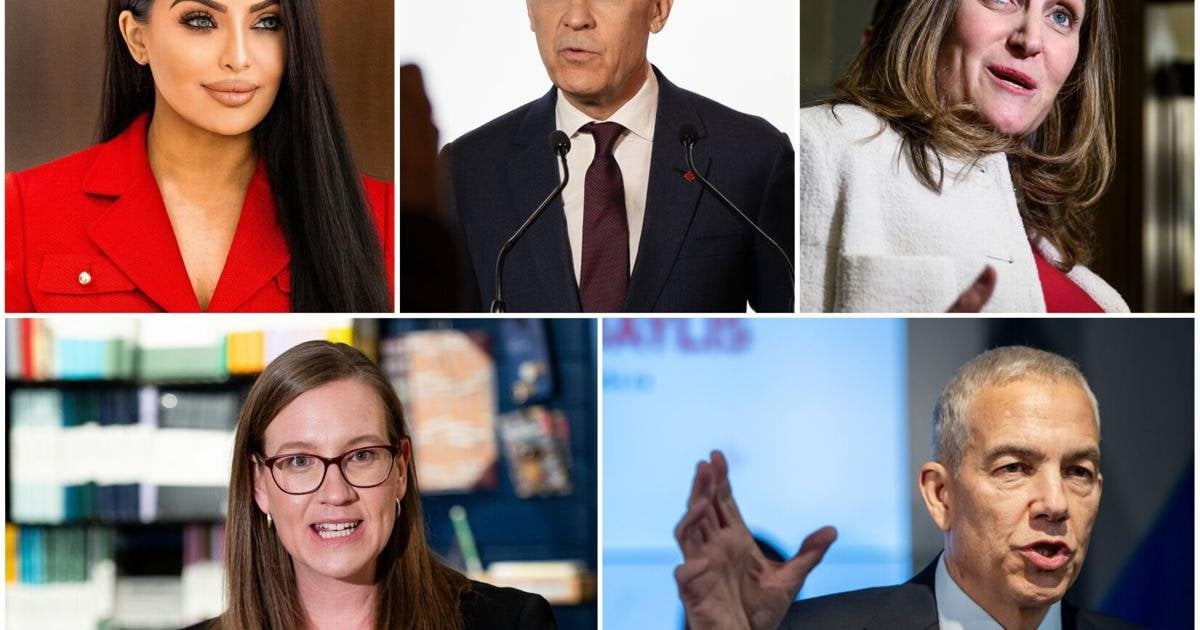
Liberal leadership hopefuls are turning away from some of Justin Trudeau’s policies. Here’s what they say they’ll actually support
Posted by IHateTrains123
Liberal leadership hopefuls are turning away from some of Justin Trudeau’s policies. Here’s what they say they’ll actually support
Posted by IHateTrains123
1 Comment
# With little over a month left before Liberals choose Canada’s next prime minister, the candidates to replace Justin Trudeau are starting to fill out their policy visions.
Defence spending is hot. The consumer carbon price is not. And at least two “czars” are on offer to help solve the nation’s problems.
With little over a month left before Liberals choose Canada’s next prime minister, the candidates to replace Justin Trudeau are starting to fill out their policy visions. There is broad agreement on issues like the desire to preserve Trudeau government social programs, including dental care, child care and public coverage of diabetes medication and contraception.
But gaps are starting to appear between their positions, too, with at least one contender — former Liberal MP Ruby Dhalla — ready to break with current Liberal orthodoxy by calling for lower greenhouse gas emission targets and an examination of whether we should keep pouring aid into war-torn Ukraine.
All five campaigns said Friday that they submitted $125,000 to the party to stay in the race, the latest portion of the total $350,000 entry fee for the contest.
Throughout the race, opposition Conservatives who have long dominated voting-intention polls have argued the slate of contenders — especially perceived front-runners Mark Carney and Chrystia Freeland — are Trudeau policy clones. That’s especially the case on carbon pricing, with Conservative Leader Pierre Poilievre slapping monikers like “Carbon Tax Carney” and “Carbon Tax Chrystia” on the Liberal leadership contenders.
Yet in recent weeks, many of the candidates have turned away from Trudeau policies that they in some cases supported as part of his cabinet.
# Carbon pricing
Carney, the former central banker in Canada and the United Kingdom who signed on as an economic adviser to the Liberal party last fall, says he would scrap the consumer carbon tax-and-rebate scheme that became a political lightning rod for the Trudeau government, and replace it with green incentives. Freeland, who resigned as Trudeau’s finance minister and deputy prime minister in December, would also cancel the policy, along with Dhalla, while Karina Gould — the Burlington MP and former House leader — has said she would freeze it at current levels.
Former Montreal-area MP Frank Baylis, who is also running for the leadership, has said he would review the government’s carbon pricing policy.
None of the candidates has said they would dismantle the federal requirement for industrial carbon pricing, with several arguing heavy emitters need to pay for pollution that is causing the climate crisis, arguing that everyday consumers shouldn’t bear too much of a burden.
The Liberal government has long insisted rebate cheques recycle most revenues from the consumer carbon price and return more money to the average household than is paid because of the policy. A study from University of Calgary economists published in December also concluded carbon pricing has had a “minimal” impact on inflation in Canada since it was implemented nationally in 2019.
When it comes to greenhouse gas emission targets, Freeland, Baylis and Gould would keep the current goals to slash emissions to at least 40 per cent below 2005 levels by 2030, and at least 45 per cent below 2005 levels by 2035. Carney’s campaign said by email that the former central banker would exceed these targets, but did not specify by how much.
Dhalla would go the opposite direction, arguing Canada should lower its climate ambition to ensure citizens aren’t overly burdened. But she didn’t say how much she would decrease the targets.
# Taxes and spending
Meanwhile, all five candidates are trying to position themselves as the top choice to lead Canada into a new period of economic growth. Part of this is evident in veiled criticism of the current Liberal government’s fiscal track.
Freeland, who resigned as finance minister hours before a fiscal update was tabled in Parliament, has suggested the government should not have pursued expensive “gimmicks” like the two-month sales tax holiday on a host of consumer goods, when facing the threat of tariffs from U.S. President Donald Trump. In an email to the Star for this story, Freeland’s campaign said “Chrystia even resigned from the Trudeau cabinet over fiscal responsibility.”
While none of the candidates pledged to balance the federal budget by a certain date, Gould said she would work toward that goal, while Dhalla said she would reduce it.
Candidates have also talked about spurring productivity and economic growth. All five say they would bail on the Trudeau government’s plan to hike capital gains taxes out of concern it will hamper business investment. Freeland has rolled out some details of her economic policy, including a plan to reinstate a tax incentive to encourage private investment and lift a rule that prevents pension funds from investing in more than 30 per cent of a single public company’s shares.
Carney, meanwhile, has said he wants to cut taxes for the middle class and increase competition in the Canadian economy, with further details to come.
Gould has also promised to reduce taxes, in her case by slashing the federal sales tax to four from five per cent for one year, while hiking taxes on big-profit corporations that earn more than $500 million.
Asked about possible tax hikes or cuts, Dhalla said she would review Canada’s “entire tax regime,” while Baylis said he would focus on increasing economic productivity.