
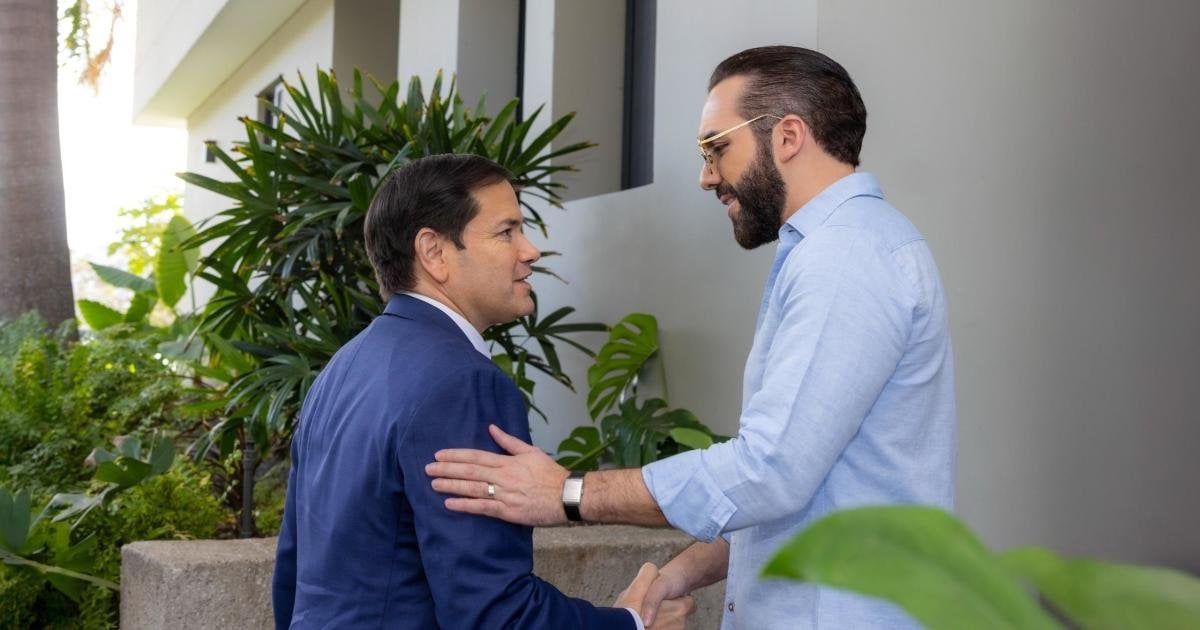
Secretary of State Marco Rubio announced last week that El Salvador's president offered to incarcerate deportees from the U.S. of any nationality, including U.S. citizens, but the deal came the same day as a less-publicized offer from the United States: nuclear power.
El Salvador's Foreign Minister Alexandra Hill Tinoco said a civil nuclear cooperation agreement with the U.S. would help power the central American country "at competitive pricing without depending on geopolitics or on oil prices."
Rubio hailed the nuclear cooperation agreement just before announcing that El Salvador's president, Nayib Bukele, also agreed to take deportees and incarcerated Americans from the U.S. and "put them in his jails."
Bukele said he would charge the United States a "relatively low" fee to house convicted criminals in El Salvador's Terrorism Confinement Center, or CECOT, a mega-prison built to hold up to 40,000 people. He said the nominal cost for America would help make El Salvador's prison system sustainable.
The nuclear agreement is a potential national security win for the United States, according to Edward Kee, who in 2022 was appointed to the Department of Energy's Nuclear Energy Advisory Committee.
El Salvador is unlikely to close in on nuclear power while President Trump is in office, according to Francisco Monaldi, director of the Latin America Energy Program at Rice University's Baker Institute for Public Policy.
Posted by John3262005
3 Comments
I mean legitimately how many prisoners would need to be healed there just to cover the cost of one nuclear plant.
Housing deported criminals to subsidize ES’s nuclear ambitions doesn’t sound equitable to ES’s majority impoverished populace nor the US taxpayers. The nuclear energy would be directed to the Crypto cartels backing El Buke who need the dedicated power source.
Any I’m sure there’s no downside to a country that has largely been run by cartels for most of the last 20 years getting nuclear power.