
The world should call Trump’s bluff on tariffs | You can’t keep giving the bully your lunch money
Posted by ONETRILLIONAMERICANS
The world should call Trump’s bluff on tariffs | You can’t keep giving the bully your lunch money
Posted by ONETRILLIONAMERICANS
5 Comments
> On Tuesday, Trump announced new tariffs on all imports of steel and aluminum. This generated a now predictable cycle in which foreign governments complained and threatened retaliation and lots of analysts wrote tweets and articles explaining why this is a bad idea, while fans of tariffs, like the union-aligned Economic Policy Institute, argued that taxing imported metals “preserves a tool that has helped shore-up critical domestic metals manufacturing with likely minimal impacts on overall consumer price inflation.”
> It’s true that making metal more expensive has only a mild impact on overall consumer price inflation, because most people simply don’t consume that much metal.
> From time to time, of course, we buy things like cars and refrigerators and high-rise apartment buildings that are made out of metal. But the cost of raw metal is a minority of the cost of any of those items; increasing the cost of metal by 25% percent increases the price of cars and fridges by significantly less than that. And metal-containing durable goods are themselves only a modest share of the consumption bundle.
> The flip side of this, as neoliberal shills have been pointing out for years, is that raising the price of raw metal is a bizarre way to bolster manufacturing jobs. Steel and aluminum are inputs into the manufacture of cars, planes, and other complicated finished goods. The goal of a successful industrial policy is to move up the value chain. Jamaica, a poor country that has a lot of bauxite, should be trying to develop an aluminum industry. The United States of America is a rich country. Airliner manufacturing is a rare field in which we retain a clear lead over Chinese capabilities, but we’re on par with what they’re doing in the European Union, and China is trying hard to catch up. Canada and Brazil both have impressive aviation industries. With these tariffs, we’re kneecapping ourselves, and we’re kneecapping the American automotive and appliance industries in export markets.
> But here’s the other thing: It’s not at all clear to me that these tariffs are actually going to happen.
> # Economic coercion not trade policy
> There’s a long-running dispute about what Trump “really thinks” about trade, and I’ll say that I personally am increasingly uncertain that I have a handle on what I think he really thinks.
> What’s clear, though, is what he’s actually doing.
> And what he’s doing is economic coercion that’s closer to a sanctions or embargo regime than it is to classic trade policy that Americans have been debating since Alexander Hamilton’s Report on Manufactures.
> # Stand up to bullying
> A telling counter to Trump’s bluster is his handling of an obscure issue related to trade with China.
> Longstanding American practice is to exempt small, low-value packages from tariffs. This is called the de minimis exemption, and it essentially reflects the fact that it would be a huge logistical pain in the ass to stop every piece of mail to collect taxes on it. It has also historically not been a big deal, because the actual volume of goods sent this way was quite small. The rise of Chinese companies like Temu and Shein has changed that. For years, American warehouses have been full of Chinese-made goods, but new Chinese e-commerce companies ship directly to American consumers from Chinese warehouses. A large number of consumer goods now qualify for the de minimis exemption, and many American retailers feel, reasonably, that this is distortionary and unfair. Trump loves tariffs, and closing this loophole is something that a meaningful American business constituency actually wanted to do. So Trump ordered the loophole closed.
> The problem is there’s no way to actually implement this. The US Postal Service initially said they would respond to Trump’s order by shutting down all packages from China. Trump, worried that American shoppers would notice that his policies were having a material impact on their lives, immediately backed down.
> The reality is that Trump is much more politically threatened by random social media influencers complaining about disruption to their favored retail channels than he is by takes about the rule of law.
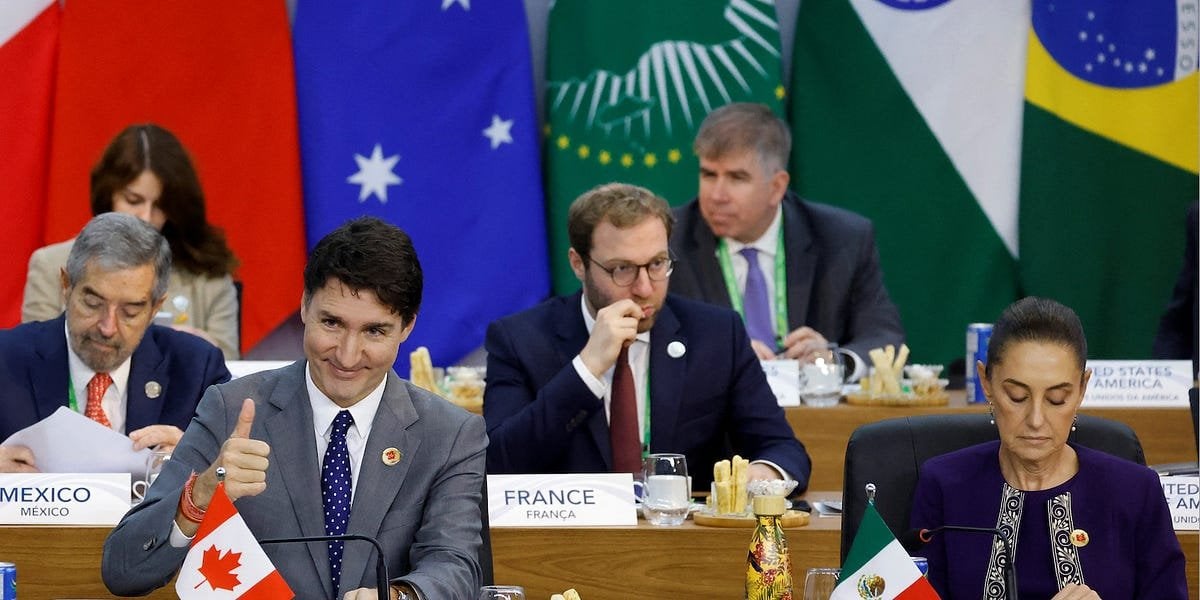
> If a non-China foreign country calls Trump’s bluff in his game of chicken, it is true that the US will feel less pain than Canada or Mexico or whoever else. But the political sustainability of Trump’s position will be low. Democrats would sincerely like nothing better than to light into Trump for directly raising the cost of living when he promised to do the reverse. Lots of Republicans still have free trade sympathies. Much of the currently Trump-aligned business community does not want trade wars and is currently mollified by the argument that Trump’s talk about tariffs is just a bluff.
!ping CONTAINERS&FOREIGN-POLICY
Most of them cannot afford to.
Except China. Xi is not beholden to voters. And Trump has made it very clear he desperately wants to avoid the impact tariffs will have on the US. He keeps backing off his threats.
If they can hold out for a month, Trump will blink before they do.
The world doesn’t need to do this Trump folds under 0 pressure
Retaliate at a personal level by sanctioning Tesla and SpaceX
>Just bell the cat bro come on just put the bell on the cat