Very interesting article about one of the single dumbest economic policies basically ever. And also how the ECB’s TPI basically passed the cost of this onto everyone by buying up the Italian government bonds to prevent a debt crisis.
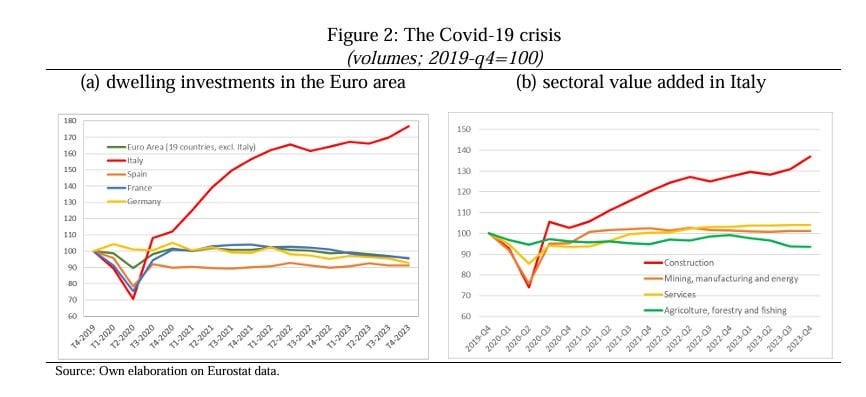
> In the depths of the COVID pandemic, with the ECB committed to keeping sovereign spreads low and the EU fiscal rules suspended, Italy launched what would become one of the costliest fiscal experiments in history. Prime Minister Conte announced that the government would subsidize 110% of the cost of housing renovations.
> rather than direct cash grants, the government issued tax credits that could be transferred. A homeowner could claim these credits directly against their taxes, have contractors claim them against invoices, or sell them to banks. These credits became a kind of fiscal currency – a parallel financial instrument that functioned as off-the-books debt (Capone and Stagnaro, 2024). The setup purposefully created the illusion of a free lunch: it hid the cost to the government, as for European accounting purposes the credits would show up only as lost tax revenue rather than new spending.
> Contractors often inflated renovation costs; for instance, a €50,000 project might be reported as €100,000. The bank would purchase the €110,000 tax credit at near face value, enabling the contractor to pocket the difference, sometimes sharing it with the homeowner. At times, no work at all was carried out, in which case, invoices for non-existent work on fake buildings were a perfect tool for organized financial crime. Fraudulent credits could then be resold multiple times in an unregulated market of state-backed tax discounts
> Once started, the Superbonus proved politically impossible to stop. The benefits were concentrated among vocal constituencies: homeowners getting renovations, the environmental movement, and contractors seeing booming business. The costs, while enormous, were spread across all taxpayers and pushed into the future through the tax credit mechanism. No government—leftist, technocratic, or right-wing—was able to resist its logic.
Two_Corinthians on
>Riccardo Fraccaro – a lawyer, Five Star Movement politician, Modern Monetary Theory adherent and architect of the SuperBonus – saw the program as a way to push a fiscal expansion while complying with EU rules. By designing the Superbonus as a system of transferable tax credits, Fraccaro and his advisors sought to create a parallel financial instrument that did not immediately register as public debt (Capone and Carlo Stagnaro, 2025).

2 Comments
Very interesting article about one of the single dumbest economic policies basically ever. And also how the ECB’s TPI basically passed the cost of this onto everyone by buying up the Italian government bonds to prevent a debt crisis.
> In the depths of the COVID pandemic, with the ECB committed to keeping sovereign spreads low and the EU fiscal rules suspended, Italy launched what would become one of the costliest fiscal experiments in history. Prime Minister Conte announced that the government would subsidize 110% of the cost of housing renovations.
> rather than direct cash grants, the government issued tax credits that could be transferred. A homeowner could claim these credits directly against their taxes, have contractors claim them against invoices, or sell them to banks. These credits became a kind of fiscal currency – a parallel financial instrument that functioned as off-the-books debt (Capone and Stagnaro, 2024). The setup purposefully created the illusion of a free lunch: it hid the cost to the government, as for European accounting purposes the credits would show up only as lost tax revenue rather than new spending.
> Contractors often inflated renovation costs; for instance, a €50,000 project might be reported as €100,000. The bank would purchase the €110,000 tax credit at near face value, enabling the contractor to pocket the difference, sometimes sharing it with the homeowner. At times, no work at all was carried out, in which case, invoices for non-existent work on fake buildings were a perfect tool for organized financial crime. Fraudulent credits could then be resold multiple times in an unregulated market of state-backed tax discounts
> Once started, the Superbonus proved politically impossible to stop. The benefits were concentrated among vocal constituencies: homeowners getting renovations, the environmental movement, and contractors seeing booming business. The costs, while enormous, were spread across all taxpayers and pushed into the future through the tax credit mechanism. No government—leftist, technocratic, or right-wing—was able to resist its logic.
>Riccardo Fraccaro – a lawyer, Five Star Movement politician, Modern Monetary Theory adherent and architect of the SuperBonus – saw the program as a way to push a fiscal expansion while complying with EU rules. By designing the Superbonus as a system of transferable tax credits, Fraccaro and his advisors sought to create a parallel financial instrument that did not immediately register as public debt (Capone and Carlo Stagnaro, 2025).