
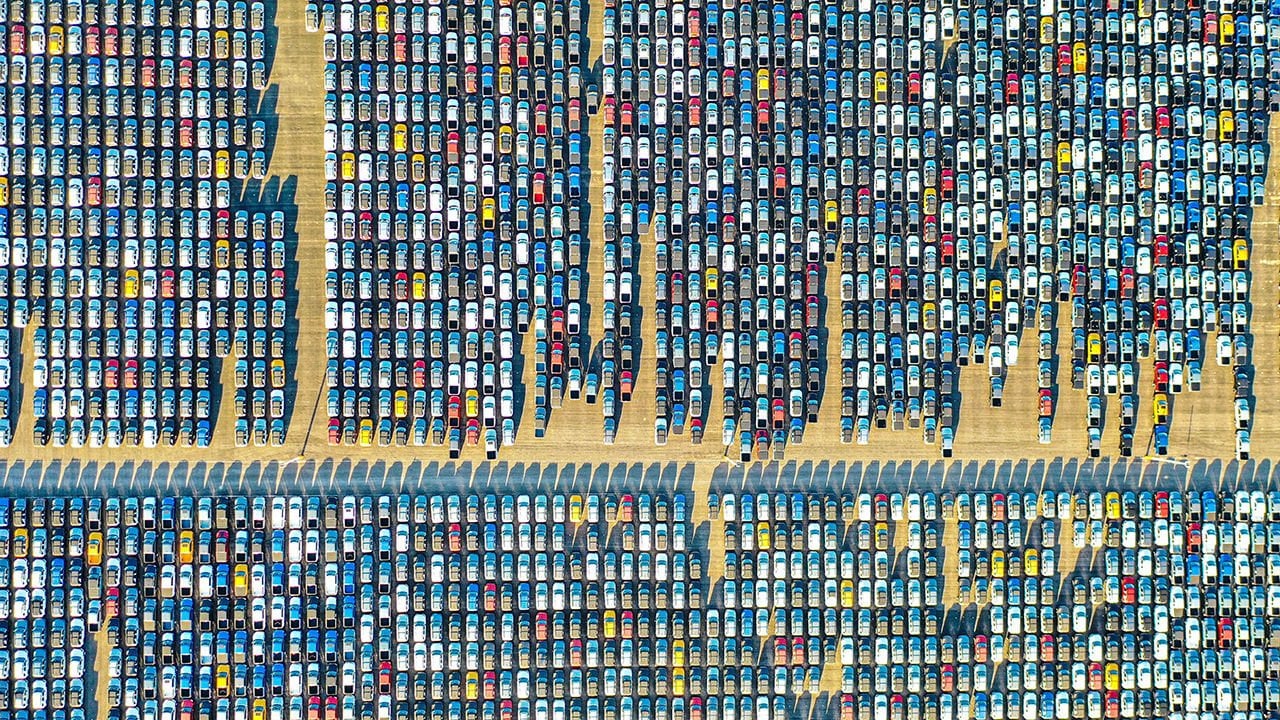
How Trump’s tariffs could crush American carmakers | “Tariffs of 25% would wipe out the profits of Detroit’s car giants if they did not raise prices or alter production, estimates Barclays”
Posted by ONETRILLIONAMERICANS
How Trump’s tariffs could crush American carmakers | “Tariffs of 25% would wipe out the profits of Detroit’s car giants if they did not raise prices or alter production, estimates Barclays”
Posted by ONETRILLIONAMERICANS
8 Comments
> Together cars and parts are vital to America’s trading partners, accounting for 31% of all Mexico’s exports to America, worth around $150bn, and 14% of Canada’s, valued at over $55bn, according to Barclays, a bank. Those exports also make up a big chunk of the American market. Cars made in Mexico accounted for 15% of sales by volume in America in 2024 and those made in Canada nearly 7%; together they made up 16% of sales by value. It is quite likely that every car made in America contains components made in one of the two countries.
> Mr Trump’s tariffs are supposedly intended to encourage Mexico and Canada to stem the flow of migrants and illegal drugs across the borders, to reduce trade deficits and to encourage American companies to relocate manufacturing back home, thus helping to revive America as a manufacturing superpower. It may well do none of these, but it will certainly damage carmakers—and Detroit’s “Big Three” will take the worst battering. Jim Farley, the boss of Ford, is not given to hyperbole. Yet he has described the impact as “devastating”.
> Mr Farley has cause for alarm, even though Ford is the least troubled of the Big Three by the new tariffs. Only a quarter of its sales cross the borders (see chart 2), and these are mostly smaller, cheaper vehicles. Stellantis (whose largest shareholder, Exor, is a part-owner of The Economist’s parent company) imports around 40% of all the cars it sells in America from Mexico and Canada, according to Bernstein, a broker, while General Motors’ share is nearly a third. Both assemble around 40% of their pricey and profitable pickups in Mexico or Canada. Tariffs of 25% would wipe out the profits of Detroit’s car giants if they did not raise prices or alter production, estimates Barclays.
> The damage would not be confined to American firms. Mexico’s allure as a destination to make and export cars has been boosted by free-trade agreements with 50 other countries, encouraging the world’s car firms to supplement factories in America with plants in Mexico, serving markets there, in America and elsewhere. Over 43% of Volkswagen’s and 27% of Nissan’s American sales are of cars made in Mexico, points out s&p Global Mobility, a data firm. bmw, Mercedes-Benz, Toyota, Honda and Hyundai also export cars from Mexico to America.
> Asian and European firms face further pain if Mr Trump goes ahead with mooted 25% tariffs on their imports from elsewhere in the world. He is unlikely to remain content with current tariffs of 2.5% on cars from Europe (which puts a 10% levy on imports of American cars) and Japan (which puts no tariffs on American cars) and nothing on South Korea (which also imposes nothing in return).
> Tariffs add another layer of uncertainty to an industry undergoing fundamental upheaval, as electrification and the rising importance of software hand the advantage to younger, nimbler Chinese manufacturers. At least 100% tariffs on Chinese electric vehicles, imposed during Joe Biden’s presidency, will keep America’s car firms safe from that competition.
!ping CONTAINERS
I live in Metro Detroit and the amount of white and blue collar auto workers who voted for him is astounding. Plenty of very talented engineers who don’t understand economics or policy at all.
Just goes to show that intelligence is selective for most people
I read somewhere that most new car buyers are older since the high prices of new cars and they have the highest incomes and net worths, i think the biggest share of new car buyers are 55+. I wonder if declining stock prices will lead to less cars bought due to declining net worth.
If Obama or Biden did it, Trump wants to destroy it. Apparently that applies to Obama’s rescue of Detroit.
>How could the democratic establishment and their “free trade disaster” do this to us?
-blue collar union workers, probably
President Xi, send Zeekr 001 shooting brake performance luxury car with the blue exterior and green interior and for max $55,000 CAD. I yearn for freedom
Yesterday, this car dealer said that nobody is going to want to buy cars if they’re $20,000 more. He said he was fine with buying American goods but you can’t build a car plant overnight. Maria Bartiromo then freaked out and said,
“How many Dodge Rams do you see around Europe, OK? How many Dodge Rams do you see driving around India? Not many, I bet. Why? Because they don’t buy our cars! And that’s what President Trump is trying to change. Maybe Dodge should start building them here and selling them here.”
What profits of Detroit car giants???