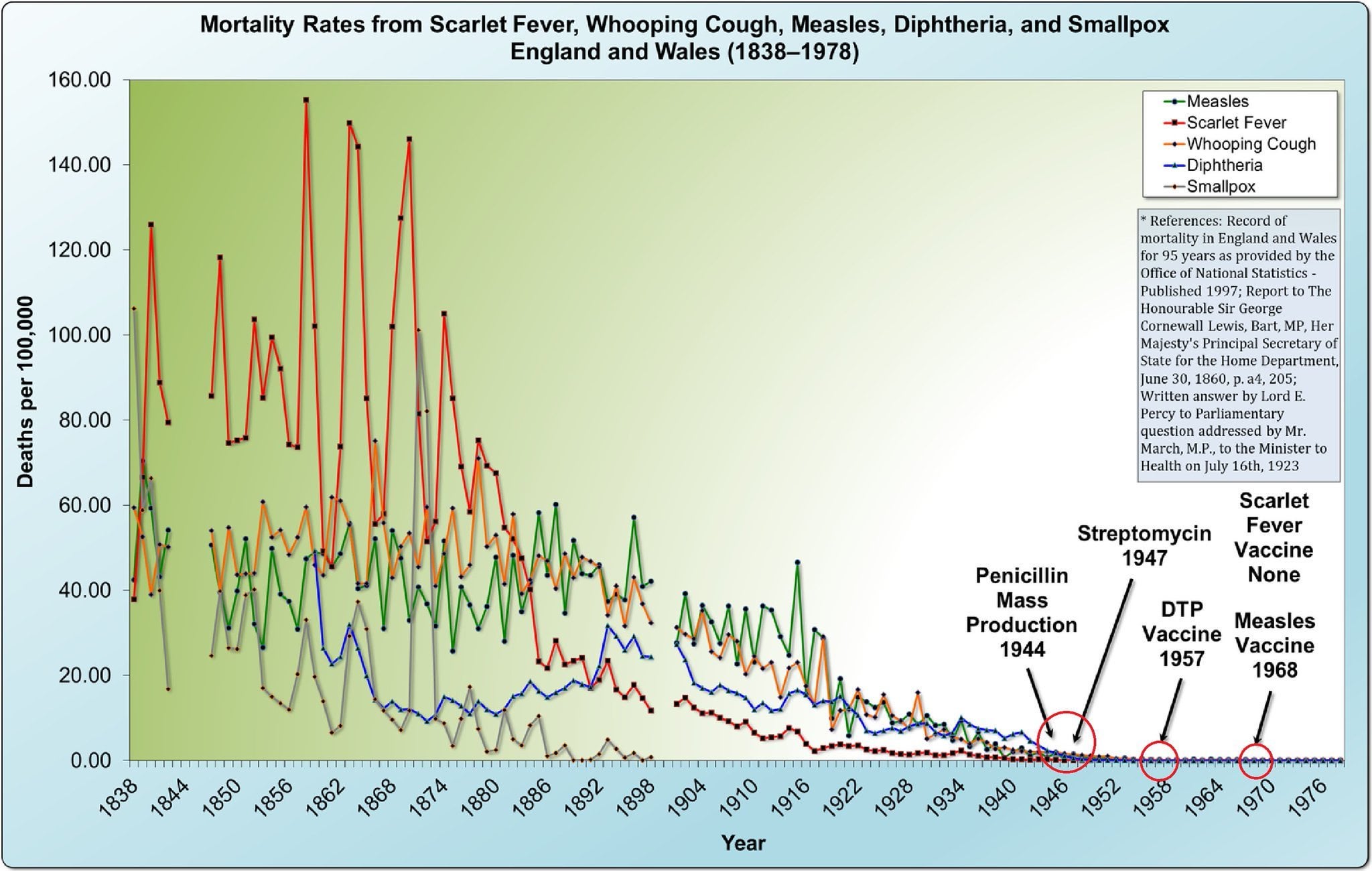
The mortality graph of England and Wales (1838-1978) reveals a pronounced decline in deaths from Scarlet Fever, Whooping Cough, Measles, Diphtheria, and Smallpox throughout 1900-1940s, significantly predating widespread antibiotic use (Penicillin-1944, Streptomycin-1947) and vaccination programs (DTP-1957, Measles-1968). This epidemiological transition represents a crucial period where combined public health interventions dramatically reduced infectious disease mortality despite limited pharmaceutical tools, with Scarlet Fever notably declining without any vaccine development, demonstrating that medical breakthroughs alone cannot explain the mortality reduction pattern observed across multiple pathogens with different transmission mechanisms.
The 1900-1940s mortality decline stemmed from an interconnected revolution in public health infrastructure coinciding with socioeconomic improvements, including the implementation of municipal sewage systems, water filtration and chlorination technologies, improved urban planning reducing population density, and formalized public health departments alongside enhanced nutritional status across populations through better food preservation methods, understanding of vitamin deficiencies, improved housing quality, and reduced overcrowding, collectively diminishing pathogen exposure while strengthening population-level immune responses during a period when Britain’s industrial cities were transforming their environmental conditions and population health governance structures.
Pre-antibiotic medical advances contributed through practical applications of germ theory in clinical and community settings, improved hospital hygiene protocols, development of passive immunization techniques like diphtheria antitoxins (1890s), effective quarantine implementation, and enhanced diagnostic capabilities, while natural epidemiological factors including cyclical patterns in pathogen virulence, evolving population immunity profiles, reduced case-fatality rates through improved supportive care, and demographic shifts altered disease transmission dynamics, collectively demonstrating how this remarkable public health achievement resulted from environmental, social, nutritional and early medical interventions—a pattern aligning with the McKeown Thesis that major infectious disease mortality declines in developed countries preceded modern medical interventions, though with important nuances acknowledging early public health science contributions.
[deleted] on
[deleted]
OrinThane on
No, it wasn’t just vaccines, it was medicine. Many, many steps on that journey spanning thousands of years led to us creating antibiotics and vaccines and they have absolutely lengthened lifespans. They are not perfect but to say they did not save us is an incredibly uninformed position to take.

4 Comments
SS
The mortality graph of England and Wales (1838-1978) reveals a pronounced decline in deaths from Scarlet Fever, Whooping Cough, Measles, Diphtheria, and Smallpox throughout 1900-1940s, significantly predating widespread antibiotic use (Penicillin-1944, Streptomycin-1947) and vaccination programs (DTP-1957, Measles-1968). This epidemiological transition represents a crucial period where combined public health interventions dramatically reduced infectious disease mortality despite limited pharmaceutical tools, with Scarlet Fever notably declining without any vaccine development, demonstrating that medical breakthroughs alone cannot explain the mortality reduction pattern observed across multiple pathogens with different transmission mechanisms.
The 1900-1940s mortality decline stemmed from an interconnected revolution in public health infrastructure coinciding with socioeconomic improvements, including the implementation of municipal sewage systems, water filtration and chlorination technologies, improved urban planning reducing population density, and formalized public health departments alongside enhanced nutritional status across populations through better food preservation methods, understanding of vitamin deficiencies, improved housing quality, and reduced overcrowding, collectively diminishing pathogen exposure while strengthening population-level immune responses during a period when Britain’s industrial cities were transforming their environmental conditions and population health governance structures.
Pre-antibiotic medical advances contributed through practical applications of germ theory in clinical and community settings, improved hospital hygiene protocols, development of passive immunization techniques like diphtheria antitoxins (1890s), effective quarantine implementation, and enhanced diagnostic capabilities, while natural epidemiological factors including cyclical patterns in pathogen virulence, evolving population immunity profiles, reduced case-fatality rates through improved supportive care, and demographic shifts altered disease transmission dynamics, collectively demonstrating how this remarkable public health achievement resulted from environmental, social, nutritional and early medical interventions—a pattern aligning with the McKeown Thesis that major infectious disease mortality declines in developed countries preceded modern medical interventions, though with important nuances acknowledging early public health science contributions.
[deleted]
No, it wasn’t just vaccines, it was medicine. Many, many steps on that journey spanning thousands of years led to us creating antibiotics and vaccines and they have absolutely lengthened lifespans. They are not perfect but to say they did not save us is an incredibly uninformed position to take.
Indoor plumbing saved us.