
Congestion pricing is a policy miracle | Traffic is down, public transit is up, the city is safer, and business is booming
Posted by ONETRILLIONAMERICANS
Congestion pricing is a policy miracle | Traffic is down, public transit is up, the city is safer, and business is booming
Posted by ONETRILLIONAMERICANS
3 Comments
# Traffic is down
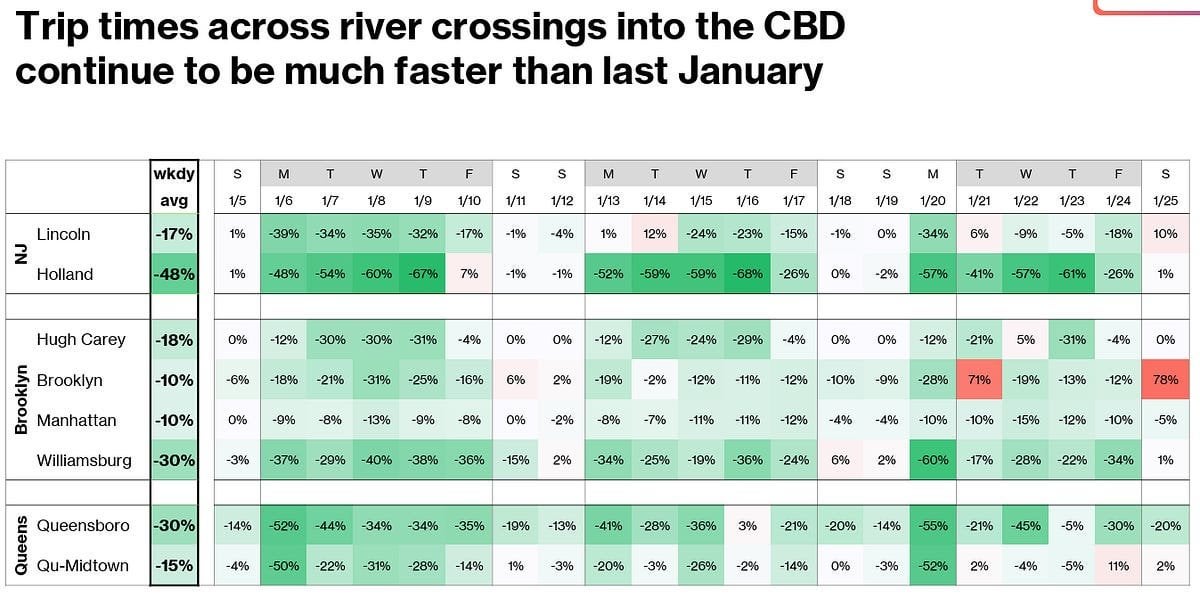
> In the first month of congestion pricing, the MTA reported over 1 million fewer vehicle entries into the toll zone than would be expected without the program, driving the significant traffic reduction seen above. It’s also worth noting that the above chart shows reduction in travel times rather than congestion—in many cases, congestion has completely disappeared, and the new travel times represent a congestion-free trip. This reduction reverses a years-long trend of rising traffic into Manhattan – congestion pricing took a worsening gridlock problem and solved a significant portion of it overnight. Additionally, while there were fears that congestion pricing would just re-route traffic to other boroughs, the data from the first months of congestion pricing suggests that traffic has not increased elsewhere in the city.
# Public transit is up
> The MTA as a whole is averaging 448K more public transit riders per day this year. To put this into perspective, the second-highest ridership subway in the US is the DC Metro, which averaged 304K riders per day in January this year. The MTA ridership growth since congestion pricing went into effect is almost 50% larger than the total ridership of America’s next-largest subway system.
# The city is safer
> One of the loudest criticisms of congestion pricing is that it “forces people to take the unsafe subway.” Putting aside the fact that the subway is already far safer than driving, increased transit ridership has driven down subway crime as more “eyes on the train” reduce the appeal of crime and make the system more safe. In January of 2025, subway crimes were down 37% vs. 2024. This is on an absolute basis, and when adjusting for ridership, the rate of crime went from one crime per 397K riders to one crime per 672K riders. To put that number into perspective, if someone rode the train twice per day, every day, for the next fifty years, that’s ~36,500 rides, and that rider would have only a ~5% chance of ever being a victim of a crime over the course of their lifetime. The risk of being a crime victim on the subway was already slim, but it’s exceedingly so now that congestion pricing has raised ridership and made the trains safer. On top of that, congestion pricing will likely be used to help fund improved fare gates that will further increase safety in the system.
# Business is booming
> there’s been increased foot traffic, retail sales, restaurant reservations, and Broadway attendance since congestion pricing went into effect. Here are some specific stats compiled by the MTA at a recent board meeting comparing Jan/Feb of 2025 vs. the same weeks of 2024:
> * Broadway attendance is up 21%
> * Restaurant reservations are up 7%
> * Pedestrian traffic is up by 4%
> * Retail sales are up $900M and retail occupancy is up .5%
> * Commercial leasing is up 61%
> Additionally, a recent study found that congestion pricing will boost NYC’s economy by up to $1.3 billion and that scrapping congestion pricing would cost the state 100k jobs.
!ping YIMBY&TRANSIT&USA-NYC
Please Chairman Hochul. Do not let the feds submarine this 🙏🏼
* In the first month of congestion pricing, the MTA reported over 1 million fewer vehicle entries into the toll zone than would be expected without the program
* In January of 2025, subway crimes were down 37% vs. 2024.
* crashes and associated injuries have fell more than 50% in January 2025 vs. 2024
* honking complaints have decreased by 69% in the congestion relief zone, marking a significant improvement in quality of life.
* traffic has not increased elsewhere in the city
* in many cases, congestion has completely disappeared […] This reduction reverses a years-long trend of rising traffic into Manhattan
* The MTA as a whole is averaging 448K more public transit riders per day this year.
* And it’s not just the MTA – buses in New Jersey are seeing significantly faster travel times.
* Broadway attendance is up 21%
* Restaurant reservations are up 7%
* Pedestrian traffic is up by 4%
* Retail sales are up $900M and retail occupancy is up .5%
* Commercial leasing is up 61%
Talk about a miracle. Results are way better than I was expecting. Very important consideration from the author at the end, that points out how highway widenings are an extremely expensive way to try to accomplish the same as congestion pricing, but miserably fail due to induced demand.
> I’d recommend supporting Steve Fulop in the upcoming New Jersey governor primary, who has far and away the best transportation plan for New Jersey.
Quoting this part too, just in case.