
Tariffs and the Hidden Chains of Modern Slavery
America’s addiction to cheap labor didn’t begin in the 20th century—it was baked into our nation’s DNA from the start. In the 1800s, the Southern economy was fueled by human bondage. Slavery wasn’t just a tolerated institution—it was defended as a moral good. Southern Democrats of the era praised slavery as a system that “civilized” Africans and provided them with a “better life.” This was the lie that kept millions in chains: that suffering could be justified if it served the economy.
The Republican Party emerged in open rebellion against this mindset. Abraham Lincoln’s presidency was a direct threat to the slaveholding status quo, and the Southern elite knew it. They saw their economic model threatened—not just their culture, but their profits. That fear led to secession and, eventually, to war.
But while the Civil War legally ended slavery, it did not end America’s appetite for cheap, disposable labor. It simply changed its form.
Fast forward to today, and you’ll find that slavery hasn’t disappeared—it’s just outsourced. Instead of American plantations, we have overseas sweatshops. Instead of cotton fields in Georgia, we have electronics factories in China. The system is just as brutal, just as exploitative, and just as invisible to most consumers.
Corporations like Nike, Apple, and countless clothing brands rely on supply chains that stretch through countries with minimal labor laws. A 2023 report from Walk Free’s Global Slavery Index revealed that garment imports by G20 nations—worth nearly $148 billion—are at high risk of being produced through forced labor. These numbers are not hypothetical. They are real. They represent real children sewing shoes, real women locked in factories, and real people living lives that bear a haunting resemblance to slavery.
When we buy these products, we are not just consumers—we are participants in a global system of exploitation. And the worst part is, we’ve normalized it. We laugh about “sweatshops” on late-night TV. We ignore the tags. We close our eyes.
For over a century, America has steadily shifted much of its industrial and manufacturing base overseas, enabling a system where cheap goods are made possible by the exploitation of labor in foreign nations. This system—while convenient and profitable—mirrors the economic logic of antebellum slavery: a few benefit richly from the labor of many, often without the laborers' rights, fair wages, or freedom.
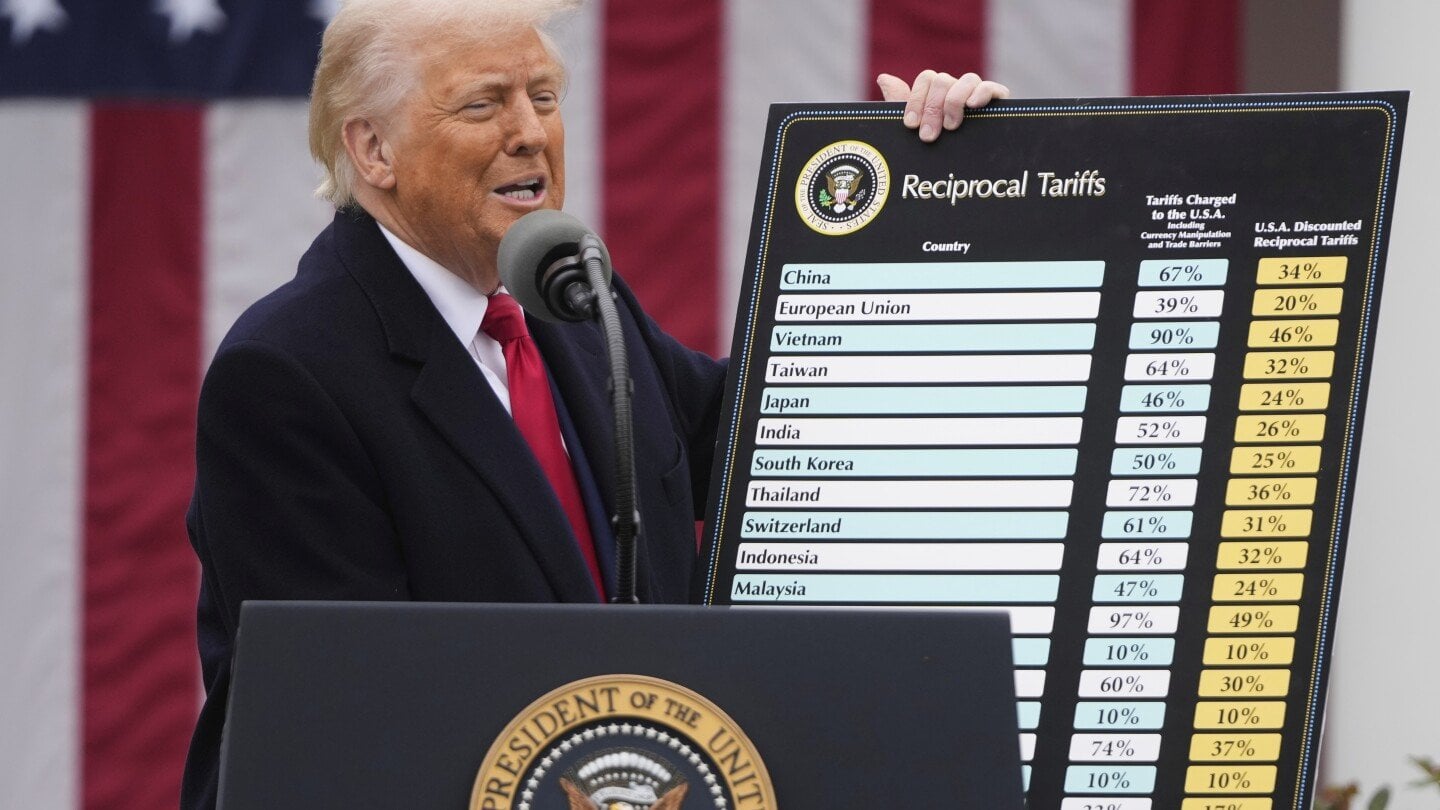
The recent tariffs issued by President Trump in April 2025—starting with a 10% blanket tariff on imports and rising to 34% for Chinese goods and 20% for EU products—are not just about trade balances or manufacturing jobs. They are a long-overdue moral correction.
(AP News)
These tariffs strike directly at the heart of America’s hidden dependency on modern-day slavery. By raising the cost of goods produced under unethical conditions abroad, they give American-made goods—produced under labor laws, wage protections, and workplace safety regulations—a fighting chance to compete. It’s not merely economics; it’s ethics.
Too long have American consumers and corporations benefited from what amounts to outsourced bondage. Whether it’s child labor in Pakistan’s garment factories, forced labor in Xinjiang, or 16-hour shifts in Vietnamese electronics plants, we have built an economy where hidden suffering fuels our comfort.
These tariffs disrupt that cycle. They expose the true cost of “cheap” goods and force a national reckoning with what kind of labor we are willing to support. They aren’t perfect, and they may cause short-term economic discomfort. But freedom, dignity, and human rights are worth more than savings at the checkout line.
Critics may say these tariffs will raise prices. Perhaps they will. But the real question is: should Americans continue buying cheap goods if they are cheap only because another human being suffered to make them?
This is not about nationalism—it’s about moral responsibility. If we claim to stand against slavery, then we must put our money where our mouths are. Tariffs are one of the few tools powerful enough to make a real difference, and we must wield them unapologetically to begin severing our economic ties to modern slavery.
America’s dependence on exploited labor did not end with the Emancipation Proclamation—it evolved. When the Civil War abolished slavery in name, the economic forces that had relied on unpaid or underpaid labor didn’t disappear. They adapted. And over the past 150 years, American policymakers—intentionally or not—built new systems that continued to serve the same end: cheap labor for the benefit of elites.
In the 1920s and 1930s, American industry took a serious blow. Some of this collapse was due to economic mismanagement and unchecked speculation, but it was also enabled by a growing disregard for domestic manufacturing. Instead of rebuilding that industry with a strong labor-first foundation, political leaders found a workaround: subsidize consumption through government programs and source production elsewhere.
The New Deal under President Franklin D. Roosevelt is often credited with saving the American economy. And while it did provide relief to millions, it also marked the beginning of a shift where the government would prop up demand at home while allowing production—dirty, dangerous, and exploitative—to migrate abroad. Over time, this laid the foundation for the post-World War II boom in globalism, offshoring, and foreign dependency.
Today, most Americans can’t afford to live without foreign-made goods. Not because they’re inherently better—but because we have allowed our own industrial base to erode in favor of cheaper labor abroad. And here's the truth most politicians won't say: we replaced American slavery with a global version of it.
We must call this what it is: economic cowardice wrapped in moral blindness. And we must reject it.
This is not a problem we can shrug off or leave to politicians. This is about each of us.
If you live in America today, you are likely surrounded by the fruits of modern slave labor. The phone in your hand. The clothes in your closet. The furniture in your living room. The shoes on your feet. If you trace their origins—really trace them—you’ll find a chain of suffering that led from a factory overseas to your doorstep.
We must stop pretending we’re not part of the system. We are. And that means we have the power—and the responsibility—to change it.
Start simple: look around your home. Take inventory. Check the tags on your clothes. Research where your favorite brands manufacture their products. Ask yourself: Would I still wear this if I knew it was made by a 12-year-old working 16-hour shifts with no days off?
If the answer is no, then action is required. Support companies that manufacture ethically and transparently. Demand that lawmakers not only maintain but expand tariffs against nations that tolerate or profit from forced labor. Stop supporting corporations that outsource morality for margins.
More than that, we must demand the rebuilding of America’s industrial base—not just to compete globally, but to prove that a free nation does not need slavery, in any form, to survive.
This is the test of our generation: to finally, fully sever the economic chains of slavery that our ancestors began breaking over 150 years ago—but never finished.
Tariffs are not the end of that process, but they are a start. They are a line in the sand, a refusal to keep hiding our complicity behind cheap prices and outsourced suffering.
This moment demands moral clarity. It demands courage. It demands that we, the people, stand up and say:
Not in our name. Not with our dollars. Not anymore.
-
AP News. (2025). "Trump announces sweeping new tariffs."
https://apnews.com/article/trump-tariffs-liberation-day -
Walk Free Foundation. (2023). Global Slavery Index.
https://www.voguebusiness.com/sustainability/modern-slavery-is-on-the-rise-fashions-role-remains-steady -
BBC Panorama. (2001). Nike: Just Do It?
-
International Labour Organization. (2022). Global Estimates of Modern Slavery.
https://www.ilo.org/global/topics/forced-labour/lang–en/index.htm -
White House. (2025). Fact Sheet on National Tariff Policy.
https://www.whitehouse.gov/fact-sheets
Posted by Budget-Composer-8175