
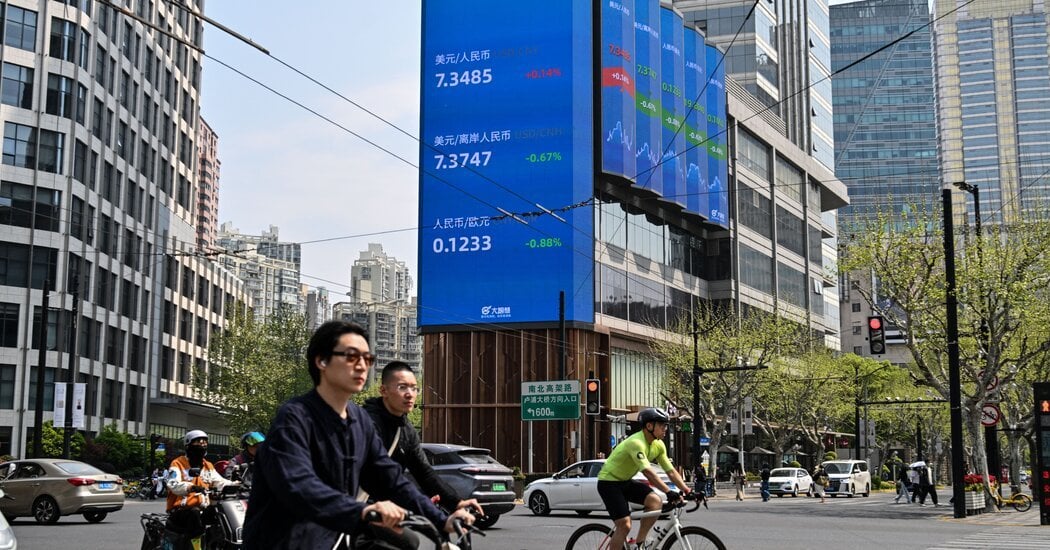
Chinese censors appeared to be carefully curating public discussion about the U.S. tariffs that took effect on Wednesday. They promoted criticism of the United States, while seemingly playing down the specifics of how President Trump’s move would effectively increase import taxes on Chinese goods to 104 percent.
On Weibo, a popular social media platform, several hashtags that used the number 104 — such as “104 tariff rate” or “America to impose 104 percent tariff on Chinese goods” — returned an error message that said: “Sorry, the content of this topic is not displayed.”
But other hashtags that focused more squarely on mocking the United States, or on touting China’s strengths, were allowed to trend — and in fact were explicitly initiated by state media. “America is fighting a trade war while begging for eggs” was one popular hashtag started by CCTV, China’s state broadcaster. “China does not provoke trouble but is never afraid of it” was another.
State media outlets adopted a similarly swaggering tone in their coverage. Several opinion pieces in the People’s Daily, the Chinese Communist Party’s official mouthpiece, declared that China had learned from years of trade frictions to diversify and shore up its economy. “In Chinese people’s genes, we never fear any risks, challenges, difficulties or contradictions, and can regard all kinds of external pressure as the driving force for our own progress,” one piece said.
Other pieces did not directly reference the tariffs but still touted the strengths of the Chinese economy. A front-page article in the People’s Daily laid out steps that the government would take to promote employment for fresh graduates.
Though some users described worries about the trade war’s repercussions, voices expressing dissent or concern were generally limited.
It was not clear whether other more negative posts had been censored, or why censors had targeted the hashtags about the 104 statistic in particular. Many individual posts that mentioned the figure were still visible, even as the hashtags themselves were blocked, and they generally expressed confidence about China’s prospects in the trade war.
But the government likely wanted to direct attention away from the specifics of the high tariff rate, because of the severe implications it could have for the Chinese economy, said Ja Ian Chong, a professor of political science at the National University of Singapore.
Posted by John3262005
1 Comment
I guess maybe they dont like people critisizing government decisions, even if its not their own??? Or idk