
What it means to tell the truth about America | And what happens when empirical fact is labeled “improper ideology”
Posted by ONETRILLIONAMERICANS
What it means to tell the truth about America | And what happens when empirical fact is labeled “improper ideology”
Posted by ONETRILLIONAMERICANS
2 Comments
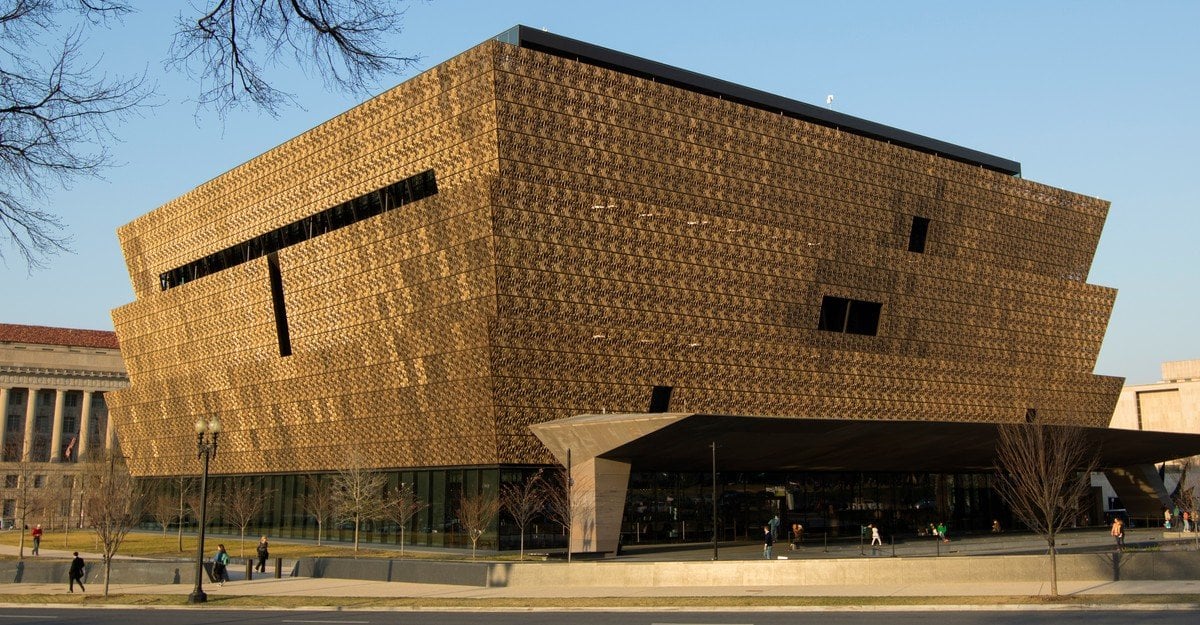
> Elizabeth Hays, a white woman from central North Carolina, had never been to the National Museum of African American History and Culture. But earlier this month, after she read about Donald Trump’s executive order targeting the museum and others throughout the Smithsonian system, she made the nearly five-hour drive up to Washington, D.C., to visit. She was worried that if she waited any longer, she might encounter a sanitized version of the museum, or no museum at all.
> She told me this in front of a display focused on contemporary manifestations of Black protest. Elisa Hill, a Black woman from Maryland, was visiting that day too. “I’m very worried about what’s going to happen here,” Hill told me, shaking her head. “Because it represents the history that we all need to know and understand. I’m just afraid that it’s going to be censored.”
> I, too, had carried this concern since hearing about the executive order. I tried to contact museum officials—including Lonnie Bunch, the head of the Smithsonian and the founding director of NMAAHC—but each person I reached out to was unavailable. I was not surprised by this response. Smithsonian officials no doubt fear that if they speak publicly about the executive order, then they, and the institution, might be further targeted. So instead, I made a trip to NMAAHC, hoping to talk directly with people there and take stock of what might be lost.
> Every time I visit NMAAHC, the first person I think of is Ruth Odom Bonner. On September 24, 2016, President Barack Obama and first lady Michelle Obama stood alongside the 99-year-old Bonner—and three other generations of her family—to ring the bell signaling the opening of the museum to the public. Bonner’s presence that day was significant because she was the daughter of a man who was born into slavery. Not the granddaughter. Not the great-granddaughter. The woman who opened NMAAHC was the child of a man born in bondage. His name was Elijah Odom.
> As a young boy, Odom and his brothers had escaped to freedom. He became a farmer, lived through Reconstruction and Jim Crow, and ultimately attended and graduated from medical school, becoming the only practicing Black physician in his community of Bisco, Arkansas. Elijah Odom’s life represented the possibility that existed on the other side of slavery. In 2016, his daughter Ruth was a reminder that the history presented in the museum she helped inaugurate did not happen all that long ago.
> The history inside the museum still reverberates through our country. It is impossible to understand the contemporary landscape of social, political, and economic inequality without understanding the forces and events that served as its catalysts. This is why so many have worked so hard to silence this history.
> Upon my arrival at NMAAHC, I stumbled onto a tour of a new exhibit, “In Slavery’s Wake: Making Black Freedom in the World,” a project that places the experiences of slavery, colonialism, and freedom-making across the world in conversation with one another.
The docent leading the tour, Edward Flanagan, was a Black man who looked to be in his 80s. He wore a black long-sleeve shirt with the face of James Baldwin alongside his words: “Ignorance allied with power is the most ferocious enemy justice can have.”
> “The only way that slavery works is the continued public application of violence and terror,” Flanagan told the group. He laced his hands together in front of his body. “Also, race does not exist. It is a social construct made necessary by unrestrained capitalism, colonialism, and the slave trade. Those three items are going to come up again and again and again. Those are the things that have formed your world.”
> This idea, that capitalism, slavery, and colonialism are the forces that have shaped our contemporary world, is central to the exhibit. And it occurred to me, listening to Flanagan, that this was the exact sort of story that Trump and many of his allies would like to excise from museums, classrooms, and every other realm of American life.
What would it mean if every American understood, as Flanagan said, that a large portion of the country’s millionaires in the mid-19th century lived along the Mississippi? Or, as he later shared, that many of our most prestigious universities established before 1865 were built using the profits of chattel slavery? These are empirical facts, not ideological ones. And as more Americans have come to understand this history, they have, appropriately, begun to question much of what they have been taught about America.
> Many universities, for instance, have begun in recent years to acknowledge the ways slavery provided the capital for their infrastructure, and the fact that such infrastructure was often literally constructed by enslaved laborers. Commissions have been formed. Memorials have been erected. New courses have been offered. It is perhaps not a coincidence, then, that these are some of the same institutions that have been most directly targeted by Trump, who has threatened to pull federal funding from universities that engage in anything that falls under his nebulous definition of DEI. Many colleges and universities are capitulating. Some are fighting back.
> Perhaps the most striking part of the exhibit was the section on rebellions. Flanagan came to a map of the world with clusters of dots, most of them between the Americas and the West African coast, crossing the Atlantic like a bridge connecting the two continents. Contrary to what many believe, he explained, rebellions were a relatively common occurrence on slave ships; the dots represented those uprisings. The caption beneath the map stated that captured Africans revolted during one in 10 slave-trade voyages. “Notice the concentration along the coast of Africa,” Flanagan said. Many of these revolts, he told us, took place when the vessels were docked offshore and land was still in sight. The captives would think, “I can still see home. It’s right over there.”
https://preview.redd.it/cu2p6gd06lwe1.jpeg?width=414&format=pjpg&auto=webp&s=054a379c04684e3ef2ec3c2796486626ed146665