
Did international trade really kill American manufacturing? | By Donald Trump’s telling it did. The data suggest otherwise
Posted by ONETRILLIONAMERICANS
Did international trade really kill American manufacturing? | By Donald Trump’s telling it did. The data suggest otherwise
Posted by ONETRILLIONAMERICANS
2 Comments
free trade chads eating good today 😋
https://preview.redd.it/dokja31blkxe1.png?width=901&format=png&auto=webp&s=60505411bcc8506de5720835a3f1d3cfbbd34511
>The decline of manufacturing jobs in rich countries has worried policymakers for decades. Manufacturing has historically been seen as an engine of economic growth because it enjoys high levels of productivity and generates spillover effects in other sectors of the economy. Such jobs are often romanticised as offering decent wages to low- and middle-skilled workers. Without these jobs, it is argued, workers have no choice but to accept lower-paying service-sector jobs, leading to a “hollowing out” of the middle class and higher levels of income inequality.
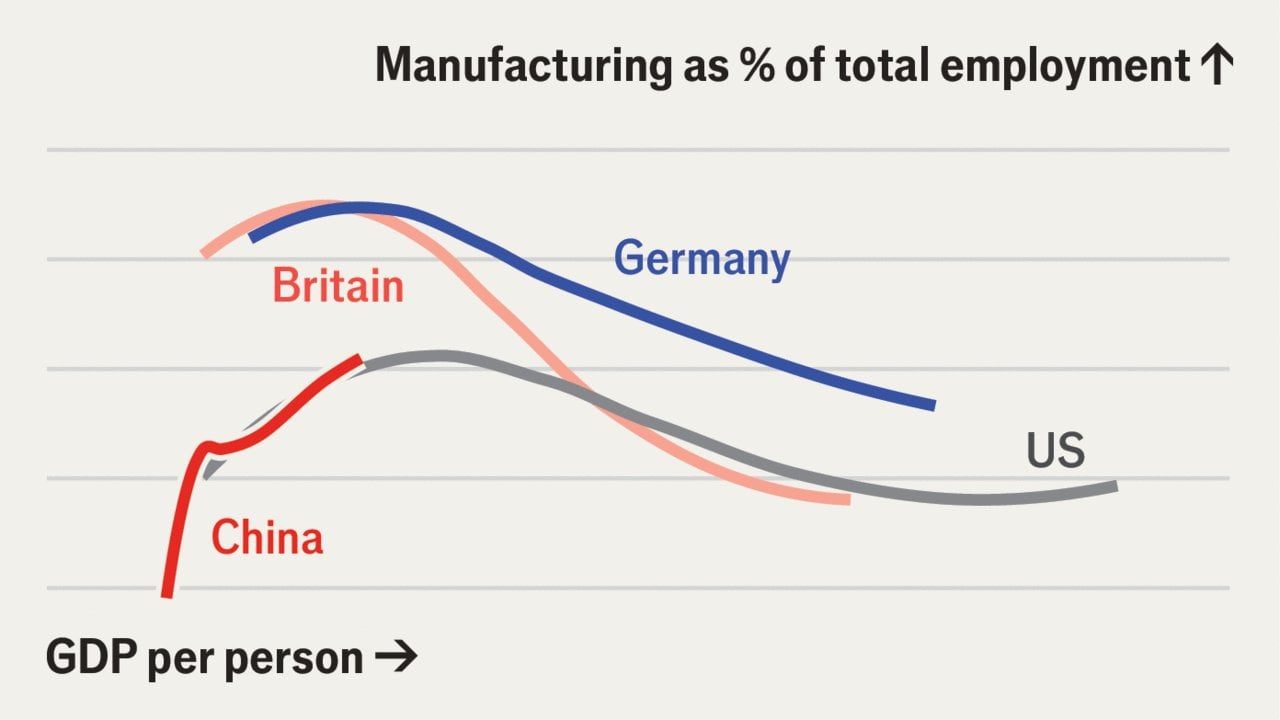
>But disappearing factory jobs are an inevitable part of economic development. Historical data from the Groningen Growth and Development Centre, a Dutch research group, show that manufacturing employment tends to follow an inverted-U pattern. During the industrialisation stage, employment shifts from agriculture to industry. As countries get richer, employment shifts once again from industry to services and manufacturing jobs decline (see chart).
>Why have rich countries like America deindustrialised? In Mr Trump’s telling, the blame can be placed squarely on international trade. When China and other developing economies were integrated into the global trading system, many firms moved their operations overseas to take advantage of lower costs. According to his administration, this led to the “offshoring of our manufacturing base”, and allowed China to achieve “global dominance in key manufacturing industries”.
>There is no doubt that America did see lots of offshoring to China. But most economists agree that the decline in manufacturing jobs is mainly the result of rising productivity. New technologies have boosted output per worker, pushing down the relative price of manufactured goods. One study by Michael Hicks and Srikant Devaraj at Ball State University in Indiana estimated that 88% of the decline in manufacturing jobs in America between 2000 and 2010 can be attributed to productivity improvements. Trade accounted for only 13%.
!ping CONTAINERS
> kill American manufacturing
Isn’t American manufacturing (output) at an all time high?