
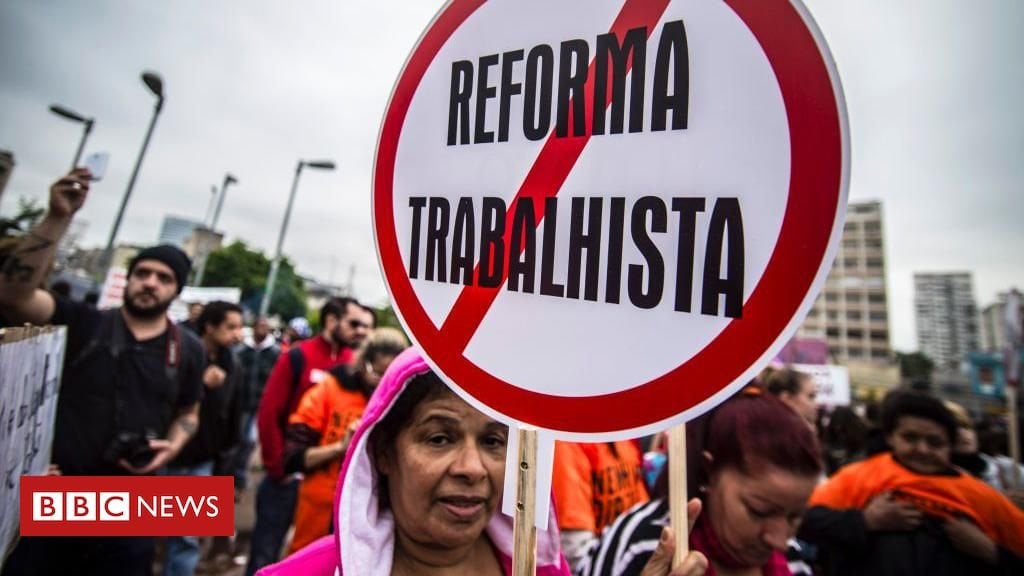
Interesting article published today by BBC Brazil, so I translated. I think a lot of us r/neoliberal BR supported the reform at the time (at least I did).
————————————————————————————————————————————–
Duke University Researcher Finds Evidence Linking Loss of Union Funding to Negative Labor Market Outcomes in Brazil
A Duke University researcher has found evidence that the loss of funding for Brazilian unions, following the 2017 reform, has had negative implications for the country's labor market.
The 2017 labor reform, approved during the government of Michel Temer (MDB), was implemented with the promise of increasing formal job creation in Brazil by allowing more flexible forms of work, reducing legal disputes over labor issues, and diminishing the role of unions in labor negotiations.
However, a novel study conducted by a doctoral researcher at Duke University (USA) revealed that although formal sector wages decreased by 0.9% in the years following the reform, formal employment also shrank by 2.5%.
To reach these results, the researcher used data from the Annual Social Information Report (Rais, a type of annual census of the formal labor market in Brazil) and the Continuous National Household Sample Survey (Pnad) from the Brazilian Institute of Geography and Statistics (IBGE), covering the period from 2012 to 2021.
Based on this data, the economist built a computational model comparing what actually happened after the labor reform with what would have happened if the policy had not been implemented—what is known in economic studies as a counterfactual.
This calculation is done this way because simply looking at labor market data before and after the reform is insufficient to understand its impact on the country, as many other things were happening concurrently.
The use of this counterfactual methodology allows isolating the effect of the reform—or specific aspects of it—while keeping all other conditions unchanged.
"What is surprising about these results is that formal workers became cheaper, their wages fell, but formal employment also decreased," observes Nikita Kohli, author of the study published in a preliminary version on the World Bank's Development Impact blog.
Intrigued by this puzzle, the Indian researcher—who has previously conducted studies on the labor markets of Pakistan, Kenya, Brazil, and India—decided to examine what happened to informal workers in Brazilian companies. She found a 6.7% increase in informal hiring in the post-reform period.
In Brazil, informal workers are considered employees without a formal contract (carteira de trabalho assinada), self-employed individuals, and employers without a National Registry of Legal Entities (CNPJ) number. Those working as Individual Microentrepreneurs (MEI), for example, are excluded from this count as they have a CNPJ.
At the end of 2017, the year the labor reform was approved, the share of informal workers among the employed in Brazil was 40.2%, totaling 37.1 million people. This means this group lacked guaranteed rights provided by Brazilian labor law (CLT), such as paid vacation, regulated working hours, the thirteenth-month salary (year-end bonus), or FGTS (employee severance guarantee fund) contributions.
For comparison, in developed countries, the average rate of informality was 18% at the time, according to data from the International Labour Organization (ILO).
Kohli observed this increase in informality in Brazil in a context where unions lost 97% of their revenue stream due to the end of mandatory union contributions, also part of the labor reform.
Through her methodology, she was able to specifically analyze the effect of this loss of union funding on the Brazilian labor market.
Kohli says her interest in studying Brazil, beyond the quality of available public data, stemmed precisely from the strength of local unions and the country's labor legislation, which result in a robust worker protection system but also increase hiring costs for employers.
"My hypothesis is that companies might be thinking: 'Okay, the unions have weakened. These formal workers have become cheaper, but now it's also less likely that we'll be inspected'," Kohli told BBC News Brasil in an interview.
Less Union Power, More Informality
Under Brazilian rules, each category of workers or companies has a single union representing its interests in a specific region, usually a municipality. Traditionally, the levels of activity and relevance of these unions vary.
To better understand the possible role of union weakening after the labor reform, Kohli divided her analysis by region and identified those with relatively strong or weak union activity before the law.
To do this, she observed the percentage of workers in each region employed by firms that had signed a collective bargaining agreement—a document established between unions and companies to regulate rights and working conditions.
The more workers were covered by this type of collective agreement, the stronger the unions that had secured these negotiations were deemed to be.
Using this data, the researcher assessed the distance of the analyzed regions from the Ministry of Labor's inspection offices, located in state capitals and some municipalities—the Regional Superintendencies and Managements of Labor (Superintendências e Gerências Regionais do Trabalho), previously known as regional delegations and sub-delegations.
These bodies are responsible for ensuring compliance with labor laws and protecting workers' rights in their respective regions.
Distance matters, Kohli explains, because labor inspectors travel from these offices to companies to conduct audits.
This means that the intensity of inspections is influenced by this distance—regions close to the offices tend to be inspected more frequently.
Taking all these aspects into account, the economist compared regions with stronger and weaker unions, before and after the reform's approval.
"The idea is that, if the policy had not been implemented, these labor markets would have exhibited similar trends," the economist explains.
"But, with the implementation of the reform, labor markets with strong unions prior to the reform are more affected [by the increase in informality within companies] than those with weak unions, because the latter effectively already lacked active unions to begin with."
Kohli's hypothesis is that this occurred because, before the reform, strong unions helped guide the actions of Ministry of Labor inspectors by suggesting where audits should be conducted, particularly in regions more distant from the Regional Superintendencies and Managements.
But, with the abrupt drop in revenue after the labor reform, caused by the end of mandatory union contributions, these entities had to reduce their staff and close offices, which may have diminished their ability to influence the inspection process.
The economist says that evidence corroborating this hypothesis is that the total number of labor inspections did not decrease after the reform, but there was a shift in their geographical distribution.
"The number of inspections is the same over time," says Kohli.
"What's surprising is that inspections increased in areas closer to the inspectors and decreased in more distant regions," the researcher highlights.
"And, indeed, I find that the decline in formal employment and the increase in informal employment stem from these more exposed areas, the places where inspections decreased. This helps strengthen my argument."
'Reform Took the Oxygen Out of the Union Movement'
Ricardo Patah, president of the São Paulo Commercial Workers Union (Sindicato dos Comerciários de São Paulo), recounts that, at the entity he leads, the number of employees reached over 600 before the labor reform. This number fell by half in the following years due to the loss of revenue.
At the time of the reform, a Datafolha poll showed that the end of mandatory union contributions divided opinions, with 46% against ending the requirement, 44% in favor, 2% indifferent, and 8% expressing no opinion.
"The 2017 reform, besides disfiguring the CLT, abruptly cut off the oxygen supply derived from union contributions for the union movement in general, and particularly for commercial workers," says Patah, who is also president of the General Union of Workers (UGT).
"This momentarily diminished our capacity to meet workers' demands. We lost members, [and] had to stop providing certain services," the union leader recalls, confirming what the Duke University researcher points out in her study.
According to the union leader, informality is a highly relevant issue in the commerce sector, and unions play an active role in reporting cases of informal hiring and other labor law violations to the Labor Courts and the Labor Public Prosecutor's Office (Ministério Público do Trabalho).
On the other hand, the Federation of Commerce of Goods, Services and Tourism of the State of São Paulo (FecomércioSP) counters some of the union leader's arguments and celebrates the reform.
The federation representing employers in the sector considers that the new labor rules did not reduce hiring costs but were an advancement, as they preserved a set of CLT rights while allowing negotiation on some aspects, like working hours and hour banks (compensatory time off systems), provided there is union participation.
Companies complain, however, that many rules approved under the new labor law continue to be challenged in court, generating uncertainty and costs.
José Pastore, a sociologist and president of FecomércioSP's Council for Employment and Labor Relations, also often argues that the reform did not ban union contributions but merely made them voluntary—a step considered necessary in a country where workers cannot choose among various union representatives nor found their own union if they wish.
Patah states that the shock from the labor reform was temporary. According to him, over the years, union entities have managed to partially recover from the initial impact by seeking new sources of revenue and encouraging voluntary worker membership to compensate for the end of the mandatory fee.
As a result, the São Paulo Commercial Workers Union, for example, currently has 470 employees, according to the union leader, having rebuilt part of its staff and the operational capacity lost immediately after the reform.
The percentage of unionized workers in Brazil, however, continues to fall year after year. According to IBGE data, the unionization rate among employed workers in the country dropped from 16.1% in 2012 to 8.4% in 2023, with 8.4 million union members that year—the lowest level in the historical series initiated in 2012.
'Informality is Increasing Worldwide'
Nikita Kohli of Duke University highlights the importance of better understanding the role of unions in a labor market like Brazil's, where informality is high—a characteristic common in developing countries.
This is because most studies conducted on the role of unions reflect the reality of developed countries, where informality is low.
"Informality is increasing worldwide," Kohli observes.
"There's platform work, which is a type of informality, and undocumented workers and migrants operating in different contexts. So, understanding how unions interact with informality is extremely important," the researcher considers.
Danilo Souza, a professor at the Faculty of Economics, Administration, Accounting and Actuarial Science at the University of São Paulo (FEA-USP) and co-author of a study on the effects of the labor reform, assesses that Kohli's study is quite interesting and utilizes cutting-edge economic analysis methods.
He notes, however, that the changes brought by the reform extended far beyond the drop in union contributions. He adds that regions with varying degrees of unionization might have been affected by other aspects of the reform, such as the reduction in litigation and new forms of hiring, including intermittent, remote, and part-time work.
"It's true, many things were happening in the economy," Kohli says, responding to the point raised by the USP professor.
"But each of these changes introduced by the reform should have facilitated formal hiring—we wouldn't expect them to lead to the reduction in formality that I observe. I compare more and less unionized regions—both are affected by all aspects of the reform, but what I capture is how they responded specifically to the loss of unionization," says the researcher.
Daniel Duque, a researcher at the Brazilian Institute of Economics of the Getulio Vargas Foundation (FGV Ibre), highlights that Kohli's paper makes an important contribution by showing evidence regarding the role of inspections in the labor market.
He notes, however, that the study lacks a discussion of the reform's overall effects—what is referred to in economics as general equilibrium.
"It might be that the reform reduced formal hiring in highly unionized markets, but does that mean the overall effect was a reduction in formal employment?" the economist questions.
The researcher affirms that, indeed, her paper cannot address general equilibrium, as this would require a different analytical model and data.
Finally, Kohli reinforces the importance and the surprising nature of her results.
"The reform was designed precisely to weaken the role of unions in the formal hiring process," the researcher observes.
"The idea was that unions represented a rigidity in this labor market. So, one would imagine that if formal workers became cheaper and unions were weakened or ceased to operate as forcefully, formal employers would think: 'now I can hire more formal workers'," she says.
"The fact that informal workers also became easier to hire was not something anticipated. So this surprised me, because it's a very indirect effect [of the weakening of unions by the reform], given that informal workers are not typically unionized—so it's important to understand it."
Posted by vitorgrs
2 Comments
The post doesn’t seem to be approved by mods for some reason… Welp?
Can ping see it? lol
!ping LATAM
If it indeed increased informal work then it’s huge failure.