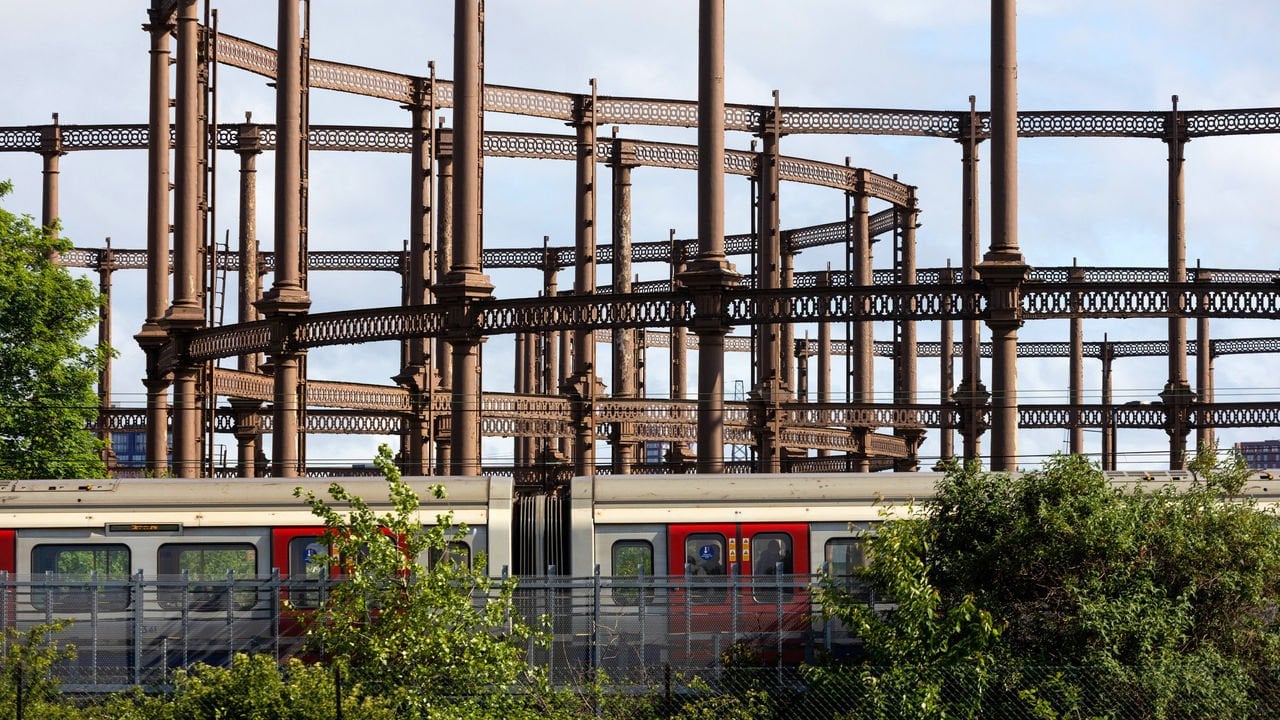
The seven giant cast-iron gasholders were once a proud symbol of Victorian engineering. Now brambles cluster around them; the site’s rusty gate has long been padlocked. Having once heated London’s East End, the Bromley-by-Bow gasworks have a prized site: a stone’s throw from Hackney Wick, the city’s hipster frontier, and just over two miles from Canary Wharf, its modern financial district. Until recently it was going to seed.
Britain’s cities contain large tracts of brownfield (ie, underused, previously developed) land, thanks to rapid deindustrialisation at the end of the last century. London alone has some 3,500 hectares (8,650 acres). That is around 25 times the size of Hyde Park, and enough space for more than 400,000 homes (London has a target of around 80,000 new homes a year). Clustered by the canals and rivers that were once industrial arteries, the sites are pretty much the only available land in a city with one of the rich world’s worst housing shortages.
And yet few are being taken on by developers. Building work for just 1,200 new private housing units started in London in the first quarter of 2025, the lowest since 2009 and just 5.5% of the city’s quarterly target, according to Molior, a consultancy. Several inner-city boroughs, including Hackney, Haringey and Lewisham, are on track to complete almost no new private homes in 2027 and 2028, despite the government’s aim to boost housebuilding.
A tour of the former gasworks helps show why. In March St William, a developer, secured permission to build 2,150 homes on the 23-acre site. That came after four years of work with organisations including Newham Council, Historic England, the Greater London Authority and the Environment Agency. Dean Summers, the company’s cheerful managing director, says he hopes to have spades in the ground next year and homes to sell by 2029.
Most projects don’t make it this far because they’re squeezed beyond viability. Many borough councils, which largely wield permit power, insist that as many as half of homes in a given development are “affordable”, which immediately rules out smaller sites. At the same time developers are hemmed in by height restrictions and minimum room and unit sizes. From 2026, any building over seven storeys will have to have a second staircase.
Around half of London’s brownfield sites have planning permission, but nearly all for designs and affordability ratios that proved unviable. Some sites, like the former gasworks, require extensive remediation. St William managed to agree on a lower ratio, partly in return for spending £72m ($96m) to restore the Grade-2 listed gasholders and create a public park. Often councils don’t budge, leaving seemingly suitable sites stuck in a “viability gap”.
Ironically, a big problem with ex-industrial plots is biodiversity. Left to go wild, they can be home to “mosaic habitats”, which have to be ripped out to clean up contaminated soil. Developers must prove that existing biodiversity levels will be increased by 10%, and maintained for 30 years. The former gasworks had a very high baseline score, including 70 trees with a “tree protection order”. Despite proposing a park, a reservoir, planting beds, several insect hotels and ten tree varieties, St William’s design scored a paltry “-40%”. One idea, putting green roofs on the flats, was objected to by nearby London City Airport, which fretted about nesting birds.
Such rules illustrate how incentives are skewed. Brownfield developers must go to great lengths to raise the ecological value of derelict, inaccessible sites, often by offsetting. Meanwhile, less environmentally friendly greenfield developments in the suburbs face far lower hurdles.
The Labour government says it wants to make building easier. But it has focused on the green belt and shiny new towns rather than where it would be most beneficial: the rusty bits. ■

1 Comment
The seven giant cast-iron gasholders were once a proud symbol of Victorian engineering. Now brambles cluster around them; the site’s rusty gate has long been padlocked. Having once heated London’s East End, the Bromley-by-Bow gasworks have a prized site: a stone’s throw from Hackney Wick, the city’s hipster frontier, and just over two miles from Canary Wharf, its modern financial district. Until recently it was going to seed.
Britain’s cities contain large tracts of brownfield (ie, underused, previously developed) land, thanks to rapid deindustrialisation at the end of the last century. London alone has some 3,500 hectares (8,650 acres). That is around 25 times the size of Hyde Park, and enough space for more than 400,000 homes (London has a target of around 80,000 new homes a year). Clustered by the canals and rivers that were once industrial arteries, the sites are pretty much the only available land in a city with one of the rich world’s worst housing shortages.
And yet few are being taken on by developers. Building work for just 1,200 new private housing units started in London in the first quarter of 2025, the lowest since 2009 and just 5.5% of the city’s quarterly target, according to Molior, a consultancy. Several inner-city boroughs, including Hackney, Haringey and Lewisham, are on track to complete almost no new private homes in 2027 and 2028, despite the government’s aim to boost housebuilding.
A tour of the former gasworks helps show why. In March St William, a developer, secured permission to build 2,150 homes on the 23-acre site. That came after four years of work with organisations including Newham Council, Historic England, the Greater London Authority and the Environment Agency. Dean Summers, the company’s cheerful managing director, says he hopes to have spades in the ground next year and homes to sell by 2029.
Most projects don’t make it this far because they’re squeezed beyond viability. Many borough councils, which largely wield permit power, insist that as many as half of homes in a given development are “affordable”, which immediately rules out smaller sites. At the same time developers are hemmed in by height restrictions and minimum room and unit sizes. From 2026, any building over seven storeys will have to have a second staircase.
Around half of London’s brownfield sites have planning permission, but nearly all for designs and affordability ratios that proved unviable. Some sites, like the former gasworks, require extensive remediation. St William managed to agree on a lower ratio, partly in return for spending £72m ($96m) to restore the Grade-2 listed gasholders and create a public park. Often councils don’t budge, leaving seemingly suitable sites stuck in a “viability gap”.
Ironically, a big problem with ex-industrial plots is biodiversity. Left to go wild, they can be home to “mosaic habitats”, which have to be ripped out to clean up contaminated soil. Developers must prove that existing biodiversity levels will be increased by 10%, and maintained for 30 years. The former gasworks had a very high baseline score, including 70 trees with a “tree protection order”. Despite proposing a park, a reservoir, planting beds, several insect hotels and ten tree varieties, St William’s design scored a paltry “-40%”. One idea, putting green roofs on the flats, was objected to by nearby London City Airport, which fretted about nesting birds.
Such rules illustrate how incentives are skewed. Brownfield developers must go to great lengths to raise the ecological value of derelict, inaccessible sites, often by offsetting. Meanwhile, less environmentally friendly greenfield developments in the suburbs face far lower hurdles.
The Labour government says it wants to make building easier. But it has focused on the green belt and shiny new towns rather than where it would be most beneficial: the rusty bits. ■