With that one executive order describing neurodivergent people as “threats to society”, I would not be too surprised if lobotomies and sterilization will be approved “treatments” for autism within the next four years.
VastMemory1111 on
Long Effort to Ban Shocks as a Treatment Faces Uncertainty
Regulators seeking to end the use of electric shock devices on people with disabilities have been swept into the government upheaval under President Trump.
A coalition of doctors, lawmakers and advocates for people with autism has spent more than a decade trying to ban a medical device that is used to deliver painful electric jolts to people with severe neurodevelopmental disabilities.
Last year, a federal ban on the devices finally seemed imminent. But the upheaval sweeping the federal government during the Trump administration’s early months could further delay a resolution, allowing continued use of the controversial devices.
Wide-ranging cutbacks have been announced at federal health agencies, including the Food and Drug Administration, whose medical devices section had been working on the lengthy and convoluted process of implementing a ban.
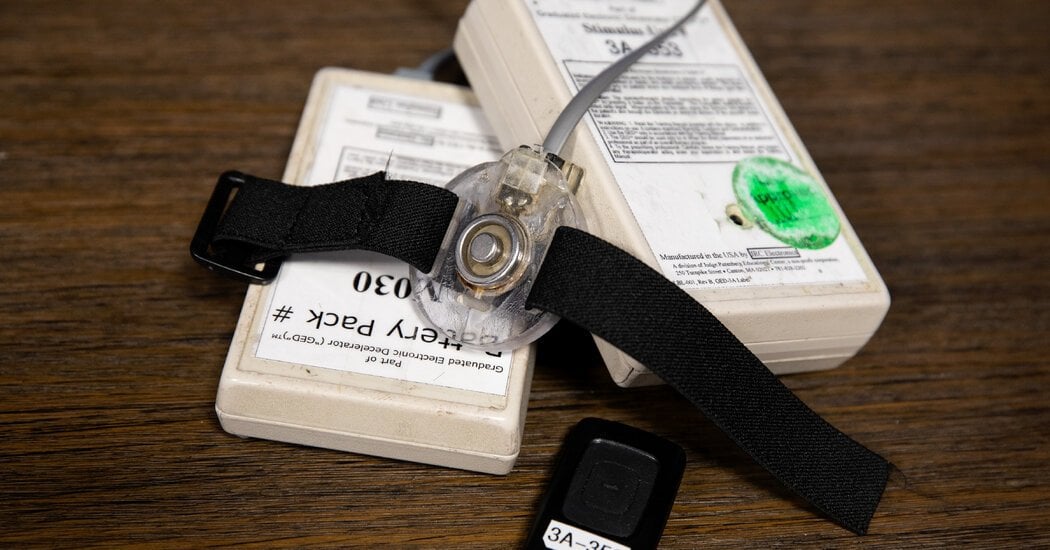
Regulators determined that the jolts, delivered through electrodes strapped to a patient’s arms and legs, caused long-term harm and should no longer be used. Clinicians and relatives of residents at a treatment facility outside Boston defend the use of the devices, calling them a last resort for some of the facility’s most extreme cases.
The uncertainty over the devices’ fate has been compounded by President Trump’s chief health official, Robert F. Kennedy Jr., who has falsely linked autism with childhood vaccines. He recently called autism a preventable epidemic that destroys families and prevents people from living a full life, a characterization described as dehumanizing by many autistic people.
Rates of diagnosis for autism — a neurodevelopmental disorder that can cause difficulties with social interaction and communication — have increased nearly fivefold among children since 2000, when officials first began collecting such data. A recent report attributed some of the increase to increased screening, as well as a broader definition of the condition.
Because it encompasses a broad array of traits that can vary in how they affect a person’s life, autism is often described as occurring on a spectrum. Some autistic people live independently, with demanding jobs and active social lives. Others have trouble navigating some tasks and interactions, but can manage well with accommodations.
A subset of autistic people, however, need extensive day-to-day support, often beyond what their families can financially or emotionally provide. And in rare cases, the struggle to communicate or process sensory input can lead to extreme verbal and physical reactions, such as head banging or striking others.
In those cases, individuals may be sent to live in a residential treatment facility, like the Judge Rotenberg Educational Center in Canton, Mass. It is the only place in the country known to use electric shocks to manage residents and prevent potentially harmful outbursts.
The devices were developed in the 1980s by the center’s controversial founder, Matthew Israel. At the time, it was common for society to segregate people with neurodevelopmental disabilities and to use restraints and punishments.
Today, Dr. Israel’s shock devices are approved for use on 55 adults living at the center. Some have worn the equipment — which is often locked onto them in fanny packs — for decades. Some people started receiving shocks as children, though the device is now approved for use only on adults.
Critics, including Jan Nisbet, founding director of the University of New Hampshire’s Institute on Disability, point out that the shock treatment is considered a corrective measure, not a cure. In other words, people could be wearing the equipment for the rest of their lives to deter any harmful behaviors.
“If you want to decrease a behavior, you can punish them,” said Dr. Nisbet, who wrote a book on the Rotenberg Center. “But you’re going to have to keep punishing them.”
RadioRavenRide on
I’m going to risk my karma and say that the situation is more complex than it seems. Specifically, there’s a divide between high-functioning autistic people and the caretakers of people with severe autism on the other. The latter side has generally been dominant as seen with organizations such as Autism Speaks, but recently it’s been more even. This divide can also be seen with the diverging responses to RFK’s speech a while back. I am against shock “treatment”, but it’s important to understand that the second camp is desparate and will do basically anything to keep their children or relatives out of harm’s way.

5 Comments
https://preview.redd.it/c5fj5lgtlt0f1.jpeg?width=226&format=pjpg&auto=webp&s=eaec82d01e29e97383a68777d20135a8e82de976
https://preview.redd.it/qymw00klnt0f1.jpeg?width=852&format=pjpg&auto=webp&s=437a7e7fcf9a76f00ce89776243fcf862261ba55
With that one executive order describing neurodivergent people as “threats to society”, I would not be too surprised if lobotomies and sterilization will be approved “treatments” for autism within the next four years.
Long Effort to Ban Shocks as a Treatment Faces Uncertainty
Regulators seeking to end the use of electric shock devices on people with disabilities have been swept into the government upheaval under President Trump.
A coalition of doctors, lawmakers and advocates for people with autism has spent more than a decade trying to ban a medical device that is used to deliver painful electric jolts to people with severe neurodevelopmental disabilities.
Last year, a federal ban on the devices finally seemed imminent. But the upheaval sweeping the federal government during the Trump administration’s early months could further delay a resolution, allowing continued use of the controversial devices.
Wide-ranging cutbacks have been announced at federal health agencies, including the Food and Drug Administration, whose medical devices section had been working on the lengthy and convoluted process of implementing a ban.
Regulators determined that the jolts, delivered through electrodes strapped to a patient’s arms and legs, caused long-term harm and should no longer be used. Clinicians and relatives of residents at a treatment facility outside Boston defend the use of the devices, calling them a last resort for some of the facility’s most extreme cases.
The uncertainty over the devices’ fate has been compounded by President Trump’s chief health official, Robert F. Kennedy Jr., who has falsely linked autism with childhood vaccines. He recently called autism a preventable epidemic that destroys families and prevents people from living a full life, a characterization described as dehumanizing by many autistic people.
Rates of diagnosis for autism — a neurodevelopmental disorder that can cause difficulties with social interaction and communication — have increased nearly fivefold among children since 2000, when officials first began collecting such data. A recent report attributed some of the increase to increased screening, as well as a broader definition of the condition.
Because it encompasses a broad array of traits that can vary in how they affect a person’s life, autism is often described as occurring on a spectrum. Some autistic people live independently, with demanding jobs and active social lives. Others have trouble navigating some tasks and interactions, but can manage well with accommodations.
A subset of autistic people, however, need extensive day-to-day support, often beyond what their families can financially or emotionally provide. And in rare cases, the struggle to communicate or process sensory input can lead to extreme verbal and physical reactions, such as head banging or striking others.
In those cases, individuals may be sent to live in a residential treatment facility, like the Judge Rotenberg Educational Center in Canton, Mass. It is the only place in the country known to use electric shocks to manage residents and prevent potentially harmful outbursts.
The devices were developed in the 1980s by the center’s controversial founder, Matthew Israel. At the time, it was common for society to segregate people with neurodevelopmental disabilities and to use restraints and punishments.
Today, Dr. Israel’s shock devices are approved for use on 55 adults living at the center. Some have worn the equipment — which is often locked onto them in fanny packs — for decades. Some people started receiving shocks as children, though the device is now approved for use only on adults.
Critics, including Jan Nisbet, founding director of the University of New Hampshire’s Institute on Disability, point out that the shock treatment is considered a corrective measure, not a cure. In other words, people could be wearing the equipment for the rest of their lives to deter any harmful behaviors.
“If you want to decrease a behavior, you can punish them,” said Dr. Nisbet, who wrote a book on the Rotenberg Center. “But you’re going to have to keep punishing them.”
I’m going to risk my karma and say that the situation is more complex than it seems. Specifically, there’s a divide between high-functioning autistic people and the caretakers of people with severe autism on the other. The latter side has generally been dominant as seen with organizations such as Autism Speaks, but recently it’s been more even. This divide can also be seen with the diverging responses to RFK’s speech a while back. I am against shock “treatment”, but it’s important to understand that the second camp is desparate and will do basically anything to keep their children or relatives out of harm’s way.