
A plan for a hefty new tax on university endowments was crafted to target “woke” schools, lawmakers said. But a small Kansas college and a Texas medical school might also be hit.
Posted by CinnamonMoney
A plan for a hefty new tax on university endowments was crafted to target “woke” schools, lawmakers said. But a small Kansas college and a Texas medical school might also be hit.
Posted by CinnamonMoney
9 Comments
This tax was particularly interesting to me because of the possible ripple effects:
Within these two trump terms, the corporate tax rate will have halved from 35% to 21% to 18% (spare me the .5 percent=).
Whilst the previously untaxed excise tax on universities will have gone from 0% to 1.4% to 1.4%/7%/14%/21% depending on endowment per eligible students (international, part time, continuing education and undocumented students do not count as eligible students).
9 universities are projected to be taxed at 21%….We are taxing the former home of Albert Einstein (Princeton) + 8 other colleges more than any corporation in America lol; in theory, i know effective tax rates & offshoring & other stuff makes this more complicated in practice.
Lastly, this new tax, would not make headway on the soon to be rapidly increasing a trillion dollar deficit to a multi trillion dollar deficit, and simultaneously would harm the businessmen at the private sector firms that are supposed to be Trump’s only regulators. Ripple effects inbound because these private institutions have held themselves to a 4-5% of their endowment spending rule year to year regardless of their returns.
For example, Harvard’s Endowment (2024): Total size: ~$50 billion; Asset allocation:
• Private equity: ~36%
• Public equity: ~17%
• Hedge funds: ~32%
• Real estate/natural resources: ~9%
• Fixed income/cash: ~6%
The unintended consequences are so numerous that it makes no sense to list them all. This is just another way in which Trump’s death by a thousand cuts policies — taxes, legal and illegal immigration, health, education, and so forth — will have lasting consequences well into the next decade.
(1/?)
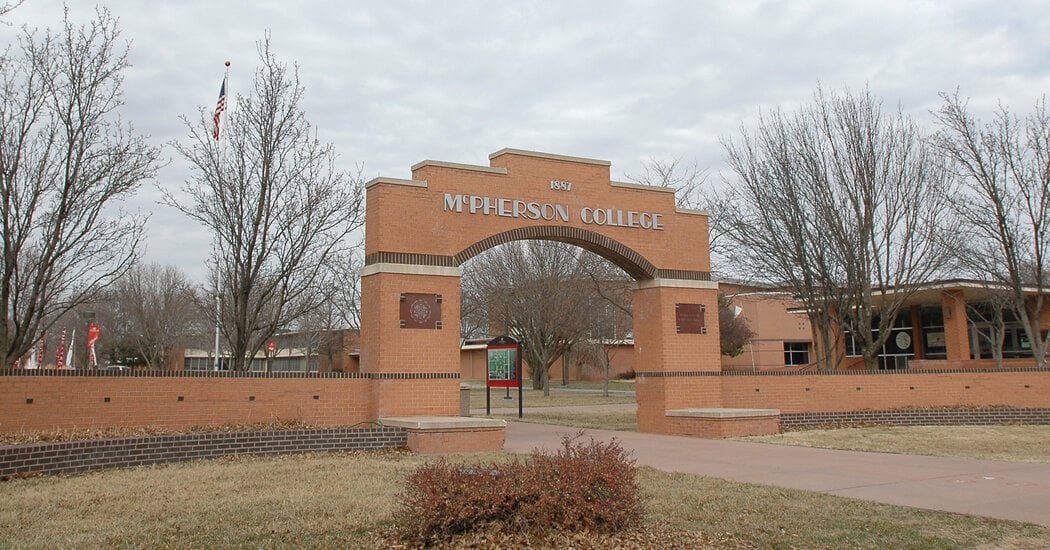
McPherson College, in the middle of Kansas wheat country, is a small school that accepts the vast majority of its applicants, many from surrounding towns. It is best known for its degree in classic car restoration. Student population = 800.
The college might still end up a potential target in a Republican plan aimed primarily at the Ivy League, which would impose billions in taxes on the investment returns of several dozen private colleges and universities.
(3/?)
The tax idea has been discussed by Republicans since at least President Trump’s first term, when a 1.4 percent tax was imposed on some endowments. Momentum to broaden it grew in 2023, when JD Vance, then a senator from Ohio, proposed a 35 percent tax on endowments of $10 billion and larger.
Now, as President Trump has made challenging the nation’s wealthiest colleges a centerpiece of his second-term agenda, the endowment tax could become a potent weapon. During Mr. Trump’s second presidential run, his campaign promised to collect billions “by taxing the large endowments of private universities plagued by antisemitism.”
The tax, part of the House proposal that President Trump has called the “big, beautiful bill,” would be tiered depending on the size of the school’s endowment and enrollment, with a top rate of 21 percent for those with endowments of at least $2 million per student.
That rate would hit nine schools, including Harvard, Yale and Princeton. The proposal threatens to cost Harvard about $850 million a year, Yale $690 million a year, and Princeton $586 million a year, according to estimates by Phillip Levine, an economics professor at Wellesley College, which would also be subject to the tax.
Upper middle-class Republican voters shooting their aspirations in the foot once more? Tell me it isn’t so!
Sidenote, I think nyt having to use the framing as red state schools will be hit too misses the opportunity to inform readers that most of these private schools have students from all 50 states such as a “red-republican state” student like myself at a blue-democratic state rich university.
/
(5/?)
The criteria for the tax excludes some schools with large endowments, such as the University of Southern California, because of their large enrollment numbers. Columbia University, which has been targeted by Republicans over accusations that it mishandled claims of antisemitism, might not have qualified either, because of the size of its student population in relation to its endowment.
While The Times’s analysis is based on endowment size, under the proposal’s current language the list is likely to grow larger because the tax would also apply to other forms of university investment income, including royalties. The existing 1.4 percent tax hit 56 schools in 2023, according to data from the Internal Revenue Service.
Republicans and others argue that the universities should use more of their endowments, some which have accumulated tax-free over centuries. Mr. Trump said on the campaign trail that the proceeds from the tax would “endow the American Academy,” a free virtual university that he said he would create. But a plan for that school has not materialized, and any money collected through the new taxes would go into the government’s general fund.
(6/?)
**Schools have pushed back against the tax, noting that they use their endowments to fund the education of poor and middle-class students. Of the $30 billion that schools spent in endowment funds in 2024, nearly half went to financial aid, according to an analysis by the National Association of College and University Business Officers.**
**(Vice President Vance was a beneficiary of this need-based aid. He attended Yale Law School as a Marine Corps veteran with a financial aid package that he later wrote “exceeded my wildest dreams.”)** <——— same asshat who wanted the top excise tax rate to be 35%
(8/?)
Williams College, a liberal arts school in Massachusetts, would be subject to at least a 14 percent tax. In an interview, its president, Maud S. Mandel, said the school devoted $92 million from its endowment this year to help over half the school’s student body.
“*Any tax on the endowment would have a direct impact on that,” she said.*
And in California, Pomona College’s vice president, Jonathan B. Williams, said the tax would cost the school $40 million a year, the equivalent of 460 full scholarships. Its enrollment is about 1,700.
“*This will shift the cost of tuition squarely on to families,” he said.*
Universities have dispatched lobbyists to Capitol Hill to try to water down the plan’s impact.
(10/?)
Four medical schools could also be on the list, including Baylor College of Medicine in Houston, which is not affiliated with Baylor University. Lori Williams, vice president of communications for the medical school, wonders whether independent medical schools were included accidentally.
“We have been engaging with legislators to seek to remedy this,” Ms. Williams said.
Lawmakers crafted an exception for religious institutions that could exempt some of the 58 schools included in The Times’s analysis. But schools formed before July 4, 1776, would be excluded from that exemption. That means Ivy League schools opened by religious groups before the nation’s founding would not be eligible.
David A. Super, a professor at Georgetown University Law Center, said that could raise legal issues.
“Particularly problematic is reliance on a date: Some faiths have established more colleges in some eras, some faiths have established more in other times,” Mr. Super said. “That starts to look like discrimination among religions.”
McPherson, known for its classic car restoration program, grew its endowment to $1.6 billion from $50 million with the help of an anonymous donor.
Matthew Lindsey, president of the Kansas Independent College Association, hopes the religious exemption will ultimately protect McPherson, which was founded by the Church of the Brethren, a pacifist Protestant denomination.
“Clearly McPherson is not the target of this legislation,” Mr. Lindsey said, noting that the bill “very much talked about woke colleges. They’re not talking about McPherson in that language.”
Gg’s r/leopardsatemyface
Compromise. Tax both universities and churches.