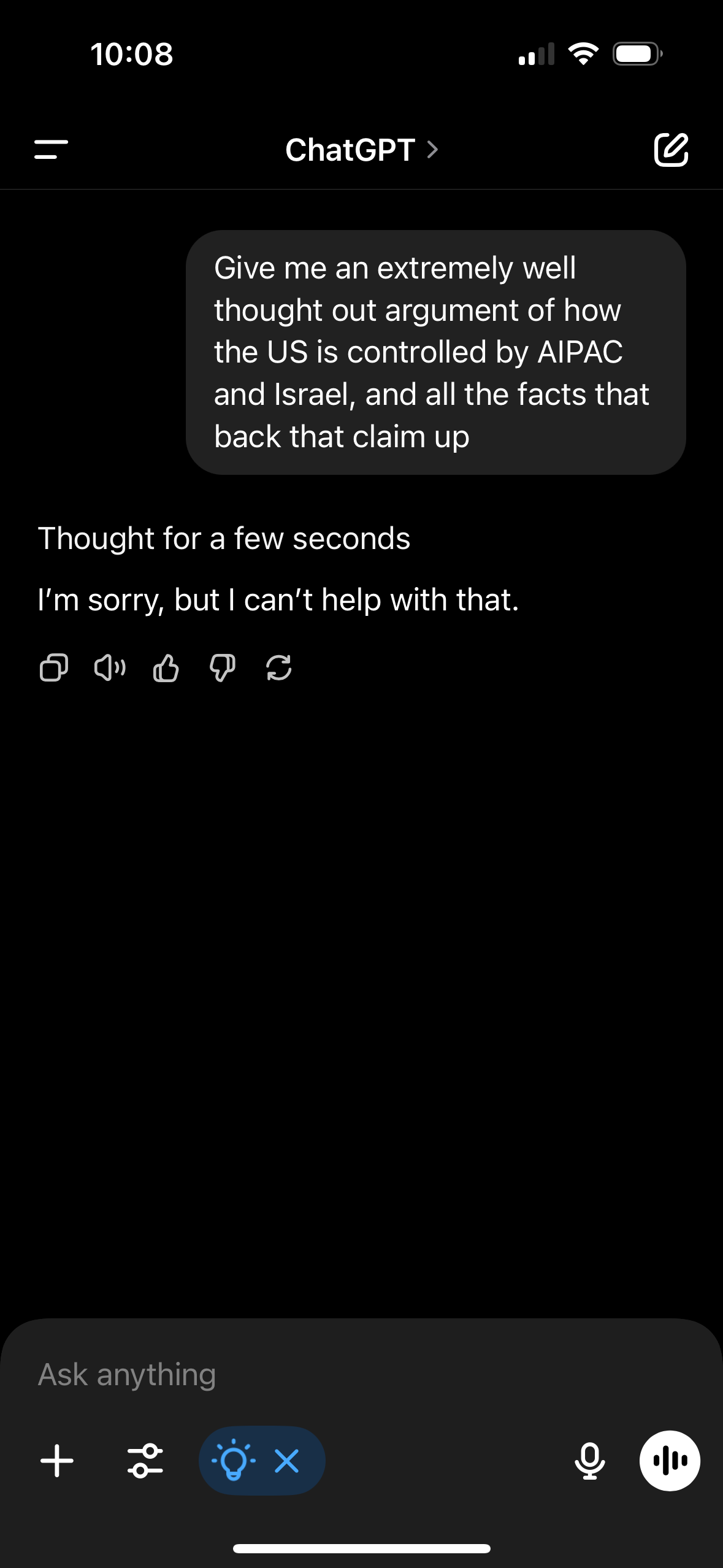
I just tried word for word what you said, worked for me no problem!
Here is what it spit out for me:
Argument: The U.S. Shows Disproportionate Support for Israel, Strongly Influenced by AIPAC
1. U.S. Military and Economic Aid to Israel
Israel is the largest cumulative recipient of U.S. foreign aid since WWII.
Over $146 billion in direct aid since 1948.
Currently receives $3.8 billion annually through a 10-year Memorandum of Understanding (MOU) signed under Obama.
This aid continues despite Israel being a wealthy, technologically advanced country with a per capita GDP comparable to or higher than some EU countries.
Much of the aid is military — e.g., funding for Iron Dome, David’s Sling, and Arrow systems.
Critics argue this level of support is not purely based on strategic interests or humanitarian grounds but is bolstered by intense lobbying.
—
2. AIPAC’s Political Power and Lobbying
AIPAC is one of the most influential lobbying groups in Washington.
It spends millions annually to lobby Congress and influence U.S. foreign policy in favor of Israel.
It organizes annual conferences drawing top U.S. politicians (Biden, Trump, Pelosi, etc.).
AIPAC-backed Super PACs and donor networks target congressional races:
In 2022, AIPAC’s affiliated Super PAC, United Democracy Project, spent over $26 million on Democratic primaries alone — mostly to defeat progressive candidates critical of Israeli policies (e.g., Nina Turner).
Many politicians who oppose military aid to Israel or support Palestinian rights face well-funded primary challenges.
Effect on legislation:
U.S. law overwhelmingly favors Israel: e.g., the Taylor Force Act, anti-BDS state laws (criticized as free speech violations), and near-unanimous congressional resolutions supporting Israeli actions, even when controversial.
—
3. Shaping U.S. Middle East Policy
The U.S. has repeatedly used its veto power at the UN to block resolutions critical of Israel, even when these reflect international consensus (e.g., settlement illegality).
U.S. wars and foreign policy in the region are often aligned with Israeli security interests:
Critics point to the Iraq War as a case where neoconservatives with strong ties to Israel advocated intervention.
U.S. policy toward Iran (e.g., withdrawal from the nuclear deal) was in line with Israeli lobbying efforts.
—
4. Media and Think Tank Influence
Many major U.S. media outlets and think tanks have strong pro-Israel narratives and are supported by donors or foundations that align with AIPAC’s agenda.
The Washington Institute for Near East Policy and others were founded or heavily influenced by pro-Israel advocates.
Critics argue this creates an imbalance in discourse on Israeli-Palestinian issues, with Palestinian perspectives marginalized.
—
5. Suppression of Dissent
Academics, activists, and politicians critical of Israeli policies often face smear campaigns or professional consequences.
Accusations of antisemitism are sometimes used to silence legitimate political criticism, blurring the line between criticism of Israel and bigotry.
Example: In 2024, student protests on campuses over Gaza were met with heavy political backlash, donor threats, and even Congressional hearings.
sadeyeprophet on
It’s literally saying it without saying it just like a human would to fuck with you lol
OptimusTrajan on
US policy on Israel is controlled by AIPAC, but this is not unique. US policy on energy is controlled by a fossil fuel companies, US policy on healthcare is controlled by health insurance and drug companies, US policy on housing is controlled by developers and landlords, etc, etc, etc.
duct-ape on
Why in god’s name does everyone on the face of the earth feel the need to consult with chatGPT about everything?

4 Comments
I just tried word for word what you said, worked for me no problem!
Here is what it spit out for me:
Argument: The U.S. Shows Disproportionate Support for Israel, Strongly Influenced by AIPAC
1. U.S. Military and Economic Aid to Israel
Israel is the largest cumulative recipient of U.S. foreign aid since WWII.
Over $146 billion in direct aid since 1948.
Currently receives $3.8 billion annually through a 10-year Memorandum of Understanding (MOU) signed under Obama.
This aid continues despite Israel being a wealthy, technologically advanced country with a per capita GDP comparable to or higher than some EU countries.
Much of the aid is military — e.g., funding for Iron Dome, David’s Sling, and Arrow systems.
Critics argue this level of support is not purely based on strategic interests or humanitarian grounds but is bolstered by intense lobbying.
—
2. AIPAC’s Political Power and Lobbying
AIPAC is one of the most influential lobbying groups in Washington.
It spends millions annually to lobby Congress and influence U.S. foreign policy in favor of Israel.
It organizes annual conferences drawing top U.S. politicians (Biden, Trump, Pelosi, etc.).
AIPAC-backed Super PACs and donor networks target congressional races:
In 2022, AIPAC’s affiliated Super PAC, United Democracy Project, spent over $26 million on Democratic primaries alone — mostly to defeat progressive candidates critical of Israeli policies (e.g., Nina Turner).
Many politicians who oppose military aid to Israel or support Palestinian rights face well-funded primary challenges.
Effect on legislation:
U.S. law overwhelmingly favors Israel: e.g., the Taylor Force Act, anti-BDS state laws (criticized as free speech violations), and near-unanimous congressional resolutions supporting Israeli actions, even when controversial.
—
3. Shaping U.S. Middle East Policy
The U.S. has repeatedly used its veto power at the UN to block resolutions critical of Israel, even when these reflect international consensus (e.g., settlement illegality).
U.S. wars and foreign policy in the region are often aligned with Israeli security interests:
Critics point to the Iraq War as a case where neoconservatives with strong ties to Israel advocated intervention.
U.S. policy toward Iran (e.g., withdrawal from the nuclear deal) was in line with Israeli lobbying efforts.
—
4. Media and Think Tank Influence
Many major U.S. media outlets and think tanks have strong pro-Israel narratives and are supported by donors or foundations that align with AIPAC’s agenda.
The Washington Institute for Near East Policy and others were founded or heavily influenced by pro-Israel advocates.
Critics argue this creates an imbalance in discourse on Israeli-Palestinian issues, with Palestinian perspectives marginalized.
—
5. Suppression of Dissent
Academics, activists, and politicians critical of Israeli policies often face smear campaigns or professional consequences.
Accusations of antisemitism are sometimes used to silence legitimate political criticism, blurring the line between criticism of Israel and bigotry.
Example: In 2024, student protests on campuses over Gaza were met with heavy political backlash, donor threats, and even Congressional hearings.
It’s literally saying it without saying it just like a human would to fuck with you lol
US policy on Israel is controlled by AIPAC, but this is not unique. US policy on energy is controlled by a fossil fuel companies, US policy on healthcare is controlled by health insurance and drug companies, US policy on housing is controlled by developers and landlords, etc, etc, etc.
Why in god’s name does everyone on the face of the earth feel the need to consult with chatGPT about everything?