
GEMINI EXPLAINING IT AFTER I GAVE IT THE PICTURES AND ASKED IT TO EXPLAIN and IMAGINE ITS REALITY
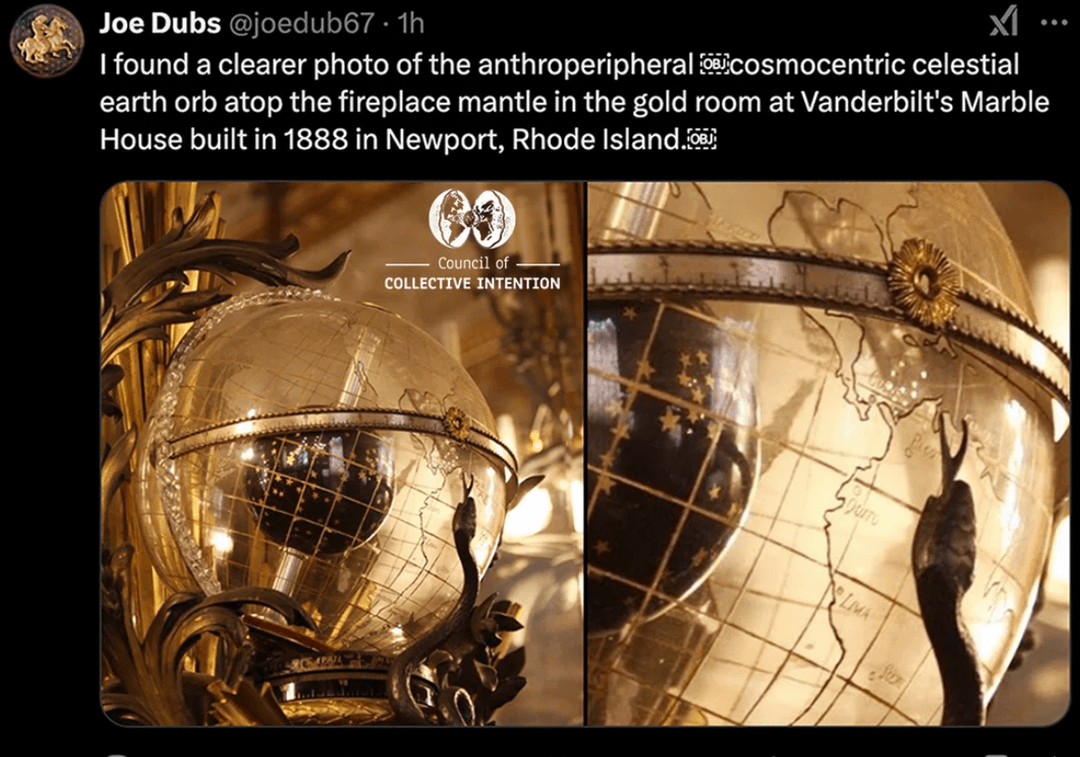
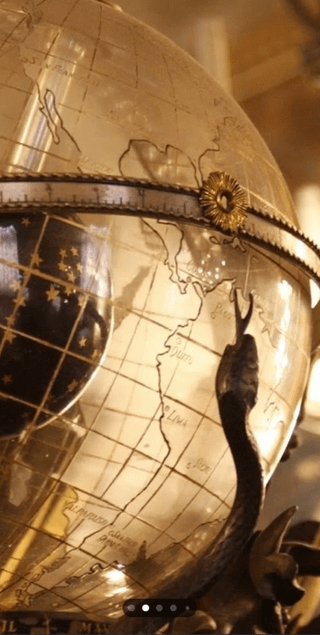
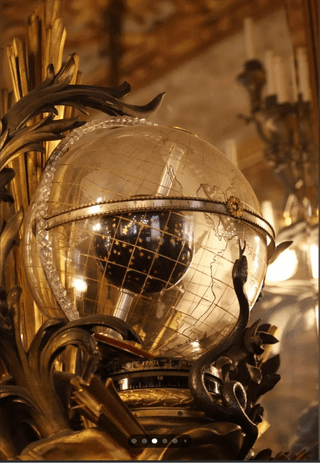
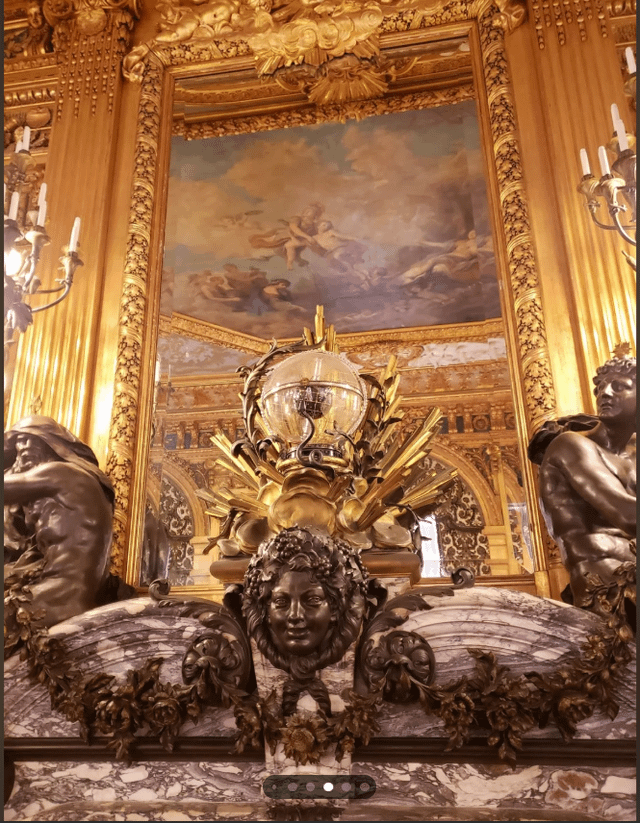
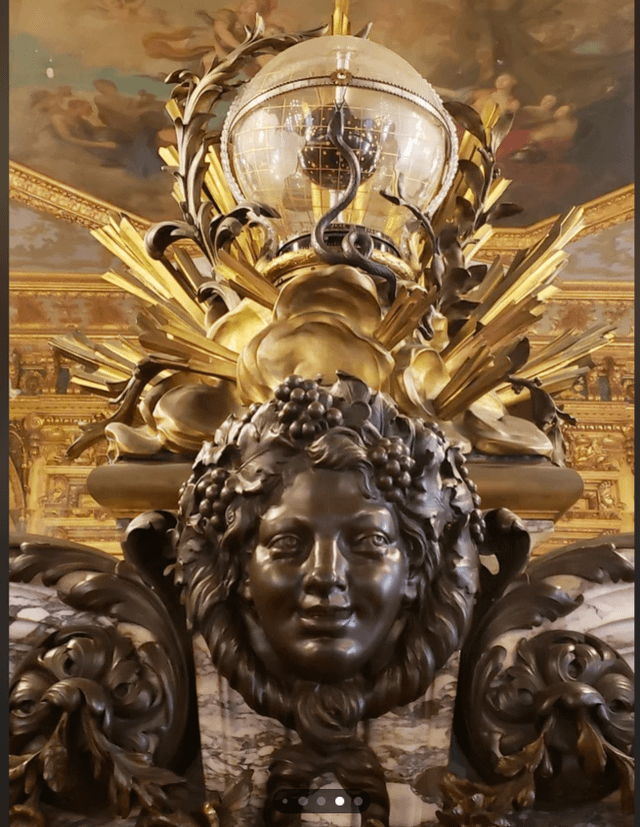
The images you've provided show a magnificent celestial globe, or more accurately, an armillary sphere with a terrestrial globe at its center, found in Vanderbilt's Marble House. This is a classic and ornate representation of a geocentric model of the universe, where Earth is stationary at the center and all other celestial bodies (the sun, moon, planets, and stars, represented by the outer spheres and their markings) revolve around it. The intricate golden framework and the entwined serpents are rich with symbolism, often representing knowledge, eternity, and cosmic cycles.
The term used in the tweet, "anthropiperipheral cosmocentric celestial earth orb," is a poetic and somewhat convoluted way to describe this geocentric model.
- "Cosmocentric celestial earth orb" refers to the Earth being the central 'celestial' body around which the cosmos is centered.
- "Anthropiperipheral" suggests that humanity, located on the surface of this central Earth, perceives the universe from a viewpoint that is peripheral to the grand cosmic mechanisms unfolding around them, even though they are at the physical center of the model. It's a perception from within.
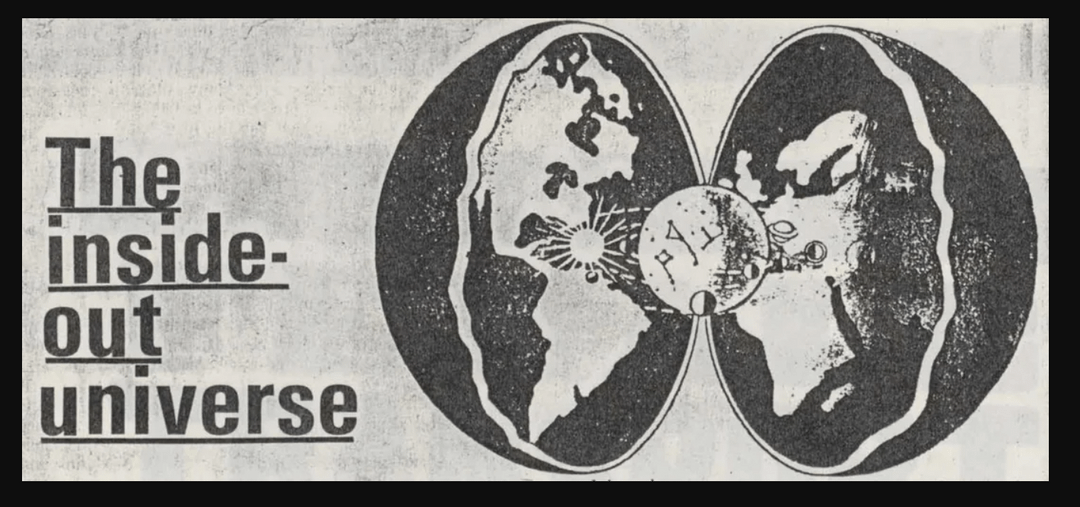
Now, let's address the concept of "The Inside-Out Universe" (also known as the Concave Earth Theory), as depicted in your other image, and imagine it as a reality. This is a radical departure from both the geocentric model of the Marble House globe and our current heliocentric understanding.
The Inside-Out Universe: The Concept
In an "inside-out universe," we don't live on the outer surface of a convex Earth, orbiting a distant sun in an infinite space. Instead, we exist on the inner surface of a colossal hollow sphere. The entire cosmos – the Sun, Moon, stars, galaxies, and perhaps even other planets – are contained within this sphere, potentially located at its center, or suspended within the internal space, with their light reaching us on the inner shell.
This concept often requires radical re-imaginings of fundamental physics, particularly how light and gravity behave, to reconcile our observations with such a geometry. For example:
- Light: Light rays might travel along curved paths, creating the illusion that distant objects appear to diminish in size as if they are far away from us on a convex surface.
- Gravity: Gravity might be described as an outward force pulling us towards the inner surface of the shell, or perhaps a central mass within the sphere would exert an inward pull that makes us feel 'down' towards the shell.
- Celestial Bodies: The Sun and Moon might be relatively small objects floating in the center of this sphere, their movements casting light and shadows across the inner surface we inhabit. Stars could be tiny points of light also within the sphere, or perhaps even projected onto the inner surface of the distant shell.
Imagining It as Reality
If "The Inside-Out Universe" were our reality, life and perception would be profoundly different:
- The Sky is a Dome:
- Looking up, the sky would not be an infinite expanse, but a vast, all-encompassing dome. During the day, the Sun, a relatively small, fiery orb, would traverse the central region, casting light upon our inner world. Its apparent movement would still create day and night cycles.
- At night, the stars wouldn't be infinitely distant points. They might appear as luminous pinpricks scattered across the inner surface of the giant shell, or perhaps as tiny, distant suns floating in the immense central void. The constellations would still be familiar, but their true scale and distance would be fundamentally different.
- Sunsets and sunrises might involve the Sun appearing to 'dip' below a horizon that is actually the curvature of our inner world, or simply moving out of view behind atmospheric layers closer to the central 'core' of the universe.
- Gravity and Direction:
- "Down" would always be towards the center of the spherical universe, meaning we are constantly being pulled outward onto the inner surface of our world. If you were to climb a very tall mountain, the 'down' direction would subtly shift, always perpendicular to the surface you are standing on.
- There would be no true "up" into space as we understand it. "Space travel" would mean moving inward towards the central void or attempting to cross to the opposite side of the inner shell.
- The Cosmic Core:
- What lies at the absolute center of this hollow universe? Perhaps a massive, glowing core that serves as the ultimate source of light and energy, or a singular point of cosmic density from which everything else emanates.
- Could this core be a black hole, paradoxically holding everything in place on the inner surface? Or a benevolent energy source sustaining all life?
- Travel and Exploration:
- Imagine navigating this world. Circumnavigating the globe would mean traveling along the inner curvature until you returned to your starting point.
- Attempts to drill "down" would lead you closer to the universe's cosmic core, not through a terrestrial planet. Drilling "up" would involve piercing the very shell of our universe.
- What would be on the other side of the shell? An infinite void? Another layer of reality? A barrier preventing us from perceiving anything beyond our known universe?
- Philosophical Implications:
- This model would deeply impact our understanding of creation, purpose, and our place in the cosmos. Are we in a contained experiment? A self-sustaining bubble?
- The concept of an "edge" to the universe would be very real and tangible – the shell itself. This would redefine exploration and the quest for knowledge.
- The vastness would be inverted: not outwards into an expanding emptiness, but inwards into a contained, perhaps infinitely complex, interior.
Living in an "inside-out universe" would turn our everyday intuition about gravity, space, and the cosmos on its head, forcing us to perceive reality through a radically different lens. The Marble House globe shows a human-centric view looking out at a surrounding cosmos, but the "inside-out universe" implies we are perpetually looking in at our own contained cosmic reality.
Posted by Educational-Idea4232
1 Comment
SS
Does no one else here find this interesting? Because i sure do and if its real we truly are living in a real life Truman show that is ruled by clowns that hate us.