
No more student visas? No problem | Beijing has reasons to want its top students to stay home
Posted by ONETRILLIONAMERICANS
No more student visas? No problem | Beijing has reasons to want its top students to stay home
Posted by ONETRILLIONAMERICANS
4 Comments
> Just how mad is Beijing about President Donald Trump’s decision to revoke student visas for Chinese nationals? Not as mad as it says, and not as mad as one might expect. Publicly, China’s leadership will likely complain that Trump’s action is yet another attempt to thwart the country’s rise. But in reality, Beijing would probably just as soon keep its smartest kids at home.
> Late last month, the U.S. State Department announced that it would “aggressively revoke visas for Chinese students, including those with connections to the Chinese Communist Party or studying in critical fields,” and that it would “enhance scrutiny” of the applications it received in the future. The new visa policy, a spokesperson said, is meant to prevent China from exploiting American universities and stealing intellectual property.
> A spokesperson for the foreign ministry quickly registered Beijing’s objection to the new policy. But when Chinese leader Xi Jinping spoke with Trump by phone last week, either he didn’t raise the new visa policy or his foreign ministry didn’t regard his comments on the matter worth including in its official summary of the call, which suggests that the issue is not a top priority in Beijing’s negotiations with Washington.
> One reason for this underwhelming response may be that re-shoring its university students serves Beijing’s current agenda. China first opened to the world in the 1980s; in the decades that followed, securing a Western education for its elite helped the country bring in the technology and skills it needed to escape poverty. China was “sending people out, learning from other places, finding the best quality wherever it was, and bringing that quality back to China,” Robin Lewis, a consultant for U.S.-China education programs and a former associate dean at Columbia University, told me. Now that period has given way to one of nationalism and self-reliance, which means promoting China’s own companies, products, technologies—and universities.
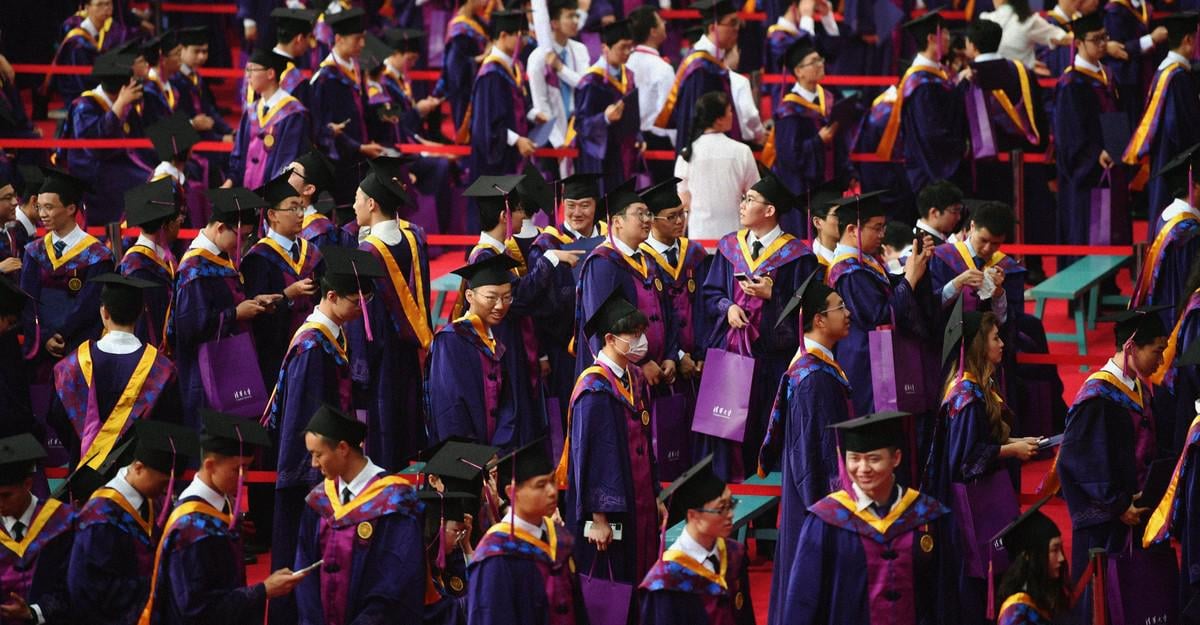
> Xi has consistently stressed the importance of education in sustaining China’s rise. His government has invested heavily in China’s schools and lavished resources on science and technology programs, with some success. Some of China’s top institutions, such as Tsinghua University in Beijing, have gained international recognition as serious competitors in scientific research.
> China would like to have its own Harvards, rather than sending its elite students to the United States, for political and cultural reasons as well as economic ones. Chinese authorities have long worried that the hundreds of thousands of students it exports to America will absorb undesirable ideas about democracy and civil liberties—and that they will access information about China that is suppressed at home, such as the story of the Tiananmen Square massacre in 1989. In fact, many young Chinese who study in the United States seem to enjoy American freedoms and seek to stay rather than return to serve the motherland. Beijing has tried to deal with this in part by monitoring the activities of its students in the U.S. and attempting to hold them firmly to the party line, including by harassing the families back home of those who stray.
> Within China, authorities can more easily confine students inside the government’s propaganda bubble, which in recent years has become more airtight. Domestic media seek to portray the U.S. as unsafe, especially for Asians, by highlighting incidents of racial discrimination, violence, and disorder. One story published last year by the state news agency Xinhua, under the headline “Chinese Students’ Dreams Turned Into Nightmares at U.S. Doorstep,” tells the harrowing tale of a Chinese student detained and deported at an airport and claims that others had suffered the same fate. China’s top spy agency, the Ministry of State Security, warned Chinese students at universities abroad against being recruited as foreign agents, and told of one such unfortunate national who was discovered and punished.
Top Chinese students study in America? Good for the CCP
Top Chinese students stay in China? Good for the CCP
China invests overseas? Good for the CCP
Other countries invest in China? Good for the CCP
China has access to top semiconductors? Good for the CCP
China is cut off from top semiconductors? Good for the CCP
China becomes rich from trading with the West? Good for the CCP
China becomes poor from being cut off from the West? Believe it or not, good for the CCP
This article is out of date, the China-US deal announced a couple days ago includes protection of Chinese student visas. Which means it was important enough to the CCP to negotiate for.
I thought the brain drain was a myth